- Farah Mehjabeen
- October 26, 2026
May 2025 conflict shattered conventional war assumptions in South Asia: Lt Gen Zakaria
-

- Sadia Basharat
- June 1, 2026
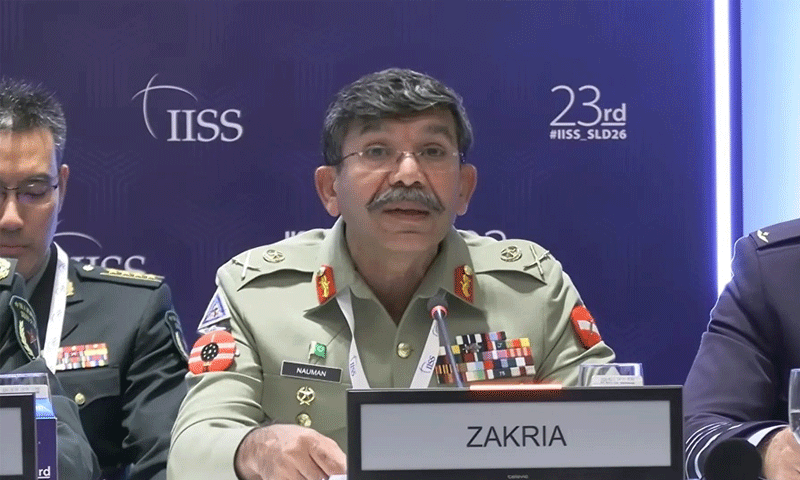
WEB DESK: Pakistan’s military response during the brief escalation with India in May 2025 effectively dismantled prevailing strategic assumptions regarding the viability of conventional warfare in South Asia, Commander I Corps Lieutenant General Nauman Zakaria stated on Saturday.
Speaking at a special session of the prestigious Shangri-La Dialogue in Singapore, Lt Gen Zakaria observed that the four-day confrontation underscored Islamabad’s operational readiness to execute highly sophisticated multi-domain operations.
He emphasised that the crisis highlighted the critical roles of strategic restraint, robust crisis management, and the responsible deployment of emerging technologies in preserving regional stability.
The military stand-off in May 2025 erupted following an attack on tourists in Indian-occupied Kashmir, which New Delhi swiftly blamed on Pakistan. Although Islamabad categorically rejected the allegations and called for an independent international probe, the situation escalated dramatically on May 7 when Indian air strikes targeted positions within Punjab and Azad Jammu and Kashmir.
Pakistan launched a calibrated military response, leading to a series of cross-border exchanges targeting military installations before a ceasefire was successfully brokered on May 10.
Strategic equilibrium and the China factor
Reviewing the broader security dynamics, Lt Gen Zakaria remarked that South Asia’s volatile strategic environment continues to be heavily conditioned by nuclear deterrence, sharp conventional military asymmetry, unresolved political disputes, and deep-seated historical tensions between the two nuclear-armed neighbours.
In this intricate landscape, he identified Beijing as a critical anchor for regional peace, noting that China remains a stabilising factor through its sustained contributions to strategic balance, economic cooperation, and transnational connectivity.
Reflecting on the specific operational lessons of the conflict, the senior commander noted that Pakistan’s performance demonstrated the potent efficacy of integrated operations across multiple dimensions.
This agility, he explained, was achieved through seamless coordination among the tri-services, augmented by cyber capabilities, electronic warfare, information operations, and advanced Intelligence, Surveillance, Reconnaissance (ISR) alongside space-based assets.
According to the I Corps Commander, the tactical and strategic outcomes of the May 2025 conflict have further diminished the prospects of a full-scale conventional war in the region.
However, he cautioned that South Asia remains susceptible to volatility due to relentless military expansion, adversarial political rhetoric, and the persistent absence of formal, institutionalised crisis-management frameworks.
Governing technology and societal resilience
Lt Gen Zakaria drew attention to the transformative impact of rapid technological advancements on global security architectures. He warned that breakthroughs in artificial intelligence, autonomous weapons systems, quantum computing, and cyber capabilities are fundamentally reshaping military doctrine and strategic competition worldwide.
Consequent to these challenges, the general called for the urgent establishment of internationally accepted norms to govern the military application of AI, autonomous systems, space technologies, and cyber warfare. He strongly stressed that human oversight must remain central and non-negotiable in any command-and-control decisions involving the use of kinetic force.
Urging both regional and global actors to modernise international legal and institutional frameworks to keep pace with innovation, Lt Gen Zakaria advocated for enhanced confidence-building measures, technical dialogue, and transparency mechanisms to mitigate the risk of destabilising arms races.
Beyond hard military capabilities, he concluded by highlighting societal resilience as an indispensable strategic asset, arguing that public trust in state institutions and enhanced digital literacy are crucial to shielding modern societies from external manipulation, polarisation, and misinformation.
You May Also Like