- Reuters
- October 20, 2026
Mir Raza’s death was murder, not suicide, judicial commission report says
-

- Syed Arfeen
- October 20, 2026
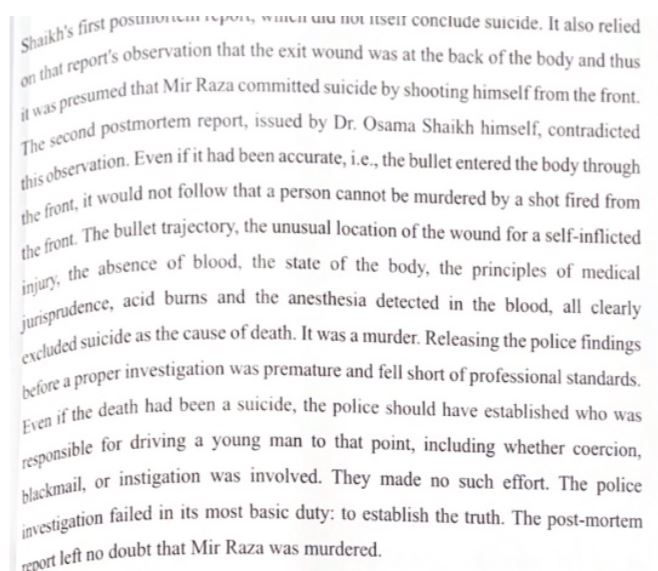
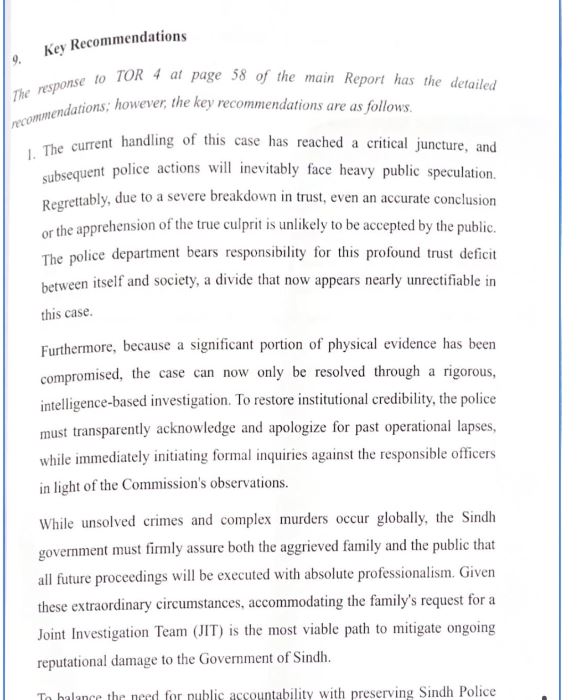
KARACHI: A judicial commission investigating the death of businessman Mir Raza Ali has concluded that his death was murder, not suicide, pointing to serious negligence and failures in the police investigation.
The Sindh government has made the commission’s report public following a decision by the provincial cabinet to release its findings.
According to the report, serious negligence and unprofessional conduct marred the investigation, while the possibility that evidence had been destroyed could not be ruled out. It also raised the possibility that facts had been concealed during the initial stages of the investigation.
The judicial commission said the controversy arose after a death initially declared a suicide was subsequently described as murder.
It said police continued to maintain the suicide theory despite its inconsistency with the second post-mortem report. The conduct of Dr Usama and people associated with him further reinforced that position, according to the report.
The commission said selected digital evidence apparently leaked to the media through police sources fuelled public speculation and gave rise to a narrative against the government.
It said the police investigation was based on unverified and unfounded text messages, selected video footage obtained by SHO Adeel Afzal, and Dr Usama’s account.
The commission said that, regardless of whether the death was suicide or murder, police had a duty to conduct a complete and professional investigation.
It noted growing public concerns and complaints about police actions, highlighting a serious lack of trust between the police and the public and the possible loss of substantial evidence.
The report said certain inexplicable actions meant the possibility of facts being concealed could not be ruled out. However, the commission said it lacked investigative powers and could not reach a definitive conclusion on whether facts had been deliberately concealed.
The judicial commission said the controversy arose after a death initially declared a suicide was subsequently described as murder.
It said police continued to maintain the suicide theory despite its inconsistency with the second post-mortem report. The conduct of Dr Usama and people associated with him further reinforced that position, according to the report.
The commission said selected digital evidence apparently leaked to the media through police sources fuelled public speculation and gave rise to a narrative against the government.
It said the police investigation was based on unverified and unfounded text messages, selected video footage obtained by SHO Adeel Afzal, and Dr Usama’s account.
The commission said that, regardless of whether the death was suicide or murder, police had a duty to conduct a complete and professional investigation.
It noted growing public concerns and complaints about police actions, highlighting a serious lack of trust between the police and the public and the possible loss of substantial evidence.
The report said certain inexplicable actions meant the possibility of facts being concealed could not be ruled out. However, the commission said it lacked investigative powers and could not reach a definitive conclusion on whether facts had been deliberately concealed.
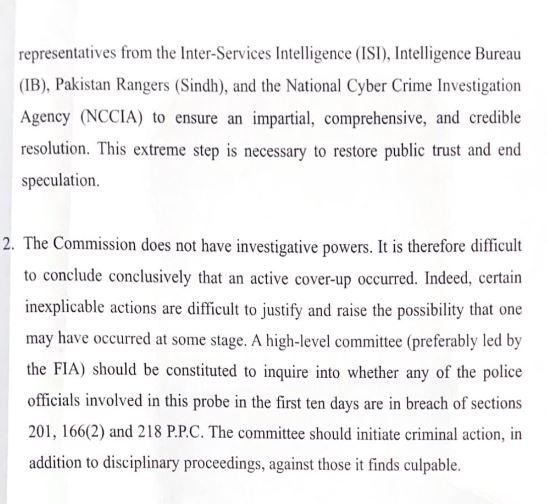
It said the case could be resolved only through a transparent, intelligence-based investigation.
The commission recommended forming a joint investigation team (JIT) headed by DIG Irfan Baloch, describing it as the most appropriate course of action in response to the affected family’s request.
It also recommended that the JIT should also include officers from security agencies with representation from the Inter-Services Intelligence (ISI), Intelligence Bureau (IB) and Rangers.
It also recommended a high-level committee headed by the Federal Investigation Agency (FIA) chief to examine the conduct of police officers during the first 10 days of the investigation.
The commission called for criminal and disciplinary proceedings against officers found responsible under Sections 201, 166(2) and 218 of the Pakistan Penal Code (PPC). It also urged the police to apologise for their past shortcomings and take action against the officers responsible.
The commission recommended a transparent investigation through a JIT for senior-level scrutiny of the formation of a controversial medical board.
The report said the commission recorded statements from family members, a business partner, friends and police officers during its proceedings.
Earlier on Monday, lawyer Jibran Nasir demanded that the Sindh government make public the judicial commission’s report and provide a copy to his family, warning that they would approach the court if the report was withheld.
The commission began its work on October 27 and continued until October 7, according to the report. It recorded 50 statements over 20 hearings.
The commission was initially given one month to complete its work, after which its tenure was extended by another 15 days.
Police investigation under scrutiny
During the commission’s earlier hearings, Justice Omar Sial of the Sindh High Court repeatedly questioned police officials over alleged lapses in the investigation, including the handling of the crime scene and the collection of evidence.
The commission questioned why the bushes at the crime scene had been burned while police were searching for empty bullet shells. The investigating officer acknowledged that this should not have happened.
The commission also raised concerns about CCTV footage from the area. The initial investigation team had obtained footage from only one of 52 cameras, raising questions about whether potentially important evidence had been preserved.
The handling of Mir Raza’s mobile phone also came under scrutiny. The investigating officer told the commission that the Punjab Forensic Science Agency had been unable to recover data from the deceased’s iPhone, although correspondence with Apple was still ongoing, according to Dawn.
The commission also questioned discrepancies in witness statements and concerns about police records allegedly withheld from the inquiry.
Medical reports and JIT recommendation
The medical examination of Mir Raza’s body was another key aspect of the inquiry. A second post-mortem examination, conducted after the body was exhumed, ruled out suicide and confirmed death from a gunshot wound, according to the final post-mortem report announced by Sindh police in August.
The commission examined concerns surrounding the first post-mortem report and the formation of the subsequent medical board. It recommended a high-level inquiry into the controversial board’s formation and called for an independent and transparent JIT to investigate the case further.
‘Judicial commission vindicated Mir Raza’s family’s concerns’
Meanwhile, lawyer Jibran Nasir said the judicial commission’s findings had vindicated the concerns raised by Mir Raza’s family.
He said the record showed that a substantial amount of evidence had been lost and that the commission’s recommendation to form a joint investigation team (JIT) reflected the family’s longstanding position.
Nasir said the commission had supported the family’s stance and acknowledged that the case had eroded public and family confidence in the police.
Mir Raza’s death
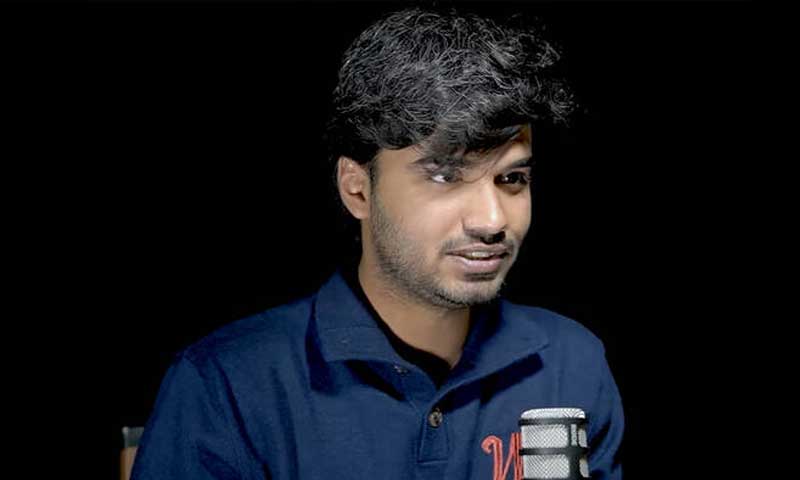
Mir Raza Ali, a 25-year-old businessman, was found dead with a single bullet wound in a deserted area of Karachi’s Gulistan-i-Jauhar on July 29, a day after he went missing. Police initially registered the case as suicide.
During the commission’s proceedings, Justice Sial questioned the investigating officer over alleged lapses in the probe, while the family’s counsel raised concerns about the handling of evidence and the examination of CCTV footage.
You May Also Like