- Reuters
- November 27, 2026
MJDA: Islamabad hosts high-level defence talks with Saudi Arabia, Turkiye today
-

- WEB DESK
- November 27, 2026
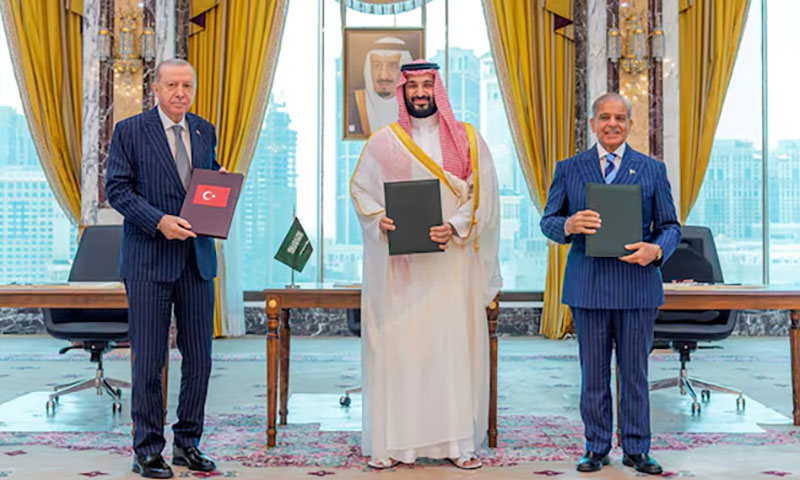
ISLAMABAD: Pakistan is hosting a high-level meeting with Saudi Arabia and Turkiye in Islamabad on Friday, November 27, to discuss regional security, the conflict involving Saudi Arabia and Yemen’s Houthi fighters, and the implementation of a trilateral defence pact, as authorities enforce extensive security and traffic restrictions across the federal capital.
The two-day meeting, scheduled for November 27 and 28, is being held under the Makkah Joint Defence Agreement, signed by the three countries in August.
Foreign and defence ministers, alongside senior military officials from the three countries, are expected to participate in discussions aimed at establishing mechanisms for implementing their collective defence commitments.
Senior defence and military officials held preparatory consultations in Islamabad on Thursday to finalise the agenda and documents for the meeting of the Strategic Political and Defence Committee.
The talks come amid continuing instability in the Middle East, particularly the conflict involving Saudi Arabia and Yemen’s Iran-backed Houthi movement.
Speaking to AFP ahead of the meeting, Defence Minister Khawaja Asif confirmed that developments in Yemen would feature prominently in the discussions.
“The continuous turmoil south of Saudi Arabia will obviously be one agenda point in the meeting and it is very important,” he said.
The minister stressed that the agreement obligates the three countries to respond collectively to threats against their security.
“Any threat to Saudi Arabia is a threat to Pakistan and Turkey according to the pact, which is absolutely clear,” Asif said.
Islamabad under heightened security, local holiday announced
Authorities have announced a local holiday in Islamabad on Friday in view of the visiting foreign delegations, while special security and traffic arrangements have been implemented across the twin cities.
Security personnel have been deployed along important routes, including those connecting Islamabad International Airport to the capital’s Red Zone, which houses key government institutions and diplomatic missions.
According to the Islamabad Traffic Police advisory, the entry of heavy vehicles into Islamabad and Rawalpindi has been prohibited from 6pm on Thursday, November 26, until 12:30am on Saturday, November 28.
Heavy transport vehicles are barred from entering through the Motorway and Grand Trunk Road during this period. The Faizabad Bus Terminal has also been closed for the same duration, while selected Metrobus and electric bus services have been temporarily suspended.
Metrobus and electric bus services between 7th Avenue station and Pak Secretariat are suspended from 10pm on November 26 until 12:30am on November 28.
Meanwhile, the district administration has closed hiking Trails 3 and 5 in the Margalla Hills to the public from 6am to 11pm on Friday as part of the security arrangements.
Federal government ministries and offices located within Islamabad’s Red Zone have also been directed to work from home on Friday, according to a notification issued by the Cabinet Division.
However, essential services, including hospitals, police, electricity and gas providers, will continue operating.
Commuters have been advised to plan their journeys in advance and follow traffic police advisories for updates on diversions and restrictions.
Makkah defence pact enters implementation phase
The Islamabad meeting is expected to focus on translating the commitments made under the Makkah Joint Defence Agreement into operational arrangements.
Pakistan, Saudi Arabia and Turkiye signed the agreement on August 7, pledging that an armed attack against any member would be treated as an attack against all three, with assistance to be provided through available means, including military support.
The three countries have since held a series of consultations to develop the agreement’s institutional and operational framework.
At their first Strategic Political and Defence Committee meeting in Istanbul, the three countries agreed to institutionalise their cooperation, including through a permanent secretariat in Saudi Arabia.
Subsequent consultations among military chiefs in Riyadh focused on practical cooperation and collective defence commitments.
Khawaja Asif described the pact as being at a “nascent stage”, emphasising the need for frequent meetings to establish its framework.
“Initially we need to have frequent meetings to steer what is being formulated, in a way that in the next couple of months we have everything in place so that we can move forward,” he told AFP.
Yemen conflict and regional tensions on agenda
The talks are taking place against the backdrop of heightened regional tensions, particularly Saudi Arabia’s confrontation with Houthi fighters in neighbouring Yemen.
The Houthis, who control the Yemeni capital Sanaa and large parts of northern Yemen, have carried out attacks against Saudi territory and regional shipping routes.
Pakistan has previously condemned Houthi missile attacks targeting Saudi Arabia’s Makkah and Madina regions and reaffirmed its commitment to the kingdom’s security under the trilateral agreement.
The Saudi-led coalition also launched military operations against Houthi positions as attacks intensified.
Khawaja Asif praised Riyadh’s handling of the conflict but warned that threats to Saudi Arabia carried implications for the other members of the defence pact.
Asked how the agreement might respond to a direct Iranian attack on Saudi Arabia, the defence minister declined to comment.
However, he identified potential Israeli military action as another concern for regional security.
“The possibility of some conflict, or aggression from the Israeli side exists, so we need to close our ranks, the countries of this region,” he said.
Pakistan’s diplomatic role amid regional tensions
The defence minister also highlighted Pakistan’s efforts to facilitate dialogue between Washington and Tehran following months of regional instability.
Pakistan helped broker a June agreement that briefly halted fighting between the United States and Iran and provided a framework for negotiations, including discussions concerning the Strait of Hormuz and Tehran’s nuclear programme.
However, the ceasefire subsequently collapsed, with Washington and Tehran accusing each other of violating its terms.
Pakistan and Qatar have since remained involved in diplomatic efforts to revive negotiations.
Asif described Islamabad’s role in facilitating communication between the two sides as “very, very constructive”, while acknowledging that the prospects for lasting peace remained uncertain.
He said peace was “not yet embedded in a way people were expecting”.
The Islamabad meeting is scheduled to continue on Saturday, with the three countries seeking to establish more concrete arrangements for defence and security cooperation under the Makkah pact.