- Uzair Chaudhary
- September 23, 2026
New Toshakhana rules bar officials from accepting gifts, PM, president exempt
-

- WEB DESK
- September 23, 2026
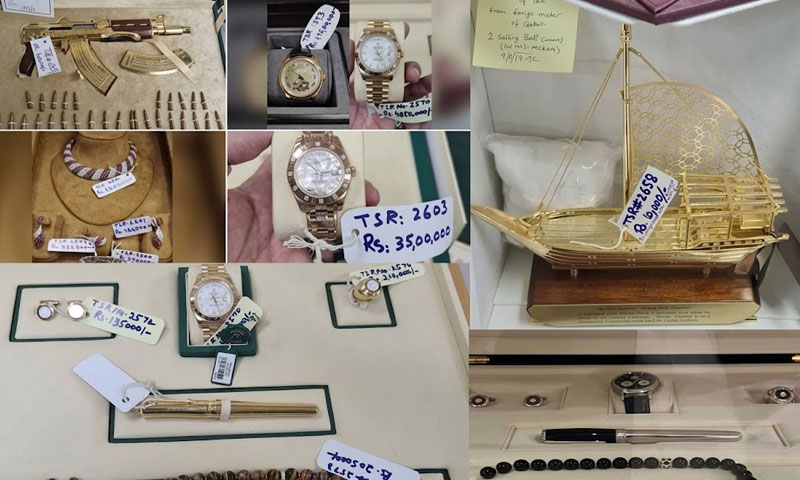
ISLAMABAD: The federal government has introduced new rules governing the management and regulation of Toshakhana, discouraging public office holders other than the president and prime minister from accepting gifts received in their official capacity and requiring unavoidable gifts to be deposited in the state repository.
The Toshakhana (Management and Regulation) Rules, 2026, issued by the Cabinet Division on September 22, have taken effect immediately.
The rules also discouraged private individuals accompanying official delegations from accepting gifts for themselves or their families from dignitaries, persons or companies they engage with in connection with official business.
“Where accepting a gift cannot be avoided because of diplomatic conventions or cultural sensitivities, it must be handed over to Toshakhana,” according to the rules.
Every gift received by a public office holder or a private individual accompanying an official delegation must be deposited in Toshakhana, while Grade 1 to 4 government employees may retain cash awards received from diplomatic personalities, it said.
However, any Grade 1 to 4 employee who solicits or encourages a cash award will face action under the law.
Declaration and deposit of gifts
According to the new policy, recipients must declare gifts to the Cabinet secretary through a signed letter containing a brief description of the gift or gifts.
“The recipient or a formally authorised person may deposit the gift in Toshakhana. Upon submission, the relevant Cabinet Division officer will issue a receipt containing a brief description and photograph of the gift.”
Gifts must be deposited within 30 days of receipt. Gifts received during foreign visits must be deposited within 30 days of the recipient’s return to Pakistan, while gifts sent separately to Pakistan must be deposited within 60 days, according to the rules.
The rules stated that failure to declare and deposit a gift within the prescribed period will trigger legal proceedings, although the recipient must first be given a reasonable opportunity to explain their position.
Exemption for ordinary food items
Small quantities of food and beverages of nominal value may be retained without declaration, according to the rules.
However, items received for official or public purposes must be reported to the Cabinet Division, including information on their receipt and use.
It said that gifts of live animals must be declared and then transferred to the nearest Remount Veterinary and Farms Corps.
Rules for commemorative items
Written commemorative items provided for display at an institution do not have to be deposited in or declared to Toshakhana, but must be displayed in the relevant institution’s building.
Similarly, according to the rules, commemorative items prepared for display and personally inscribed for the recipient do not have to be deposited or declared, provided they are displayed in the recipient’s office building.
If such an item is kept at a private residence, its value must be nominal and the recipient must submit a declaration to the Cabinet Division.
FBR, private experts to assess gift value
The market value of gifts will be assessed by the Federal Board of Revenue (FBR) and a qualified private-sector evaluator appointed through an open advertisement, according to the rules.
The average of the valuations provided by the FBR and private evaluator will be treated as the gift’s assessed market value.
If the two valuations differ by more than 25 per cent, the matter will be referred to a third private evaluator.
The value of gifts consisting of weapons will be assessed by the Pakistan Ordnance Factories (POF), Wah, and the value determined by POF will be treated as the assessed market value.
Toshakhana gifts to be sold through open auction
The new rules provide for all existing and future Toshakhana gifts eligible for disposal to be sold through open public auction.
The Cabinet Division will conduct the auctions with the approval of a committee, which may seek expert opinion where necessary.
The auctions will be conducted under the Disposal of Public Assets Regulations, 2024, or any subsequent applicable rules.
The reserve price of each gift cannot be lower than its assessed market value, while an assessed value more than three months old cannot be used to determine the reserve price.
Live media coverage of auctions
The rules require the auction process to be covered live by the media through the Ministry of Information and Broadcasting.
Toshakhana auctions are to be held preferably every two years, but an auction must be conducted at least once during every financial year.
Proceeds from the auctions will be deposited into a separate account and used to promote primary education for girls in the country’s most deprived areas.
The account will be maintained by the Ministry of Federal Education and Professional Training, while spending from it will require prior approval from the prime minister.
Antiques and sensitive gifts exempt from auction
Gifts classified as antiques or having cultural or historical significance will not be auctioned.
The relevant committee will determine whether a gift falls into these categories.
Gifts of high value or those considered diplomatically or internationally sensitive will also be exempt from auction.
Annual third-party audit
The rules require a third-party audit of all gifts received and disposed of through Toshakhana at the end of every financial year.
A record must be maintained of all deposited gifts, including the date of receipt, the recipient and the person depositing the gift, according to the rules.
The record must also contain the gift’s assessed market value, date of assessment, auction date, reserve price and final auction price.
The record must be updated on the same day that a gift is deposited or new information concerning it becomes available.
Monthly disclosure on web portal
The Cabinet Division will update information available on its web portal by the last day of every month.
However, the name and country of the dignitary who presented a gift will not be published on the portal.
The new rules replace the 2023 procedure governing the acceptance and disposal of gifts.
The government said the new framework was intended to clarify the procedures for receiving, declaring and depositing gifts received by public office holders in their official capacity.
You May Also Like