- WEB DESK
- October 6, 2026
Pakistan and China sign landmark $7b deals to boost industrial and digital cooperation
-

- Sadia Basharat
- May 25, 2026
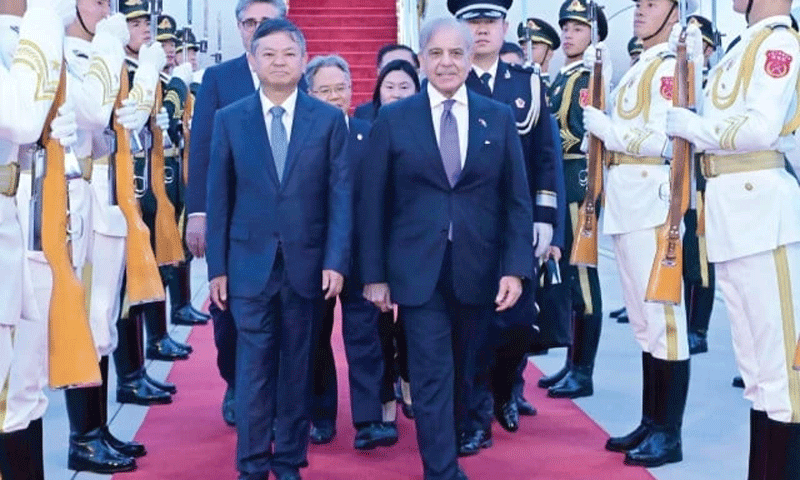
WEB DESK: Pakistan and Chinese enterprises have signed a series of groundbreaking agreements and memorandums of understanding (MoUs) valued at over $7b (£5.5b) during a high-profile investment conference in Hangzhou.
Led by Prime Minister Shehbaz Sharif, the high-level delegation sought to deepen technological, agricultural, and industrial ties between the two long-standing allies, marking a significant milestone as both nations celebrate 75 years of diplomatic relations, according to The Express Tribune.
The multi-billion-dollar deals were formalised during the Pakistan-China Business-to-Business Investment Conference, targeting critical sectors including information technology, renewable energy, battery storage systems, telecom, and agriculture.
Addressing an audience of international investors and government officials, Prime Minister Sharif urged Chinese firms to relocate their manufacturing operations to Pakistan.
Citing China’s rising labour costs, he championed a “win-win model” where Chinese businesses could establish plants within Pakistan’s designated export zones including a massive 6,000-acre special economic zone in Karachi and export goods duty-effectively to global markets.
Major industrial breakthroughs and agricultural mechanisation
Among the flagship agreements finalised at the conference was a monumental $1.12b deal between Haolu Engineering and Technology Company and Fauji Fertilizer aimed at modernising fertiliser production.
Additionally, a $100m MoU was secured between IBI Beijing United Information Technology and the RIC to enhance agricultural machinery and agrochemicals, which includes setting up a regional headquarters in Multan.
Officials noted that across five recent bilateral conferences, over 200 MoUs worth $20b have been signed, with nearly 30pc already successfully converted into legally binding contracts.
“Pakistan is seeking expertise, investment, and industrial cooperation rather than aid or handouts,” Prime Minister Sharif asserted, emphasizing that sustainable development stems purely from productive economic partnerships.
The Prime Minister also highlighted the urgent need to boost Pakistan’s per-acre agricultural yields through modern mechanisation and high-quality seeds.
He pointed out that whilst China imports roughly $100b worth of agricultural products annually, Pakistan currently accounts for only a fraction of that figure, representing a massive untapped export market for local farmers.
Digital transformation and strategic alliance with Alibaba Group
In a bid to revolutionise Pakistan’s digital landscape, the Prime Minister visited the headquarters of tech giant Alibaba Group, signing a comprehensive long-term strategic framework agreement alongside Alibaba Chairman Joe Tsai.
This partnership will focus heavily on artificial intelligence (AI), cloud computing, digital trade, and smart healthcare.
Under these arrangements, Alibaba Cloud and Pakistan’s Ignite will collaborate to develop localised AI models for Urdu and regional languages, whilst simultaneously launching nationwide digital training programmes for 500,000 young Pakistanis.
The technology pact also extends into advanced healthcare and financial inclusion. Alibaba’s DAMO Academy will deploy AI-powered disease screening systems across major Pakistani cities, whilst a separate agreement with the Small and Medium Enterprises Development Authority (SMEDA) will onboard 2,000 Pakistani small businesses onto a dedicated “Pakistan Pavilion” e-commerce platform.
Furthermore, a $3m initial investment by Koko Tech will introduce ‘Buy Now, Pay Later’ fintech solutions to the country.
Following additional meetings with Chinese green-energy leaders like CATL and StarCharge to discuss electric vehicle infrastructure and battery storage, Prime Minister Sharif arrived in Beijing to conclude his tour with high-level talks alongside President Xi Jinping and Premier Li Qiang.