- Muhammad Zareef
- November 1, 2026
Aurangzeb sets priorities as Pakistan assumes charge of developing nations’ bloc G-24
-

- WEB DESK
- November 1, 2026
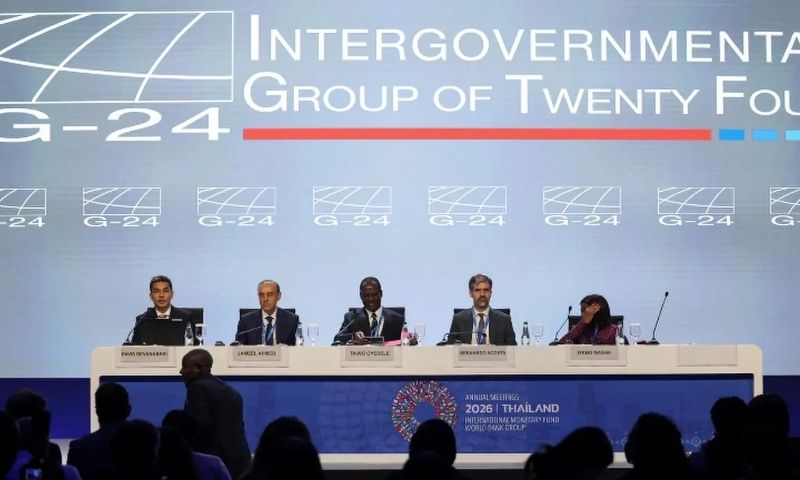
ISLAMABAD: Pakistan on Sunday assumed the chairmanship of the Intergovernmental Group of Twenty-Four (G-24), with Finance Minister Muhammad Aurangzeb outlining three priorities aimed at strengthening the voice of developing economies and making the global financial system more inclusive and responsive to their needs.
Aurangzeb described the chairmanship as a significant responsibility, saying Pakistan would work towards a fairer, more responsive and development-oriented international financial system.
“The future of developing economies is not peripheral to the future of the global economy. It is central to it,” the finance minister said in a statement issued by the Ministry of Finance.
He called for renewed international cooperation, stronger multilateral institutions and greater global commitments to address climate shocks, development financing gaps and economic fragmentation.
Aurangzeb said emerging and developing economies had considerable potential to drive investment, innovation, entrepreneurship and global growth, adding that their interests needed stronger representation in international economic policymaking.
Outlining Pakistan’s agenda, the finance minister identified three strategic priorities for its tenure as G-24 chair: placing development at the centre of global economic policymaking, making multilateral institutions more inclusive and representative, and promoting a development-oriented international financial architecture.
On the first priority, he said macroeconomic stability should serve as the foundation for investment, productivity, employment and shared prosperity rather than remain an end in itself.
He said this approach would help developing and low-income economies move beyond repeated cycles of crisis management towards sustainable economic growth.
The second priority involves strengthening the representation of developing countries in international financial institutions, particularly those commonly known as the Bretton Woods institutions — the International Monetary Fund (IMF) and the World Bank.
Aurangzeb said developing countries should have fairer representation, meaningful participation in decision-making and a greater say in shaping policies that affect their economies.
He also called for the institutions to become more responsive to the changing economic circumstances and development requirements of their member countries.
The third priority focuses on reforming the international financial architecture to make development financing more accessible and affordable.
The finance minister said Pakistan would advocate timely and affordable financing for development projects, sustainable debt solutions, stronger global financial safety nets and greater support for countries confronting climate change.
He also stressed the need to mobilise more public and private capital to address financing shortages in developing economies.
“Our task is to ensure that the immense potential of developing economies is not constrained by an international financial architecture that has yet to fully adapt to a changing world,” he said.
Aurangzeb emphasised that financial stability must be aligned with long-term development objectives, drawing on Pakistan’s experience of economic stabilisation, reforms and resilience.
He said countries undertaking economic reforms needed adequate financing and policy space to maintain sustainable growth, attract investment and generate employment.
Pakistan would work with G-24 members across Africa, Asia, Latin America and the Caribbean, as well as the IMF, World Bank and other international partners, to advance the group’s shared priorities, he added.
The finance minister said the country’s chairmanship would be guided by the G-24’s established principles of consultation, consensus and collective advocacy.
He also acknowledged the leadership and contributions of outgoing chair Nigeria, expressing Pakistan’s commitment to building on the group’s achievements.
Aurangzeb said the success of collective leadership should be measured by tangible development outcomes rather than statements or declarations alone.
“The true measure of our collective leadership will not simply be the strength of our voice, but the difference that voice makes,” he said.
He reaffirmed Pakistan’s commitment to translating the G-24’s collective position into greater international influence and meaningful progress for developing economies.
PM Shehbaz hails Pakistan’s G-24 chairmanship as diplomatic milestone
Meanwhile, Prime Minister Shehbaz Sharif has welcomed Pakistan’s assumption of the chairmanship of the G-24, describing it as a significant diplomatic milestone that would strengthen the country’s role in global economic affairs.
In a statement issued by the Prime Minister’s Office on Sunday, Shehbaz congratulated Finance Minister Muhammad Aurangzeb and the entire finance ministry team, praising their hard work, effective diplomacy and professional capabilities.
He also commended the finance minister and his team for their role during the annual meetings of the World Bank and the International Monetary Fund (IMF), saying their efforts had helped secure a prominent position for Pakistan in the economic leadership of developing countries.
The prime minister said the G-24 chairmanship would provide Pakistan with an important platform to contribute to reforms in the global financial system, advocate fair financial support to address climate change and promote sustainable development opportunities for emerging economies.
He described Pakistan’s new role as recognition of its effective contribution and voice in the global economic landscape.
Background
Established in 1971 by the Group of 77 (G-77) and formally constituted in 1972, the G-24 is an intergovernmental coalition of developing countries from Africa, Asia, Latin America and the Caribbean.
Despite its name, the group is not limited to 24 members. Its primary purpose is to coordinate the positions of developing economies on international monetary and development finance issues and strengthen their collective representation in discussions involving the IMF and World Bank.
The group seeks to ensure that developing countries have a stronger voice in decisions concerning global economic governance, development financing and the international monetary system.
The G-24 is not an organ of the IMF, although the fund provides secretariat services to the group. Its members’ finance ministers meet ahead of key IMF and World Bank meetings to coordinate their positions on issues affecting developing economies.
You May Also Like