- Web Desk
- 52 Minutes ago
Pakistan, Qatar broker 60-day roadmap as US-Iran Switzerland talks conclude first round
-

- Reuters
- 3 Hours ago
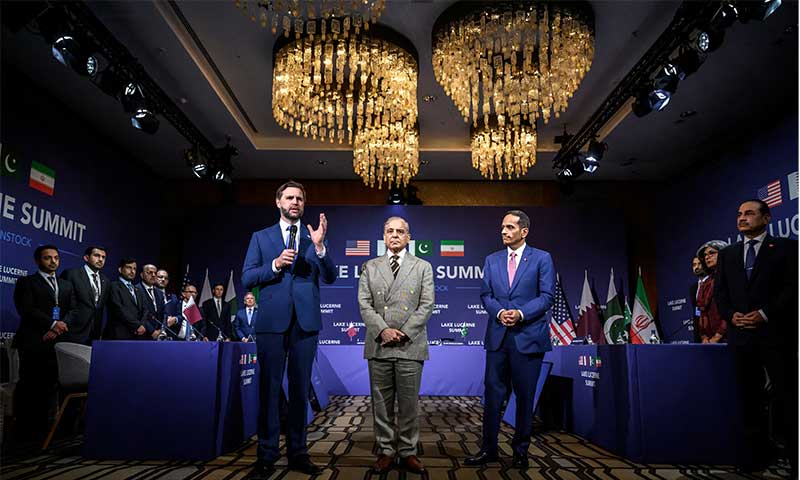
BUERGENSTOCK/DUBAI: Senior officials from the United States and Iran concluded an initial round of negotiations in Switzerland on Monday, with mediators announcing a framework aimed at securing a comprehensive agreement within 60 days.
In a joint statement, mediators Qatar and Pakistan said both sides had endorsed a roadmap towards a final accord, while technical-level discussions would continue throughout the week at the Swiss resort of Buergenstock. The statement added that the parties had agreed on arrangements intended to help end hostilities in Lebanon and establish a communication mechanism to facilitate the safe passage of commercial vessels through the Strait of Hormuz.
The talks, led by US Vice President JD Vance and Iranian officials, began on Sunday under the terms of a memorandum of understanding reached last week that extended a fragile ceasefire first established in April. Negotiations continued overnight and into Monday morning.
Iranian Foreign Minister Abbas Araqchi said in a social media post that Tehran had secured exemptions allowing oil and petrochemical exports, the release of a portion of its frozen assets and the launch of a reconstruction and development initiative for the country.
The White House did not immediately confirm whether the high-level phase of the negotiations had formally concluded as Prime Minister Shehbaz Sharif and Field Marshal Syed Asim Munir also held a meeting with a US delegation headed by Vice President JD Vance.
Dispute over talks amid Trump warnings
The negotiations opened against a backdrop of renewed tensions after Iran announced it had once again closed the Strait of Hormuz and US President Donald Trump reiterated warnings of possible military action against Tehran.
According to a Fox News report, Trump said he had warned Iranian officials that any further attempt to shut the strategic waterway would have severe consequences. He also repeated earlier remarks suggesting Washington could take control of the strait and potentially impose transit fees.
Trump argued that agreeing to last week’s memorandum had helped prevent a global economic downturn that could have been triggered by soaring oil prices resulting from the closure of the strait.
Oil prices, which had already declined significantly over the previous week, extended losses following news of progress in the negotiations. Brent crude futures fell by more than $1 to $79.44 per barrel.
Conflicting accounts from both sides
American and Iranian sources offered differing descriptions of the discussions.
Iran’s semi-official Tasnim news agency, citing an unnamed source, reported that the Iranian delegation refused to return to the main negotiating room after Trump’s remarks became public. According to the report, communication continued indirectly through Pakistani and Qatari mediators.
The source said Tehran maintained that substantive discussions on its nuclear programme could only begin once other elements of the memorandum, including the release of frozen funds and US waivers for Iranian oil exports, had been implemented.
A US diplomat involved in the negotiations rejected suggestions that the Iranian delegation had withdrawn, saying officials remained engaged in talks late into the night.
“We’ve talked about the Strait, Lebanon, nuclear issues, and details of implementing the MOU, among other topics,” the diplomat told Reuters.
Strait of Hormuz and Lebanon dominate agenda
The memorandum calls for the reopening of the Strait of Hormuz, a critical route for global energy supplies, and an end to hostilities across the region, including in Lebanon.
Tehran has argued that Washington failed to uphold commitments related to halting fighting in Lebanon and announced over the weekend that maritime traffic through the strait had once again been suspended. Iranian officials had also indicated before the talks that sensitive issues such as the country’s nuclear programme would not be part of Sunday’s agenda.
Speaking in Switzerland, Vance suggested progress had been made on Lebanon despite ongoing violence.
“These things are always a little bit messy,” he said.
Back in Washington, Trump warned that the United States could resume attacks on Iran if Tehran failed to restrain allied groups in the region.
“Iran must immediately stop their highly paid PROXIES in Lebanon from causing trouble,” Trump wrote on social media. “If they don’t, we’ll hit Iran very hard again, just like we did last week, only harder!!!”
At the same time, Vance said Trump wanted to pursue a different relationship with Iran, telling reporters that the president had asked negotiators “to turn over a new leaf” in relations with the Iranian people.
A US official said discussions had also focused on clarifying Iran’s position regarding the Strait of Hormuz and establishing mechanisms to prevent future disruptions to shipping.
Lebanon fighting shows signs of easing
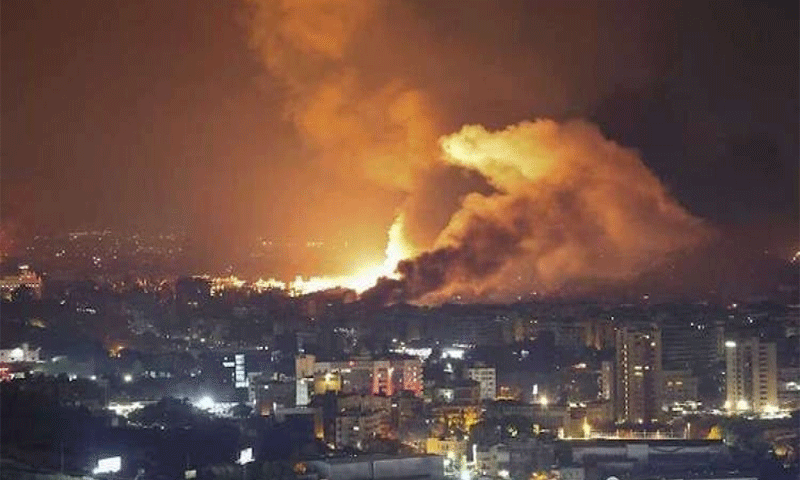
Despite the announcement of a new ceasefire in Lebanon on Friday, fighting has continued in recent days. Iran cited ongoing Israeli military operations as justification for its decision to again close the strait, a move that disrupted global energy supplies after nearly four months of restrictions.
Data from maritime analytics firm Kpler showed that only five vessels passed through the strait on Sunday, compared with 26 a day earlier, indicating a sharp decline in traffic.
However, Sunday appeared relatively calm in Lebanon, with no major outbreaks of violence reported by evening after days of intense Israeli strikes and Hezbollah attacks on Israeli positions.
More than one million people have been displaced since Israel launched its offensive in March against Hezbollah fighters operating near the border.
Reuters journalists in southern Lebanon reported unusually heavy traffic as residents began returning home, with some motorists waving Hezbollah flags while travelling through the area.
You May Also Like