- Farah Mehjabeen
- October 26, 2026
Pakistan records highest-ever childhood immunisation coverage, survey shows
-

- WEB DESK
- August 6, 2026
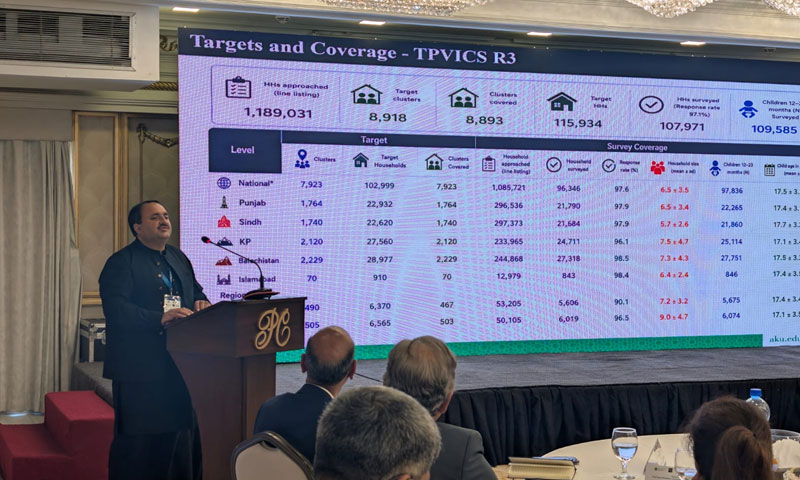
ISLAMABAD: Pakistan has achieved its highest-ever childhood immunisation coverage, with more than four out of five children aged between 12 and 23 months now fully vaccinated, according to the findings of an independent national survey released on Thursday.
The “Third-Party Verification Immunization Coverage Survey (TPVICS) Round 3”, unveiled at a national dissemination meeting in Bhurban, found that 81.3 per cent of children in the target age group were fully immunised in 2026, up from 53.8 per cent in 2013, marking the country’s highest routine immunisation coverage on record.
The independently verified survey was commissioned by the Federal Directorate of Immunization (FDI) under the Ministry of National Health Services, Regulations and Coordination, with technical support from the Centre of Excellence in Women and Child Health at Aga Khan University and financial backing from Gavi, the Vaccine Alliance, and the Gates Foundation.
The findings also showed a sharp decline in the number of so-called “zero-dose” children – those who have not received a single routine vaccine.
According to the survey, the estimated number of not immunised children aged 12 to 23 months fell to around 160,000 in 2026 from approximately 308,700 in 2022, representing a reduction of 148,700 children, or 48.2 per cent.
The national proportion of zero-dose children also declined from 4.9 per cent in 2022 to 2.5 per cent this year.
At the same time, the proportion of partially immunised children dropped significantly to 16.2 per cent, compared with 40.8 per cent in 2013, indicating that substantially more children are completing the full vaccination schedule.
Health officials said the results reflected sustained efforts to strengthen Pakistan’s routine immunisation programme and improve access to vaccines in underserved communities.
“The survey provides independently verified evidence that Pakistan has made significant progress in expanding routine immunisation services over the past decade,” the Federal Directorate of Immunisation said in a statement.
The survey found that more than four out of every five Pakistani children now receive the complete schedule of recommended routine vaccines, compared with just over half in 2013.
Provincial performance
The survey showed improvements across all provinces and regions, although disparities remain.
Punjab continued to record the highest routine immunisation coverage among the provinces, with 90.0 per cent of children fully immunised, up from 65.6 per cent in 2013. The proportion of not immunised children in the province declined to 0.4 per cent.
Sindh registered one of the most significant gains, with full immunisation coverage increasing to 74.6 per cent from 29.1 per cent in 2013, while the percentage of children receiving no vaccines fell from 8.5 per cent to 2.8 per cent.
In Khyber Pakhtunkhwa, full immunisation coverage rose to 71.5 per cent, compared with 52.7 per cent in 2013, although the province continued to report relatively higher numbers of under-immunised children than Punjab.
Balochistan, which has historically recorded the country’s lowest immunisation rates, posted the largest relative improvement. Full immunisation coverage more than tripled to 56.6 per cent from 16.4 per cent over the same period, although 13.4 per cent of children in the province still receive no routine vaccinations.
Among the regions, Azad Jammu and Kashmir recorded the highest full immunisation coverage at 92.2 per cent, up from 90.2 per cent, while Islamabad maintained high performance with only 0.4 per cent of children classified as not immunised.
Gilgit-Baltistan recorded a marginal decline in full immunisation coverage to 70.2 per cent from 70.5 per cent.
Survey to guide policy
Officials said the independently verified findings would help federal and provincial authorities identify districts with remaining immunity gaps and better target resources towards children who remain unvaccinated or fail to complete their vaccination schedules.
“The results will provide us with the evidence needed to guide future planning,” Federal Directorate of Immunization Director General Dr Musa Khan said.
“We will not remain stagnant, and we will continue working to improve immunisation coverage across Pakistan.”
Dr Musa Khan commended the efforts of provincial and area Expanded Programme on Immunization (EPI) teams, saying the survey findings would provide a strong evidence base for future planning.
He said the results would help identify low-performing districts and underserved communities, enabling targeted interventions to further strengthen routine immunisation coverage across the country.
Dr Sajid Soofi, Director of the Centre of Excellence in Women and Child Health at Aga Khan University, said the nationwide survey required extensive fieldwork across the country despite operational challenges.
“The work behind this survey is unimaginable,” he said, crediting field teams for collecting data in every district and overcoming logistical obstacles.
Joint Secretary (FC & Immunisation) and National Coordinator of the National Emergency Operations Centre (NEOC) Muhammad Anwar-ul-Haq said the findings were broadly consistent with Pakistan’s polio surveillance data.
He noted that immunisation indicators in Balochistan had improved significantly, adding that stronger routine immunisation was a positive sign for the country’s polio eradication efforts. He said closer coordination between the Expanded Programme on Immunisation (EPI) and the Polio Eradication Initiative (PEI) had contributed significantly to the improved results.
The event concluded with the presentation of commemorative shields to the guests of honour and other health officials in recognition of their contributions to the nationwide initiative.
The government said it would use the survey findings to further expand routine immunisation services, reduce dropout rates, improve equitable access to vaccines and reach every remaining zero-dose child.
Routine immunisation is considered one of Pakistan’s primary public health interventions against vaccine-preventable diseases such as measles, polio, diphtheria, pertussis and hepatitis B.
The latest survey provides the strongest independent evidence to date that childhood vaccination coverage has continued to improve nationwide, although health authorities say sustained investment will be required to close remaining gaps, particularly in underserved and remote areas.
You May Also Like