- Ghayas Uddin
- October 30, 2026
Pakistan rises to 95th in global innovation index, regains ‘overperformer’ status
-

- WEB DESK
- October 30, 2026
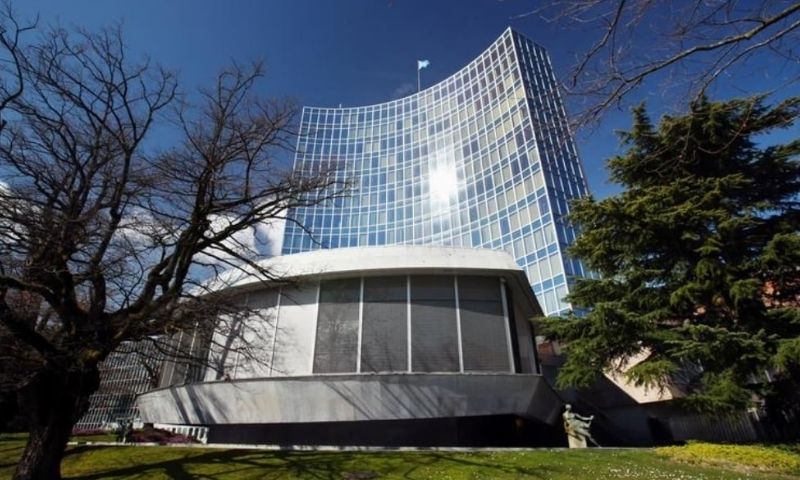
ISLAMABAD: Pakistan has climbed four places to 95th among 139 economies in the Global Innovation Index (GII) 2026, regaining its status as an innovation “overperformer” for the fourth time, according to a report released by the World Intellectual Property Organisation (WIPO).
Pakistan improved from 99th position in 2025, with the latest ranking highlighting strengths in mobile app creation, information and communication technology (ICT) services exports, high-tech imports and software spending.
The overperformer designation is given to economies that achieve innovation results above expectations for their level of economic development.
Pakistan previously held the status in 2022 and 2024 and has now returned to the group after being absent in the 2025 edition.
WIPO said that Pakistan’s strengths were concentrated in the digital economy, with the country ranking 10th globally in mobile app creation, 15th in ICT services exports, 19th in high-tech imports and 33rd in software spending.
It also ranked Pakistan 49th in scientific production and 47th in university quality, describing these as relatively strong indicators supporting the country’s developing digital economy.
The report showed a considerable gap between Pakistan’s innovation inputs and outputs.
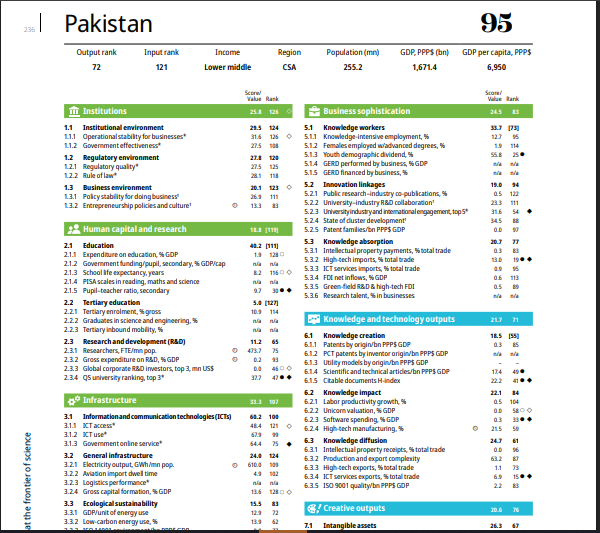
The country ranked 121st in innovation inputs, which cover the resources and conditions supporting innovation, but stood at 72nd in innovation outputs, reflecting the results generated from those resources.
Both positions improved from the previous year, when Pakistan ranked 124th in inputs and 75th in outputs.
“Innovation overperformance shows that innovation does not follow a straight line from income to results,” the report said, adding that economies could generate more innovation than expected for their level of development by building on focused strengths.
WIPO identified 21 economies as innovation overperformers in 2026, four more than in the previous edition.
India and Vietnam remained the longest-standing members of the group, having maintained the status for 16 consecutive years.
Pakistan was among the countries returning to the list, alongside Mozambique and Moldova, while Bhutan joined for the first time.
Pakistan ranked 15th among 36 lower-middle-income economies and eighth among 11 countries in the Central and Southern Asia region.
Regional and global rankings
India remained the region’s leading innovation economy, ranking 38th globally, followed by Kazakhstan at 73rd, Bhutan at 74th and Uzbekistan at 77th.
Sri Lanka stood at 94th, one place ahead of Pakistan, while Nepal ranked 104th and Bangladesh 105th.
Bangladesh was placed 10th among the 11 economies in Central and Southern Asia, while Pakistan stood eighth in the regional rankings.
Globally, Switzerland retained the top position for the 16th consecutive year, followed by Sweden and the United States. South Korea and Singapore ranked fourth and fifth, respectively, while China stood 10th, Japan 12th and Hong Kong 14th.
WIPO said the leading economies had remained broadly unchanged from 2025, with no new country entering the top 15. Europe accounted for 14 of the world’s 25 leading innovation economies, while five Asian economies featured in the top 25.
The report also highlighted India’s performance as a long-standing innovation overperformer. India ranked 38th overall, with its innovation outputs placing it 25th globally, compared with 49th in inputs.
Its strengths included ICT services exports, in which it ranked first, and late-stage venture capital deals, where it stood fourth.
Innovation strengths and challenges
WIPO said Pakistan was among the economies generating higher-than-expected innovation outputs from relatively limited inputs. Its performance was above the level predicted by its innovation input score, although the report also pointed to the need for more balanced innovation systems.
The index assesses economies across seven pillars: institutions, human capital and research, infrastructure, market sophistication, business sophistication, knowledge and technology outputs, and creative outputs.
Pakistan did not feature among the leading economies in any of the index’s individual innovation pillars or among the world’s top 100 innovation clusters, according to the report.
WIPO said emerging economies such as Pakistan could build on their existing strengths to improve overall innovation performance.
It noted that countries seeking to move higher in the rankings needed to strengthen research capacity, university quality, business research and development, patenting and links between scientific institutions and industry.
The report also highlighted the broader global challenges facing innovation. While most indicators continued to advance, progress had slowed, with about three-quarters of global innovation indicators remaining below their decade-long averages.
Global research and development spending remained at a historic high, with R&D intensity close to two per cent of gross domestic product, while investment related to artificial intelligence continued to be a major driver of growth, according to the report.
Pakistan’s overall ranking has fluctuated over the past seven years. It stood at 107th in 2020, improved to 99th in 2021 and reached its best position of 87th in 2022.
It ranked 88th in 2023, slipped to 91st in 2024 and fell to 99th in 2025 before recovering four places in the latest index.
The 2026 index draws primarily on data from 2024 to 2026, accounting for more than 80 per cent of its data points. WIPO cautions that changes in methodology and data availability can affect year-to-year comparisons of rankings.