- WEB DESK
- November 5, 2026
Pakistan risks missing $8.1bn AI opportunity as digital skills gap holds back youth: study
-

- WEB DESK
- November 5, 2026
ISLAMABAD: Pakistan could see its economy expand by about $8.1 billion over the next decade through artificial intelligence, but gaps in digital skills and limited internet access among young people could prevent the country from fully benefiting from the technology, a new Commonwealth-wide study has warned.
The findings were published in The Ayre Index: The 2026 Commonwealth Youth AI Readiness Index, produced by the Ayre Think Tank and launched at the Commonwealth Heads of Government Meeting in Antigua and Barbuda on November 5.
The index ranked Pakistan 24th among 56 Commonwealth countries, with a score of 46.4 out of 100, below the study’s benchmark of 53 for youth AI readiness.
Only 15 of the 56 countries assessed reached or exceeded the benchmark, according to the research, which examined the conditions affecting about 732 million young people across the Commonwealth and drew on 1,128 research sources.
The study estimated that AI could increase the level of Pakistan’s gross domestic product by $8.146 billion after 10 years under its moderate scenario.
The conservative estimate was $4.073 billion, while the optimistic scenario put the potential gain at $12.219 billion.
Among the 41 Commonwealth countries ranked below the readiness benchmark, only Bangladesh had a slightly larger potential gain under the moderate scenario, at $8.214 billion.
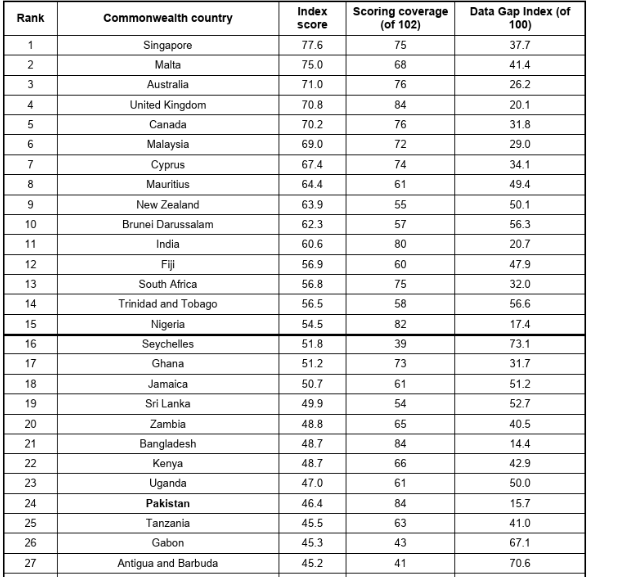
Bangladesh ranked 21st with a score of 48.7, while India ranked 11th with 60.6.
Digital access remains a major challenge
Despite relatively affordable mobile data and widespread electricity availability, the research pointed to a significant gap between affordability and actual access to digital technology.
Survey data examined by the researchers showed that only 49.8 per cent of young Pakistanis used the internet, while 58.4 per cent owned a mobile phone.
Internet speeds were also relatively slow, the study said.
Pakistan has an estimated 70.2 million people aged between 15 and 29, making the development of digital and AI skills particularly important for the country’s future workforce and economic growth.
The report also identified weaknesses in practical digital education and training.
It found that relatively few young Pakistanis had experience in tasks such as checking the reliability of online information, protecting personal data or writing computer programs.
Pakistan scored just 2.5 out of 10 for education and training provision, highlighting weaknesses in the teaching and training systems measured by the index.
Strong demand for AI training
The study pointed to growing demand for AI skills among young Pakistanis.
In July 2026, the Higher Education Commission reported that 6,000 students from 100 universities had completed a nationwide AI training programme after more than 82,000 applications were received.
Universities have also been directed to introduce a compulsory AI course in undergraduate and postgraduate degree programmes from the 2026 academic year, according to the study.
The report said such initiatives could help young people develop practical skills, find employment, start businesses and benefit from opportunities in the digital economy.
Calvin Ayre, founder of the Ayre Think Tank, said governments could not afford to remain complacent as AI transformed the way people worked, conducted business and created wealth.
“AI is going to change how we work, how we do business and how wealth is created,” he said.
“What matters is giving young people the skills and the chance to get ahead — whether to start businesses, find jobs or build something for themselves.”
Ayre said the index was designed to show countries where they stood, what they were doing well and where further action was needed.
Five priorities identified
The study said Pakistan’s challenge was to ensure that the benefits of AI extended beyond the technology sector.
Helping young people use AI to improve their skills, reach customers and establish businesses would be crucial to translating the estimated economic opportunity into jobs and higher incomes, it said.
The accompanying white paper identified five priorities: ensuring affordable and reliable access to technology; improving education to develop practical skills; creating stronger links between training, employment and entrepreneurship; developing AI tools suited to local languages and needs; and establishing safeguards that allow young people to question automated decisions.
The report called on governments, educators and development partners to better understand the barriers facing young people in individual countries before deciding where investment could have the greatest impact.
Professor C. Justin Robinson, Pro Vice-Chancellor and Campus Principal of the University of the West Indies’ Five Islands Campus, said young people needed to be equipped not merely to consume AI products developed elsewhere but also to question, improve and develop technology suited to their own needs.
The report said the choices governments and institutions make now would determine whether young people were able to participate meaningfully in the AI-driven economy.
You May Also Like