Pakistan to recruit 6,000 ‘cyber space defenders’
-

- Zahid Gishkori
- November 26, 2026


ISLAMABAD: Pakistan has decided to recruit 6,000 specialised personnel, termed “cyber space defenders”, and expand its nationwide network of Cyber Police Stations from 16 to 150 within nine months to combat rising cybercrime across the country.
Prime Minister Shehbaz Sharif approved the restructuring plan following a briefing by the Ministry of Interior and the National Cyber Crime Investigation Agency (NCCIA), which is facing a mounting backlog of cases, acute manpower shortages, outdated technology and a severe funding deficit.
وزیراعظم محمد شہباز شریف کی زیر صدارت نیشنل سائبر کرائم انویسٹیگیشن ایجنسی (NCCIA) کی تنظیم نو کے حوالے سے اجلاس آج اسلام آباد میں منعقد ہوا.
گفتگو کرتے ہوئے وزیرِ اعظم نے کہا کہ سائبر کرائمز کی روک تھام اور تحقیقات کے نظام کو جدید تقاضوں سے ہم آہنگ کیا جائے. عوام کو سائبر جرائم سے تحفظ فراہم کرنا حکومت کی اولین ترجیحات میں شامل ہے. این سی سی آئی اے کو ایک مؤثر، فعال اور جدید ادارہ بنانے کے لیے تنظیمِ نو کا عمل تیز کیا جائے.
وزیراعظم نے نیشنل سائبر کرائم ایجنسی اور اس کے تمام ذیلی دفاتر میں آئی ٹی اور اے آئی کے شعبے سے وابستہ ماہرین کو تعینات کرنے کی ہدایت کی. وزیرِ اعظم نے مزید کہا کہ این سی سی آئی اے میں میرٹ کی بنیاد پر بہترین افرادی قوت کی خدمات حاصل کی جائیں. اس ادارے کی تنظیم نو میں اے آئی اور جدید ٹیکنالوجی کے استعمال پر توجہ مرکوز کی جائے. سائبر کرائم کے زیر التوا مقدمات کے حل کے لیے تمام وسائل بروئے کار لائے جائیں.
وزیر اعظم نے این سی سی آئی اے کی جانب سے پیش کی گئی اصلاحات کی سفارشات پر غور کرنے کے لئے وفاقی وزراء محسن نقوی، اعظم نذیر تارڑ، محمد اورنگزیب اور شزا فاطمہ خواجہ پر مشتمل کمیٹی بنانے کے احکامات جاری کئے، جو رواں ہفتے کے آخر تک اپنی سفارشات وزیر اعظم کو پیش کرے گی۔
اجلاس میں این سی سی آئی اے کی تنظیم نو کے حوالے سے سفارشات پیش کی گئیں. بریفنگ میں بتایا گیا کہ این سی سی آئی اے کو قومی سطح کی پاکستان سائبر پولیس میں تبدیل کرنے کی تجویز ہے جس کے لئے بہترین افرادی قوت میرٹ کی بنیاد پر رکھی جائے گی. سائبر کرائم کے ضمن میں نیشنل سیکیورٹی کے لیے مخصوص نظام فعال ہو چکا ہے. موجودہ نظام کے تحت سائبر کرائم کیسز کے حل کے لیے حتی المقدور اقدامات لیے جا رہے ہیں.
اجلاس میں NCCIA کی کارکردگی، انتظامی ڈھانچے اور مستقبل کے لائحہ عمل پر بھی غور کیا گیا. اجلاس میں وفاقی وزراء اعظم نذیر تارڑ، ڈاکٹر مصدق مسعود ملک، احد خان چیمہ، محمد اورنگزیب سید محسن رضا نقوی، وزیر مملکت برائے داخلہ طلال چوہدری، وزیر مملکت برائے خزانہ بلال اظہر کیانی اور متعلقہ اداروں کے اعلیٰ افسران شریک تھے۔
— Prime Minister’s Office (@PakPMO) November 25, 2026
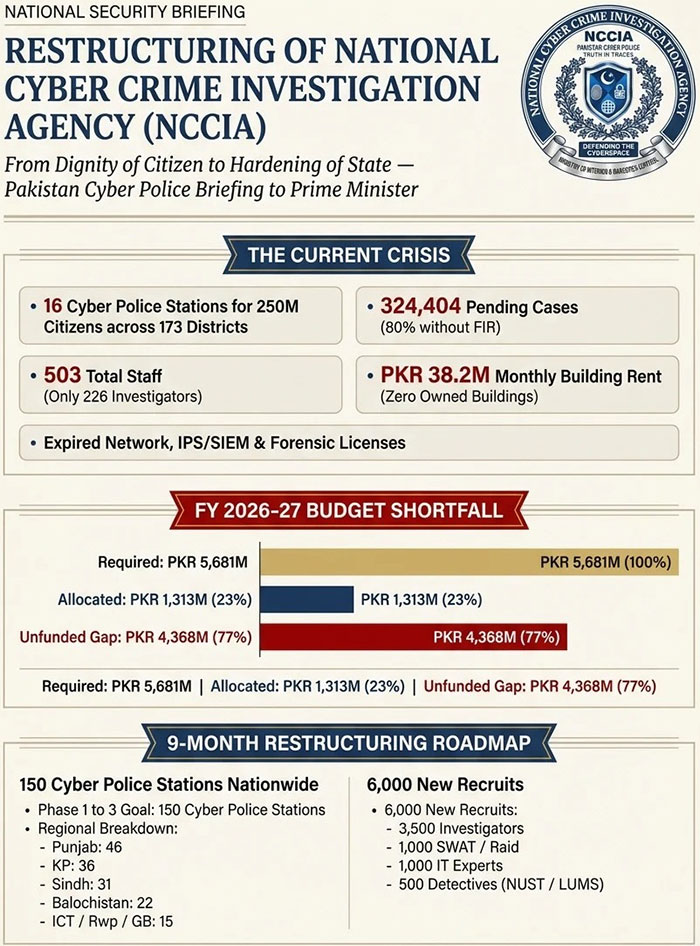
The Hum Investigation Team (HIT) has seen official briefing documents prepared by the Ministry of Interior for the prime minister, which reveal that the country’s primary digital law enforcement agency is struggling to meet its responsibilities, with 324,404 cybercrime cases pending nationwide and First Information Reports (FIRs) yet to be registered in 80% of complaints.
The proposed nine-month restructuring blueprint aims to address these shortcomings by significantly expanding the agency’s nationwide presence, recruiting specialised personnel and strengthening its operational and technical infrastructure.
Currently, only 16 Cyber Police Stations serve a population of around 250 million across 173 districts and 31 police ranges. The agency has a total workforce of just 503 personnel, including only 226 borrowed investigators available to handle cybercrime investigations across the country.
— Reporter
The scale of the challenge is particularly evident in Punjab, where 61 officers are tasked with serving a population of around 140 million. Investigators at Lahore’s Cyber Police Station are handling an average of 3,441 pending cases each, while the corresponding figure in Multan stands at 4,672.
The agency also lacks dedicated buildings of its own, spending more than Rs38.2 million every month on rented premises. Its critical network infrastructure, Intrusion Prevention System (IPS), Security Information and Event Management (SIEM) systems and digital forensic licences have also expired.
Eight structural gaps behind NCCIA’s crisis
The agency’s internal assessment identifies eight major structural weaknesses that have undermined its operational capacity and ability to tackle increasingly sophisticated digital crimes.
These include weak internal governance and a lack of institutional accountability, which have contributed to systemic inefficiencies and misconduct, eroding public trust.
Acute manpower shortages have left the agency heavily dependent on deputed personnel rather than a dedicated workforce of cybercrime specialists. Its limited nationwide presence, with just 16 operational Cyber Police Stations, has also created significant gaps in access to digital law enforcement, particularly outside major urban centres.
The mounting case backlog presents another major challenge. According to the briefing documents, 324,404 cases are pending, while FIRs have not been registered in 80% of complaints. Moreover, around 70% of public complaints raised during traditional police open-kacheri sessions now relate to cybercrime and are routinely referred to the NCCIA, adding to the agency’s workload.
— Reporter
Infrastructure deficiencies further compound the problem, with the agency operating entirely from rented premises and spending more than Rs38.2 million monthly on rent.
The assessment also highlights the expiry of essential cybersecurity and digital forensic licences, outdated legal procedures that hamper timely investigation and prosecution, and a widening gap between the agency’s operational requirements and available financial resources.
Provincial pressures and pay disparities
The operational burden varies across provinces, reflecting different patterns of cybercrime and security challenges.
In Punjab, only 61 officers are available to deal with cybercrime affecting a population of around 140 million. The province’s two busiest Cyber Police Stations face particularly heavy caseloads.
Lahore’s 31 investigators are handling 106,684 pending cases, averaging 3,441 cases per officer. In Multan, 12 investigators are burdened with 56,064 cases, or an average of 4,672 cases each.
Sindh’s position as a major economic hub generates substantial volumes of financial and commercial cyber fraud. Khyber Pakhtunkhwa faces heightened digital threats linked to terrorism and anti-state activities, while Balochistan confronts complex cyber threats associated with insurgency.
The agency’s ability to recruit and retain qualified personnel is further undermined by significant pay disparities with provincial police forces.
A Superintendent of Police (SP) in Punjab Police receives a gross monthly salary of Rs392,872, which is Rs123,473, or 46%, higher than the Rs269,399 earned by an NCCIA Deputy Director.
Similarly, a Punjab Police Deputy Superintendent of Police (DSP) draws Rs325,177 per month, compared with Rs234,627 for an NCCIA Assistant Director — a difference of Rs90,550, or 39%.
NCCIA officers also receive lower medical and travel allowances and do not have access to official government residences, further widening the disparity in service benefits.
77% budget shortfall
The agency’s financial position is another major obstacle to its operations, with the 2026-27 fiscal year allocations falling substantially short of its requirements.
According to the briefing, the NCCIA’s overall budgetary demand increased by 123% year-on-year, from Rs2,548 million in FY2025-26 to Rs5,681 million in FY2026-27. However, its allocation rose by only 3%, from Rs1,279 million to Rs1,313 million.
Consequently, the agency has received only around 23% of its requested funding, leaving a shortfall of Rs4,368 million, or 77% of its total requirements.
The biggest gap is in non-salary operational expenditures (OERE), which cover rent, forensic licences, technology upgrades and field operations.
The OERE demand more than tripled, rising from Rs1,317 million in FY2025-26 to Rs4,449 million in FY2026-27. However, the allocation increased only marginally, from Rs424 million to Rs442 million, leaving a deficit of Rs4,007 million compared with Rs893 million in the previous fiscal year.
Employee-related expenses (ERE), meanwhile, remained unchanged at Rs1,231 million in demand. Against this, the agency received Rs871 million, leaving a shortfall of Rs360 million. In FY2025-26, the allocation stood at Rs855 million against the same demand, with a deficit of Rs376 million.
Nine-month restructuring roadmap
To address the institutional crisis, the proposed restructuring plan envisages a three-phase expansion of the Cyber Police Station network, increasing the number of stations from 16 to 150 over nine months.
Under the first phase, spanning months one to three, the existing 16 stations will be integrated and 34 new stations established, taking the nationwide total to 50.
The second phase, covering months four to six, will add another 50 stations, bringing the total to 100. In the final phase, during months seven to nine, a further 50 stations will be established, completing the expansion to 150.
Under the proposed distribution, Punjab will have 46 Cyber Police Stations, followed by Khyber Pakhtunkhwa with 36, Sindh with 31 and Balochistan with 22. The remaining 15 will be established across the Islamabad Capital Territory, Rawalpindi and Gilgit-Baltistan.
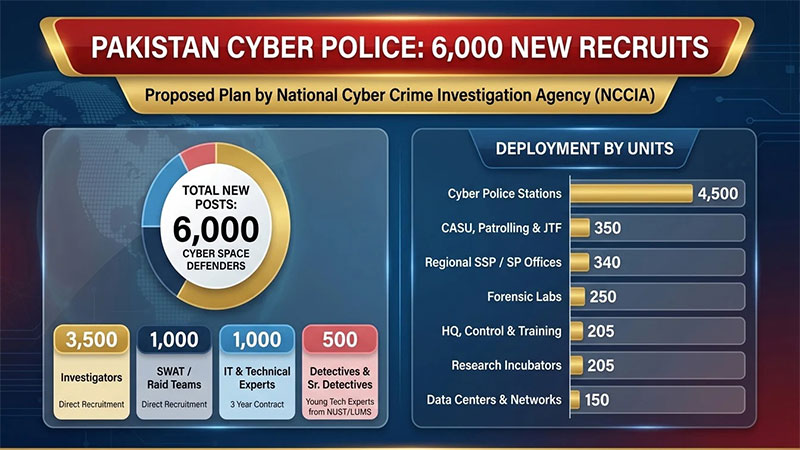
To staff the expanded network, the blueprint proposes recruiting 6,000 personnel across four specialised categories.
These include 3,500 directly recruited investigators, 1,000 personnel for Swat and raid teams, 1,000 technical and IT experts hired on three-year contracts, and 500 contractual detectives and senior detectives recruited from young technical graduates of leading institutions, including National University of Science and Technology (Nust) and Lahore University of Management Sciences (Lums).
Around three-quarters of the new workforce, or 4,500 personnel, will be deployed directly to Cyber Police Stations. This deployment will comprise 3,000 investigators, 700 Swat and raid team personnel, 500 detectives and senior detectives, and 300 technical and IT experts.
The remaining 1,500 personnel will be assigned to specialised units and support infrastructure across the country.
These deployments include 350 positions for the Cybercrime Analysis and Support Unit (CASU), patrolling and Joint Task Forces, comprising 200 investigators, 100 technical and IT experts and 50 Swat personnel.
Regional SSP and SP offices will receive 340 personnel, including 150 investigators, 150 Swat and raid team members and 40 technical and IT experts.
Another 250 technical and IT experts will be assigned to forensic laboratories to address bottlenecks in the examination of digital evidence.
The headquarters, control and training units will receive 205 personnel, comprising 100 Swat and raid team members, 75 investigators and 30 technical and IT experts. A further 205 personnel, including 130 technical and IT experts and 75 investigators, will be deployed to research incubators.
The remaining 150 technical and IT experts will be assigned to data centres and networks to maintain and secure the agency’s core digital infrastructure.
Through the proposed expansion of its nationwide presence, specialised recruitment and investment in technical infrastructure, the NCCIA aims to strengthen its capacity to investigate cybercrime, address the mounting case backlog and improve access to digital law enforcement across Pakistan.
You May Also Like