- Farah Mehjabeen
- November 18, 2026
Pakistani astronaut inches closer to historic spaceflight as China prepares Shenzhou-24 launch
-

- WEB DESK
- November 18, 2026
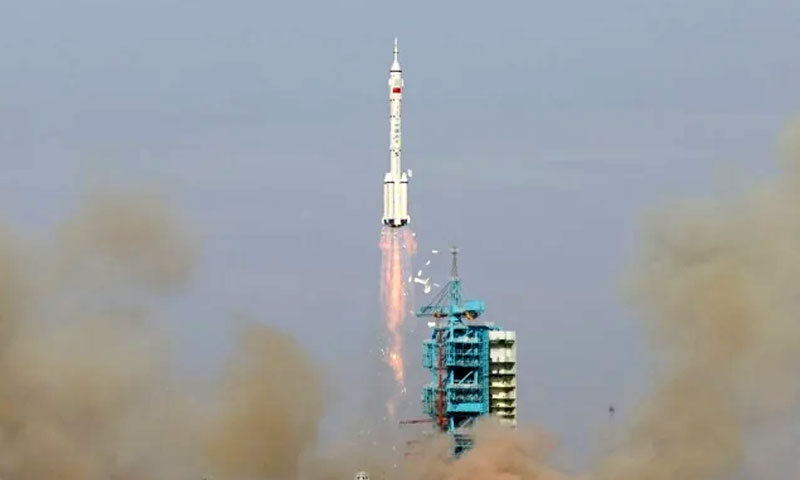
China moved its Shenzhou-24 crewed spacecraft and Long March-2F carrier rocket to the launch area on Tuesday, bringing Pakistan closer to sending its first astronaut to space as part of a joint mission with Chinese astronauts.
The upcoming flight will also mark the first time a foreign national joins China’s crewed space programme and visits its Tiangong space station.
🚀👍The Shenzhou XXIV spacecraft and the rocket will undergo final functional checks in the next several days, and the launch will take place in due course. [📷/China Daily] https://t.co/qWa9Uhag6M
— Chinese Space Station (@CNSpaceStation) November 18, 2026
The spacecraft and rocket combination was transferred to the service tower on Tuesday at the Jiuquan Satellite Launch Center in northwest China’s Gobi Desert, according to the China Manned Space Agency (CMSA).
The agency said the launch facilities and equipment were in good condition, adding that the spacecraft and its carrier rocket would undergo final functional checks and joint tests over the next several days.
🚀The upcoming Shenzhou XXIV manned mission is set to mark the first joint flight involving Chinese and foreign astronauts in the history of China’s manned space program.
🇵🇰A Pakistani astronaut has been selected to work as the payload specialist in the Shenzhou XXIV crew and spend a multi-day journey inside the @CNSpaceStation, before returning to Earth with two Chinese astronauts from the Shenzhou XXIII team. [📷/China Daily]
— Chinese Space Station (@CNSpaceStation) November 18, 2026
The Shenzhou-24 mission will be launched at an appropriate time in the near future, the CMSA said, without announcing a specific date.
The mission will transport astronauts to the Tiangong space station and involve the first joint flight of Chinese and foreign astronauts in the history of China’s human spaceflight programme.
Pakistani astronaut’s role in Shenzhou-24
A Pakistani astronaut has been selected to serve as a payload specialist aboard Shenzhou-24, undertaking a short-duration orbital mission at the Chinese space station.
According to the CMSA, the Pakistani astronaut will spend several days aboard Tiangong before returning to Earth with two Chinese astronauts from the Shenzhou-23 crew.
The return journey will take place aboard the Shenzhou-23 spacecraft, which has been docked at the space station since May.
The two spacecraft — Shenzhou-23 and Shenzhou-24 — will serve different purposes during the mission.
While Shenzhou-24 will carry the Pakistani astronaut from Earth to the Tiangong space station, Shenzhou-23 is already docked at the orbital facility and will be used for the return journey. This means the Pakistani astronaut will travel to space aboard one spacecraft and return to Earth aboard another.
The mission will make the Pakistani participant the first foreign national to visit Tiangong and the first non-Chinese astronaut to take part in a crewed flight under China’s human spaceflight programme.
China has not publicly identified the Pakistani astronaut selected for the flight.
However, two Pakistani candidates, Muhammad Zeeshan Ali and Khurram Daud, have undergone specialised training at the China Astronaut Research and Training Centre in Beijing. One has been selected for the mission, while the other will serve as a backup astronaut.
Pakistan-China space cooperation
The upcoming flight follows a bilateral agreement signed between Pakistan’s Space and Upper Atmosphere Research Commission (Suparco) and the CMSA in February 2025 to establish a programme for training Pakistani astronauts.
Under the arrangement, selected Pakistani candidates would receive training in China before participating in short-term space missions alongside their Chinese counterparts.
The Space and Upper Atmosphere Research Commission (SUPARCO) announces a landmark advancement in Pakistan’s Manned Space Mission Program as two Astronaut Candidates, Khurram Daud and Muhammad Zeeshan Ali are set to depart for the People’s Republic of China to begin advanced astronaut training at the Astronaut Centre of China (ACC).
This is a significant step forward in Pakistan’s space exploration journey that positions the country in the community of a select group of nations actively engaged in human spaceflight programs. Under this collaboration, Pakistan is preparing for its first-ever participation in a mission to the China Space Station (CSS). The mission is currently planned for launch in late 2026, where a Pakistani astronaut will serve as a Payload Expert aboard the Shenzhen mission.
During mission aboard the ‘China Space Station (CSS)’, the Pakistani astronaut will conduct several scientific experiments in microgravity. These experiments span critical areas including material science, fluid physics, life/ bio science, and biotechnology, with potential applications for climate resilience, food security, and industrial innovation.
On the historical occasion, Honourable Prime Minister of Pakistan Mr. Muhammad Shehbaz Sharif commended the efforts of SUPARCO; a harbinger of deep space exploration. He also appreciated ironclad China-Pakistan brotherhood, yet another testimony of which is choosing Pakistan to be the first country for participation in Manned Space Mission.
— Ministry of Information & Broadcasting (@MoIB_Official) April 22, 2026
The two countries shortlisted candidates for the programme in February 2026, with SUPARCO subsequently identifying Ali and Daud for advanced training in China.
The selection process involved three phases of screening and evaluation before the candidates began specialised astronaut training.
The programme represents an expansion of Pakistan-China cooperation in space exploration, building on their existing collaboration in satellite development, space technology and scientific research.
For Pakistan, the mission will mark a major step in its human spaceflight ambitions, giving a Pakistani astronaut the opportunity to participate in an orbital mission and undertake scientific activities in a microgravity environment.