
- WEB DESK
- October 5, 2026
Pakistan’s climate-hit women farmers turn to borrowing amid financial exclusion
-

- WEB DESK
- September 6, 2026
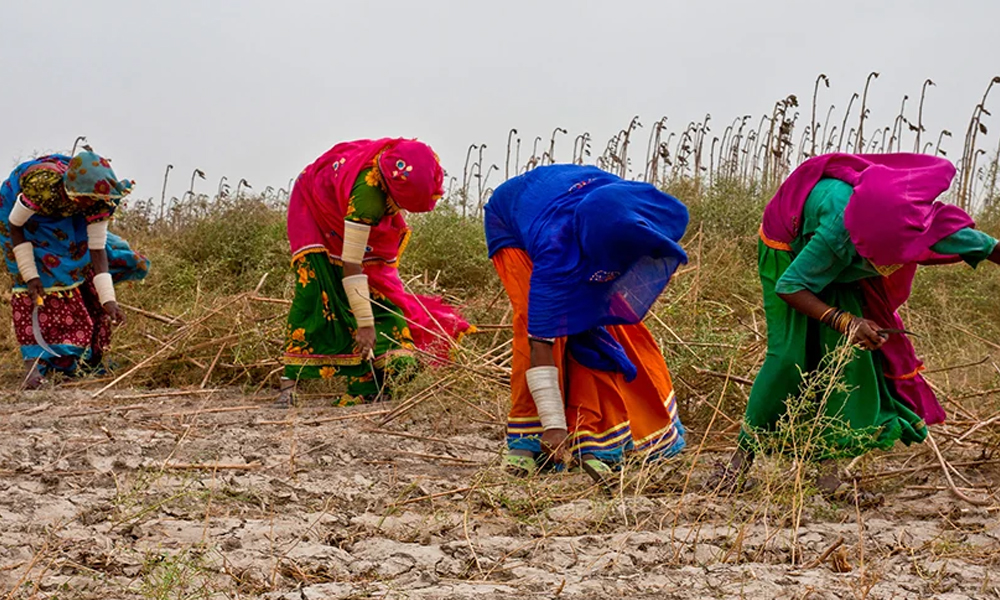
ISLAMABAD: Women farmers in Pakistan are increasingly turning to borrowing to cope with climate-related shocks while remaining largely excluded from formal financial services, according to a new study.
The study titled “Designing Gender-Responsive Climate Finance: A Diagnostic Study and Product Framework for Women Farmers in Pakistan”, conducted by Mobilink Bank and the Sustainable Development Policy Institute (SDPI), found that more than nine in 10 women farmers surveyed had experienced an extreme climate-related event such as a heatwave, flood, heavy rainfall or drought-like conditions during the previous five years.
“More than 80 per cent reported crop losses or other negative impacts on farming, while borrowing ranked among the most common coping mechanisms across all eight districts surveyed in Punjab and Sindh,” it said.
The findings highlight what researchers described as a widening gap between women’s contribution to agriculture, their exposure to climate risks and their access to formal finance, underscoring the need for financial products designed specifically around the circumstances of women farmers.
The findings were presented at a policy dialogue in Islamabad jointly hosted by SDPI and Mobilink Bank, bringing together government officials, financial regulators, banks, development finance institutions and development partners to discuss ways of translating the research into practical financial solutions.
Adviser to the Finance Minister Adnan Pasha, who attended the event as guest of honour, said women farmers needed to be formally recognised as economic actors and contributors to Pakistan’s agricultural economy.
He said the government was considering policy recommendations emerging from the study and called on financial institutions to develop products that addressed barriers faced by women, particularly limited access to finance, collateral constraints and climate-related risks.
The study found that 67 per cent of employed women in Pakistan work in agriculture, yet only 1.5 per cent of agricultural households are formally recorded as female-headed, highlighting a significant disconnect between women’s role in farming and their formal economic recognition.
Land ownership is another major barrier. Only about 2 per cent of ever-married women aged 15 to 49 own land either alone or jointly, while 97.2 per cent reported that they had not inherited land or a house.
The disparity is particularly pronounced in Sindh, where 99.1 per cent of women surveyed did not own land either alone or jointly, the study found.
Limited ownership of productive assets can also make it difficult for women farmers to qualify for conventional agricultural credit, which often relies on land or other collateral.
The study also identified a substantial gender gap in access to financial and digital services.
While 56 per cent of men have a full-service financial account, the figure falls to just 14 per cent among women. Mobile-wallet ownership is similarly much lower among women, at 11 per cent compared with 48 per cent among men.
The researchers said these structural barriers become particularly significant when climate shocks destroy crops, livestock and other sources of income.
In Khushab, for example, every woman who reported using a coping strategy said she had borrowed money, while more than half had also sold livestock. Researchers said such measures may help households survive an immediate crisis but can weaken their ability to generate income in the future.
The study is based on field research conducted across eight districts in Punjab and Sindh and seeks to identify financial products and policy interventions that could help women farmers manage climate risks while improving their access to formal finance.
Head of Strategy, Sustainability and Women Financial Services at Mobilink Bank Khowla Shoaib said that agriculture accounted for about 60 per cent of the bank’s gross loan portfolio, with women accounting for more than 21 per cent.
She said that the findings reinforced the bank’s assessment of the financial and climate-related challenges faced by women farmers and would help strengthen its existing portfolio and guide the development of new gender-responsive financial products.
Pakistan is among the countries most vulnerable to climate change, with increasingly frequent floods, heatwaves, erratic rainfall and droughts posing risks to agriculture and rural livelihoods.
The scale of those risks was demonstrated by the 2022 floods, which caused more than $30 billion in damages and economic losses, while an estimated $16.3 billion was needed for resilient reconstruction, according to assessments cited by the study.
SDPI Deputy Executive Director (Research) Dr Sajid Amin Javed said that the study was significant because it examined climate finance at the level of small farmers rather than focusing only on broader financing needs.
He said a gender perspective was particularly important because a large proportion of women involved in agricultural work remain largely unrecognised as agricultural workers.
“Strengthening the rural economy, particularly agriculture and livestock, is essential to strengthening Pakistan’s broader economy,” Javed said, adding that partnerships with financial institutions such as Mobilink Bank could help sustain research by providing access to large-scale customer data.
Head of the Energy Unit at SDPI Engr Ubaid Zia said that women were already doing agricultural work, absorbing the impact of climate shocks and borrowing to survive, but were not being adequately served by the formal financial system.
He said the problem was structural, with many financial products designed around assumptions of land ownership, individual mobility and digital access that did not reflect the realities of women farmers.
The researchers called for a shift towards gender-responsive and climate-sensitive financial products that could provide women farmers with timely credit, support recovery after climate shocks and help protect productive assets such as livestock.
The study’s findings suggest that improving women’s access to finance is not only a question of financial inclusion but could also be central to strengthening Pakistan’s agricultural resilience as climate risks intensify.
You May Also Like

- WEB DESK
- October 5, 2026
Petrol price increased by 88 paisas, diesel cut by Rs1.88
- WEB DESK
- October 5, 2026