
- Reuters
- September 15, 2026
Pakistan’s economy shows stronger stability in H1-FY26 despite global, climate pressures
-

- Sadiq Khan
- May 12, 2026
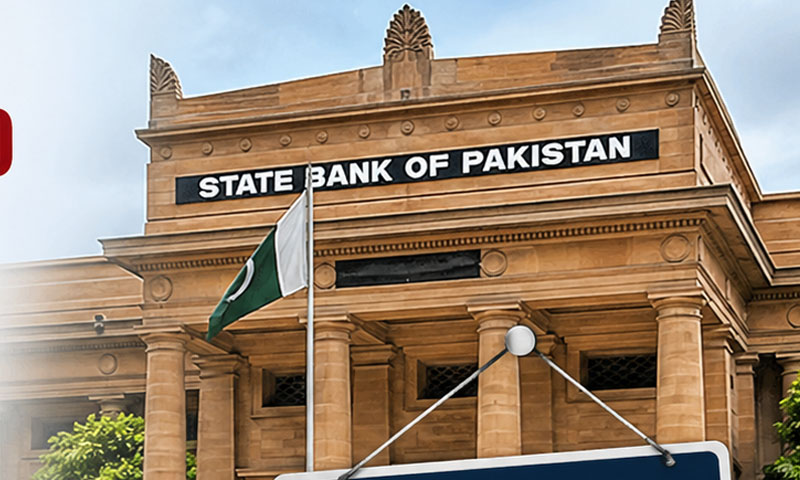
ISLAMABAD: State Bank of Pakistan said Pakistan’s macroeconomic stability improved further during the first half of FY26 despite challenges arising from global trade uncertainty and domestic floods, while warning that the ongoing Middle East conflict poses risks to inflation, trade and remittance flows.
In its “State of Pakistan’s Economy, Half Year Report FY26” released on Tuesday, the central bank said prudent monetary and fiscal policies, structural reforms, favorable commodity prices and the IMF programme helped strengthen key economic indicators during H1-FY26.
The report noted that average national CPI inflation eased further during the period, while the SBP’s foreign exchange purchases and net financial inflows helped improve external buffers. The central bank maintained a cautious monetary policy stance with a positive real interest rate, while the fiscal balance recorded a surplus in H1-FY26.
According to the report, Pakistan’s real GDP grew at twice the pace recorded in the same period last year, mainly driven by improved industrial activity, followed by services and agriculture sectors.
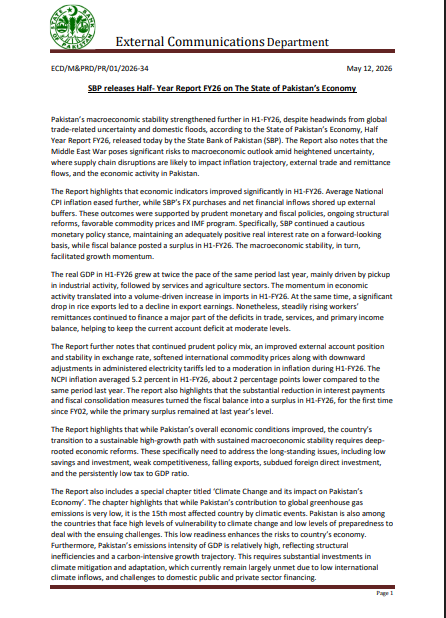
The rise in economic activity also pushed imports higher on a volume basis, while a sharp decline in rice exports reduced overall export earnings. However, increasing workers’ remittances continued to finance a major portion of deficits in trade, services and primary income balances, helping contain the current account deficit at moderate levels.
The SBP said inflation averaged 5.2 percent during H1-FY26, around two percentage points lower than the same period last year, supported by exchange rate stability, easing international commodity prices and reductions in electricity tariffs.
The report added that lower interest payments and fiscal consolidation measures turned the fiscal balance into a surplus during H1-FY26 for the first time since FY02, while the primary surplus remained at last year’s level.
Despite the improvement in economic conditions, the central bank stressed that Pakistan still requires deep-rooted structural reforms to achieve sustainable high growth and long-term macroeconomic stability.
The report identified low savings and investment, weak competitiveness, declining exports, subdued foreign direct investment and a persistently low tax-to-GDP ratio among the major structural challenges facing the economy.
The SBP also included a special chapter on climate change, warning that Pakistan remains among the world’s most vulnerable countries to climate-related disasters despite contributing minimally to global greenhouse gas emissions.
It said Pakistan ranks as the 15th most affected country by climatic events and faces serious risks due to low preparedness and limited climate financing. The report further noted that Pakistan’s GDP emissions intensity remains relatively high because of structural inefficiencies and a carbon-intensive growth model.
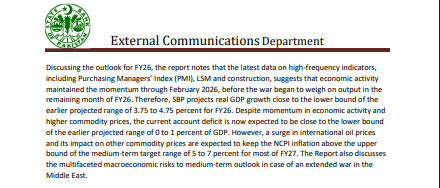
Discussing the outlook for FY26, the SBP said high-frequency indicators, including the Purchasing Managers’ Index, Large-Scale Manufacturing and construction activity, showed economic momentum remained intact through February 2026 before the Middle East war began affecting output in the remaining months.
#SBP has released Half-Year Report on the State of Pakistan’s Economy for FY26.
— SBP (@StateBank_Pak) May 12, 2026
See PR: https://t.co/F2ujiajGmt
Read Report: https://t.co/zcSCUPDamw pic.twitter.com/wmdvFegc1c
The central bank now expects real GDP growth to remain close to the lower bound of its earlier projected range of 3.75 to 4.75 percent for FY26.
It also projected the current account deficit to stay near the lower end of the earlier estimate of zero to one percent of GDP, despite stronger economic activity and rising commodity prices.
However, the SBP warned that rising international oil prices and higher global commodity prices may keep inflation above the medium-term target range of 5 to 7 percent for most of FY27, while an extended conflict in the Middle East could create additional risks for Pakistan’s medium-term economic outlook.
You May Also Like
- WEB DESK
- September 15, 2026
Petrol price rises by Rs4.10, diesel by Rs6.41 per litre
- Reuters
- September 15, 2026
Samson, Reddy lead India to series-clinching win over Afghanistan
- WEB DESK
- September 15, 2026