- WEB DESK
- October 16, 2026
Pakistan’s migration story: Millions head abroad, thousands return
-

- WEB DESK
- October 16, 2026
ISLAMABAD: More than 3.47 million Pakistanis registered for overseas employment between 2021 and 2025, as economic pressures, demand for foreign labour and the search for better opportunities drove workers to seek jobs abroad. Meanwhile, thousands of Pakistanis were deported from foreign countries for reasons ranging from visa violations and overstaying to illegal entry, begging-related offences and other immigration breaches.
Fresh figures presented in the National Assembly on Friday, have brought the departure of professionals into sharper focus. Federal Minister for Overseas Pakistanis and Human Resource Development Chaudhry Salik Hussain reported in a written reply that more than 1.87 million Pakistanis had gone abroad for work over the preceding three years, including doctors, engineers, information technology professionals, teachers and other workers.
The figures reveal two interconnected realities: overseas employment remains a vital source of income for Pakistani households and foreign exchange for the country, but irregular migration and deportations expose some citizens to financial losses, exploitation and legal consequences.
Official data from the Bureau of Emigration and Overseas Employment (BEOE), parliamentary disclosures and government reporting provide a picture of the scale of migration. However, deportation figures remain fragmented, and the available evidence does not justify treating every Pakistani who leaves as a permanent emigrant or every deportee as a criminal.
Millions register for overseas employment
Official figures from the Bureau of Emigration and Overseas Employment show that 3,473,124 Pakistanis registered for overseas employment between 2021 and 2025. The figures reflect registrations through the formal overseas employment system and should not be interpreted as a confirmed count of all Pakistanis who physically left the country for work
The figures show a sharp post-pandemic increase. Registrations climbed from 288,280 in 2021 to more than 832,000 in 2022, reaching a five-year high of 862,625 in 2023. They declined to 727,381 in 2024 before recovering to 762,499 in 2025.
The relatively low figure in 2021 reflected the continuing effects of the Covid-19 pandemic on international travel and overseas recruitment. As economies reopened and recruitment resumed, demand for foreign workers recovered.
The subsequent surge coincided with inflation, pressure on household incomes and uncertainty over employment prospects in Pakistan. These factors provide important context, although the registration data alone cannot establish how much of the increase resulted directly from economic hardship.
The five-year total measures registrations for overseas employment, not every Pakistani who physically left the country. It excludes many students, family migrants, permanent emigrants and people travelling abroad through other routes. Some registered workers took temporary contracts, returned home or moved between countries.
The latest parliamentary figures: More than 1.87 million departures
A written reply presented by Chaudhry Salik Hussain in the National Assembly on October 16, 2026, in response to a question by PPP MNA Shazia Somro, reported that more than 1.87 million Pakistanis had gone abroad for work over the preceding three years.
The reported figure was accompanied by occupational data for highly educated and professional workers. The documents listed 45,830 such workers in 2024, 28,726 in 2025 and 15,850 in 2026 up to the date covered by the reply.
The occupation-specific figures included managers, engineers, accountants, doctors, nurses, teachers, computer programmers and system analysts. The distinction between the overall three-year departure figure and the listed professional categories is important: the figures supplied for individual occupations do not, by themselves, account for the entire 1.87 million.
The figures also cover 2026, which is not included in the five-year BEOE total above. They should therefore be treated as a separate parliamentary disclosure rather than added to the 2021–2025 registrations without confirming the definitions and periods covered by each dataset.
Professionals leaving Pakistan
Managers formed the largest listed professional group in the National Assembly figures, with 23,674 going abroad in 2024, 9,562 in 2025 and 5,190 in 2026 so far.
Engineers numbered 8,015 in 2024, 5,945 in 2025 and 3,605 in 2026 to date. The figures for accountants were 4,779, 4,305 and 1,771, respectively.
The healthcare sector also featured prominently. The number of doctors going abroad for employment rose from 3,625 in 2024 to 3,795 in 2025, with another 2,093 recorded in 2026 so far. Nurses numbered 2,030 in 2024, 1,639 in 2025 and 626 in 2026 to date.
Teachers accounted for 1,729 departures in 2024, 1,725 in 2025 and 1,457 in 2026 so far. In information technology, 1,351 computer programmers went abroad in 2024, followed by 1,147 in 2025 and 664 in 2026 to date. System analysts numbered 388, 362 and 243, respectively.
The figures also covered pharmacists, dental surgeons, consultants, budget controllers, financial analysts and pilots. Financial analysts numbered 683 in 2024, 923 in 2025 and 424 in 2026 so far, while the figures for pilots were 33, 37 and 11, respectively.
The data raise questions about Pakistan’s ability to retain and replace skilled workers, particularly in healthcare, education, engineering and technology. They do not, however, establish how many professionals settled permanently abroad, returned to Pakistan or moved between countries.
Who is leaving Pakistan?
Overseas migration was not confined to doctors, engineers and other highly qualified professionals. A substantial share of registered emigrants comprised unskilled, semi-skilled and skilled workers seeking better-paid employment abroad.
The Pakistan Economic Survey 2024–25, drawing on BEOE data for 2024, recorded 366,092 unskilled workers, 255,706 skilled workers and 56,562 semi-skilled workers registered for overseas employment. Highly skilled workers accounted for 29,437 registrations, while 19,587 were classified as highly qualified.
The distribution shows that Pakistan’s overseas employment sector is not simply about the departure of highly trained professionals. It also involves large numbers of workers whose labour supports domestic industries, infrastructure and services.
The brain-drain question
A separate Gallup Pakistan analysis of BEOE registrations found that, between 2011 and 2024, registrations for overseas employment increased by 151 per cent for doctors, 172 per cent for engineers, 990 per cent for managers and 2,144 per cent for nurses. These are long-term comparisons, not growth rates limited to the past five years.
Professionals working abroad can earn higher incomes, acquire international experience and support their families. But when trained workers leave faster than institutions can recruit and replace them, shortages may develop in healthcare, education, engineering, technology and management.
The challenge is not to prevent Pakistanis from seeking opportunities overseas. It is to ensure that the country continues to train enough professionals, creates attractive employment at home and enables expatriates to contribute through investment, research, professional networks and eventual return.
Where are Pakistanis going?
The Gulf remains the principal destination for Pakistan’s overseas workforce, particularly Saudi Arabia and the United Arab Emirates, alongside Qatar, Oman, Bahrain and Kuwait.
Saudi Arabia has maintained its position as the largest single destination. In 2025, 530,256 Pakistanis registered for overseas employment in the kingdom, accounting for about 70 per cent of the annual total. The workforce included labourers, drivers, construction workers, technicians and employees in services, maintenance and hospitality.
The UAE remained another major market, offering employment in construction, retail, transport, hospitality, business services and professional occupations. Qatar and Oman also attracted Pakistani workers across several sectors.
Pakistanis travelled to Europe, the United Kingdom and other destinations for employment, education, family reunification and, in some cases, asylum. Such movements follow different legal routes and are not fully captured by overseas employment registrations.
The concentration of workers in Gulf labour markets makes Pakistan’s overseas employment sector particularly dependent on recruitment demand and immigration policies in a relatively small group of destination countries.
How many Pakistanis were deported?
Pakistan does not have a single publicly available, consolidated annual series that reliably counts every Pakistani deported from every country between 2021 and 2025. Official disclosures cover different periods, destinations and categories, and some figures overlap.
In June 2025, Interior Ministry officials told the Senate Standing Committee on Overseas Pakistanis that approximately 58,000 Pakistanis had been deported since 2023, based on information received from the Federal Investigation Agency (FIA) and Pakistani missions abroad. Around 5,600 of the cases were reportedly linked to begging in Saudi Arabia, Oman and Qatar.
Officials from the Ministry of Overseas Pakistanis separately reported approximately 7,873 deportations between 2019 and 2025, including 1,064 cases linked to begging. They also said 1,460 deportees had travelled through 691 overseas employment promoters.
These figures should not be added together or treated as competing estimates of the same population. They cover different periods and appear to draw on different administrative records. The government has not published a reconciled dataset explaining the differences.
Begging-related deportations
A written reply by Interior Minister Mohsin Naqvi to the National Assembly in May 2025 reported that 5,402 Pakistanis had faced deportation from Saudi Arabia, Iraq, Malaysia, Oman, Qatar and the UAE in begging-related cases since January 2024.
The total included 4,850 cases in 2024 and 552 in 2025 up to the time of the reply. Saudi Arabia accounted for 5,033 cases.
The figures cover a specific category and a limited group of countries, not all deportations of Pakistani nationals worldwide. They should also be kept separate from the other ministry-reported totals.
Returns from Iran, Iraq and Europe
At the Senate committee meeting in June 2025, the director general of Passports and Immigration cited approximately 34,000 Pakistanis deported from Iran and 50,000 from Iraq in the preceding year. The briefing discussed, among other issues, people overstaying during pilgrimage-related visits.
These figures were not accompanied by a reconciled annual worldwide total and should be treated as separate estimates rather than added to the Interior Ministry’s figure.
The FIA’s 2024 administrative reporting also recorded deportees returned from several countries, including Iran, Turkey, Greece, Oman and Spain. Such administrative series provide information about particular routes but do not constitute a complete global count.
More than 21,000 Pakistanis deported from Gulf countries in 2026
A written response presented to the National Assembly showed that 21,951 Pakistanis were deported from six Gulf countries between March 1 and July 13, 2026.
Saudi Arabia accounted for 15,495 cases, followed by the UAE with 3,803, Oman with 1,606, Bahrain with 521, Qatar with 429 and Kuwait with 97.
The response listed 4,628 deportees as absconders, 1,294 as having been jailed and 968 as blacklisted. Another 1,155 cases involved lost passports, while 689 concerned visa violations and 342 involved refused entry. A further 6,662 cases were placed under an “others” category that was not explained in the response. The figures also included 472 Pakistanis deported for begging.
These 2026 figures fall outside the five-year period covered by the BEOE employment-registration series.
Why were Pakistanis being returned?
Official disclosures identify a range of reasons for deportation, including visa overstays, illegal entry, begging-related offences, forged documents, visa violations and criminal or security-related grounds. Some cases involved lost or retained passports, while others concerned travellers refused entry for failing to meet immigration requirements.
The available records do not establish the proportion of all deportations attributable to each reason across every country and year. Nor do they justify treating all deportees as criminals or assuming that every return resulted from illegal migration.
The distinction matters because a person deported for overstaying a visa, a traveller refused entry and someone removed following a criminal conviction may appear in different administrative categories. A more consistent reporting system would help clarify the scale and causes of these returns.
Remittances: the other side of migration
Despite the risks associated with irregular migration, overseas Pakistanis remain a major economic asset.
The Ministry of Overseas Pakistanis reported that Pakistanis working abroad sent home approximately $40 billion in remittances in 2025, an increase of 9 per cent from the previous year. It also reported that 762,499 Pakistanis registered for overseas employment during 2025, about 5 per cent more than in 2024.
During the National Assembly session on October 16, 2026, Minister of State for Overseas Pakistanis Awn Chaudhry said more than 10 million Pakistanis lived abroad and sent home around $40 billion in remittances.
Why were Pakistanis leaving?
Limited access to secure, adequately paid employment remains an important part of the explanation. Pakistan’s working-age population continues to grow, while job creation has struggled to keep pace with the number of people entering the labour market.
Inflation, rising living costs, low wages and uncertainty over household purchasing power can make foreign employment attractive, particularly when workers expect to earn in stronger currencies. Doctors, nurses, engineers, managers and other professionals may also seek better working conditions, career development and advanced training.
The Financial Times reported in October 2026 that rapid population growth, insufficient job creation and weaknesses in public services were adding to the pressures facing Pakistan’s younger generation. The available migration figures do not establish the individual motivation of every person who leaves, but they place the employment outflow in a wider economic and demographic context. Financial Times, October 2026.
A country exporting its hopes
Pakistan’s migration story is not simply one of people leaving or being sent back. It is a story of aspiration, economic pressure and the relationship between a country’s workforce and its future.
Between 2021 and 2025, approximately 3.47 million Pakistanis registered for overseas employment. The latest parliamentary disclosures add a further dimension, highlighting the departure of professionals as well as the wider employment outflow. Deportation figures, meanwhile, reveal the vulnerabilities that can accompany migration, although the available records remain too fragmented to provide a complete worldwide total for 2021–2025.
Overseas employment can offer dignity, prosperity and international experience. Remittances can support families and strengthen the economy. But these benefits should not obscure the risks faced by people who travel through fraudulent or irregular channels, the disruption of family life or the potential loss of experienced workers.
Pakistan’s challenge is not to stop its citizens from leaving. It is to ensure that they can travel safely and legally, that their rights are protected abroad, and that opportunities at home are strong enough to make staying a viable choice.
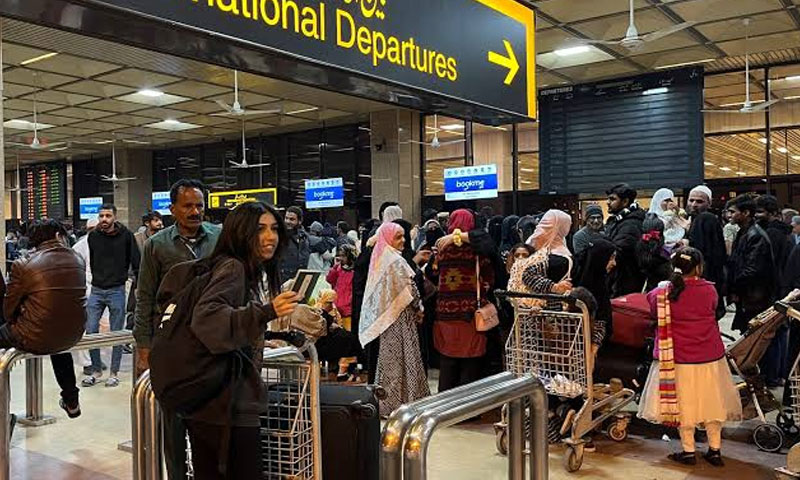
A country cannot build lasting prosperity on remittances alone. It must also create the conditions that encourage its people to invest their skills, ambitions and futures at home. Until it does, the departure halls of its airports will continue to reflect both the promise of opportunity abroad and the opportunities many Pakistanis believe they cannot find in their own country.
You May Also Like