- WEB DESK
- October 25, 2026
PIMS fire: PM reiterates no leniency for those responsible for negligence
-

- WEB DESK
- September 2, 2026
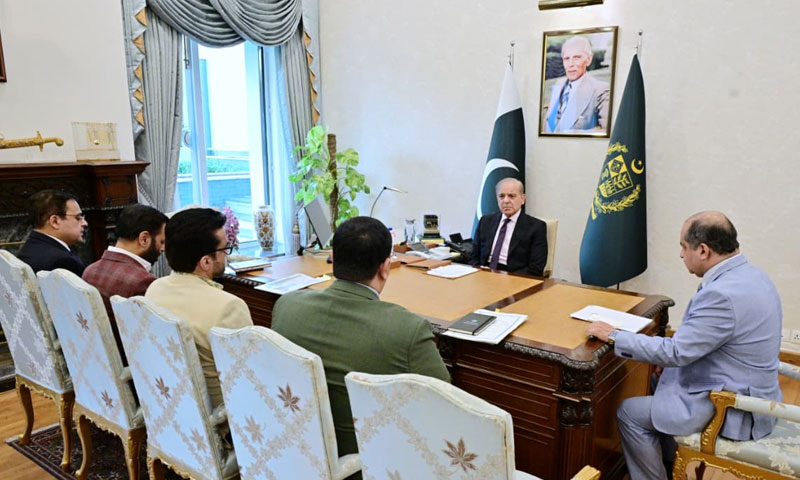
ISLAMABAD: Prime Minister Shehbaz Sharif on Wednesday reiterated that no leniency would be shown to officials found guilty of criminal negligence in the August 26 fire at the Pakistan Institute of Medical Sciences (PIMS), which killed 14 babies.
The prime minister, after returning to Islamabad from Kyrgyzstan, chaired an emergency meeting on health affairs and the ongoing investigation into the PIMS fire, according to the Prime Minister’s Office.
The meeting was attended by Federal Minister for National Health Services Syed Mustafa Kamal, Minister for Economic Affairs Ahad Cheema, Health Secretary Muhammad Mahmood and PIMS new Executive Director Dr Muhammad Salman.
The prime minister was briefed on affairs related to the health sector, as well as progress in the investigation into the fire at the federal capital’s largest public-sector hospital.
Officials told the meeting that implementation of the prime minister’s decisions was being ensured in light of the preliminary investigation report.
Shehbaz directed the health minister and health secretary to ensure their personal presence at PIMS on alternate days and oversee the implementation of measures aimed at improving the hospital.
He also ordered authorities to ensure better treatment facilities at PIMS and the implementation of all necessary safety measures.
The prime minister further directed the health ministry to accelerate the process of reforms in the health sector.
The premier reiterated that officials found guilty of criminal negligence in the PIMS fire would not be given any concession, the PM Office said.
Parliamentary panel flags regulatory gaps in Islamabad healthcare system
Meanwhile, a National Assembly subcommittee on health has submitted a special report to Prime Minister Shehbaz Sharif, flagging irregularities, mismanagement and alleged corruption in public and private hospitals in Islamabad and calling for immediate action to overhaul the capital’s healthcare system.
The committee has also asked the prime minister to ensure implementation of the recommendations contained in its report, according to a letter sent to the premier.
The report revealed that no hospital in Islamabad currently has a proper and effective healthcare licence, highlighting what the committee described as serious gaps in the regulation of healthcare facilities in the capital.
It recommended that comprehensive financial and medical audits of all public and private hospitals in Islamabad be conducted and that authorities ensure the provision and verification of complete records of all registered healthcare providers.
The committee also found that Islamabad lacked an effective mechanism to determine and monitor healthcare charges, resulting in patients having to pay high fees because of inadequate oversight.
The report called for the development of an effective system for monitoring healthcare charges to protect patients from excessive fees and ensure greater transparency in the sector.
The subcommittee further recommended removing all members of the healthcare regulatory authority who were found to have conflicts of interest, saying such conflicts undermined the authority’s ability to effectively regulate the sector.
It also called for audits of basic health units, rural health centres and community health centres in the rural areas of Islamabad.
The committee recommended establishing a comprehensive system for monitoring medical and financial affairs, geographical mapping of healthcare facilities and licensing of healthcare providers.
The report and accompanying letter were sent to the prime minister by the National Assembly’s subcommittee on health, which urged immediate implementation of the proposed measures to address regulatory and administrative shortcomings in Islamabad’s healthcare system.
Earlier, a parliamentary committee investigating the August 26 fire at PIMS, questioned the hospital’s management, emergency response and regulatory oversight, with officials unable to provide a definitive explanation for what caused the blaze. Committee members called for former PIMS Executive Director Dr Imran Sikandar to be summoned before the panel to answer questions about the hospital’s management and the circumstances surrounding the incidents.
Answering the committee, Health Minister Mustafa Kamal said that conflicting accounts had been presented about the origin of the fire, with one version blaming an air conditioner and another pointing to electrical wiring: “Some say the fire started from the wiring, while others say it was caused by the AC. We are being lied to.”
He said the committee had been given references to an air-conditioning unit, a socket and other possible sources, but had still not been able to determine how the fire started.
“The committee still does not know how the fire started,” the minister said.
According to Kamal, the committee had been told that the fire spread within around 120 seconds. He added that the staff members present at PIMS at the time of the incident were still at the hospital, while the committee had also concluded that the cause of the fire remained unclear.
Kamal said he had deliberately kept himself separate from the committee’s investigation to ensure impartiality and had also offered the ministry for scrutiny as part of the inquiry.
“We have kept ourselves separate from the committee and remained impartial,” he said. “We have also presented the ministry for the inquiry.”
The committee chairman said the priority was to ensure that such an incident did not happen again, while members indicated that reforms would be introduced following the investigation.
The proceedings also exposed wider concerns about the administration of PIMS. The committee chairman said major hospitals in Pakistan were being run by business interests rather than doctors, while other members complained about a lack of coordination between departments.
At PIMS, one department head allegedly does not communicate with another and departments do not allow others to use their resources, lawmakers were told.
“PIMS has become a fiefdom,” the committee chairman said.
Regulator questioned
The committee also sharply questioned officials of the Islamabad Healthcare Regulatory Authority over their oversight of PIMS.
The chairman asked the officials when the authority had last visited the hospital. An authority representative was unable to give a specific date and replied, “I don’t remember exactly.”
Officials said public-sector hospitals did not fall within the authority’s domain. The chairman challenged the explanation, pointing out that the regulator was responsible for licensing.
PIMS spokesperson Dr Aneesa told the committee that the healthcare authority had never issued a licence to PIMS and had never visited the hospital. Senator Rubina Khalid criticised the authority over what she described as a failure to monitor the hospital.
“You have never even asked about the condition of PIMS, yet you are giving us lectures,” she told the officials.
The committee was also informed that the head of the Islamabad Healthcare Regulatory Authority owns a medical college, adding another point of concern for lawmakers.
Members questioned the structure of the regulatory body, saying it had been designed to operate separately from the ministry. Some members said they saw little need for the institution in its current form.
Rubina Khalid urged the health minister to abolish the authority at the earliest opportunity.
You May Also Like