
- WEB DESK
- October 4, 2026
PTI to go ahead with Islamabad march after govt-opposition talks end in deadlock
-

- WEB DESK
- October 4, 2026
ISLAMABAD: The Pakistan Tehreek-e-Insaf (PTI) on Monday announced that it will go ahead with its long march on Islamabad after government-opposition talks ended in deadlock early Sunday, with the two sides failing to reach an agreement on key issues.
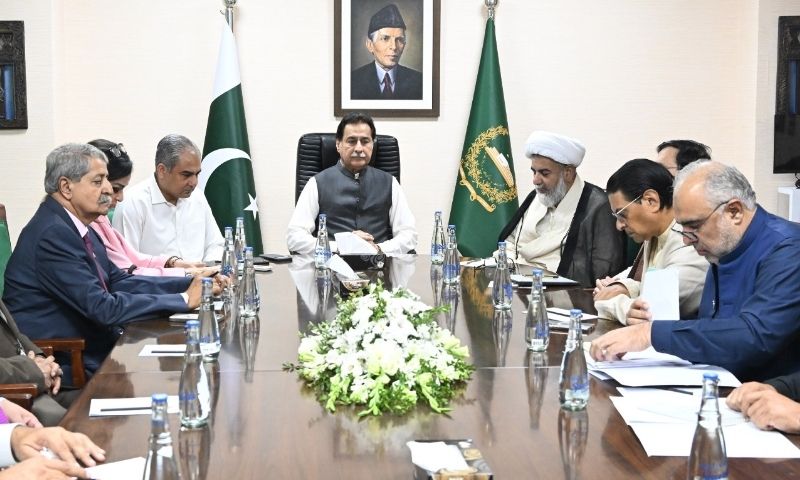
The negotiations, held at the National Assembly speaker’s chamber and chaired by Speaker Ayaz Sadiq, continued until around 2:30am but failed to produce an agreement on a draft understanding.
The deadlock came despite marathon discussions in which the two sides exchanged proposals and reached an understanding on some issues, according to sources familiar with the negotiations.
The main differences centred on the PTI’s demand for access to its founder Imran Khan and the government’s insistence on assurances regarding the Khyber Pakhtunkhwa government’s cooperation in the fight against terrorism.
The government and opposition sides blamed each other for the failure of the talks.
Prime Minister Shehbaz Sharif’s Adviser on Political Affairs Rana Sanaullah said the talks failed because the KP government was unwilling to give assurances that it would support security forces in the fight against terrorism.
He said the government would not allow the PTI’s march to enter Islamabad, while adding that there would be no objection to political meetings if they were not used for political activities that could create a law and order situation.
Minister of State for Interior Talal Chaudhry said that counterterrorism was a major point of disagreement, accusing the KP government of refusing to implement the National Action Plan.
He urged the PTI to cooperate in a national effort against terrorism and said the fight against militancy was a battle for Pakistan’s stability.
The opposition gave a different account of the failure.
PTI Chairman Barrister Gohar Ali Khan said a deadlock had emerged and the sides had not agreed on whether another session would be held.
He said, however, that nothing should be considered final because “in politics, nothing is final”, leaving open the possibility of further engagement.
Senate Opposition Leader Allama Raja Nasir Abbas said the deadlock remained over several issues, including ‘meetings’ with Imran Khan and the approach to counterterrorism in KP.
He said the opposition had concerns about military operations in areas where internally displaced people were present and added that the government had told them it was not currently in a position to arrange a meeting with Imran Khan.
The government had, however, offered to facilitate meetings between Imran’s sisters and lawyers, he said.
PTI leader Salman Akram Raja said the two sides had failed to reach consensus on the fundamental issues under discussion.
PPP Senator Sherry Rehman, who was part of the government-allied negotiating team, said the draft had been changed four times and the opposition ultimately did not agree to provisions concerning the long march and other matters.
The negotiations were launched on Friday in an attempt to prevent the PTI from proceeding with its planned October 4 march. The first round ended without a breakthrough, but both sides agreed to continue talks on Saturday.
The PTI’s proposed framework called for regular meetings between the prime minister and opposition leaders, the creation of a joint political negotiating committee, and guarantees of legal, medical and visitation rights for Imran Khan and his wife Bushra Bibi.
It also sought progress on pending legal cases involving Imran, Bushra and other political prisoners, while calling for consultations between the federal and KP governments on counterterrorism and a joint strategy to address the security situation in the province.
The proposal linked the cancellation of the long march to written assurances from the federal government on implementing the agreed measures.
The government, meanwhile, had sought cancellation of the October 4 protest as a condition for moving forward with several concessions. The issue of access to Imran Khan had emerged as a central point of contention during the negotiations.
PTI announces march schedule
Following the failure of the talks, KP Chief Minister Sohail Afridi announced that the first phase of the PTI’s march would begin from Gandi Chowk in Lakki Marwat at 1pm on Sunday.
He said that participants from Lakki Marwat, Tank, Dera Ismail Khan, North and South Waziristan and Bannu will join the convoy, which will travel towards Karak, where it will spend the night.
According to the schedule announced by Afridi, the march will continue on October 5 from Karak towards Kohat, with participants from Karak joining the convoy.
On October 6, participants from Kohat, Hangu, Kurram and Orakzai are expected to join before the convoy moves towards Peshawar.
The march will leave Peshawar’s Badaber area on October 7, with participants from Khyber district joining the convoy. It will then move towards Charsadda, he said.
On October 8, the convoy will leave the Charsadda Interchange, with participants from Charsadda and Mohmand joining it. PTI supporters from across KP are expected to converge at Khairabad, where the party says it will announce its next course of action.
The announcement came as the federal government stepped up preparations to prevent the march from reaching the capital.
Sohail Afridi shares draft of demands
In a post on X, KP Chief Minister Sohail Afridi shared the draft the PTI had submitted to the negotiating committee, saying the party’s demands were constitutional and lawful.
He said that the proposed agreement called for regular meetings between the prime minister and opposition leaders to discuss political, constitutional and legal issues, as well as the creation of a joint political committee to continue negotiations.
According to Afridi, it also sought guarantees of legal, medical and visitation rights for PTI founder Imran Khan and his wife Bushra Bibi, including access to family members, lawyers and authorised associates in accordance with jail rules and applicable law.
The draft further called for action on pending legal applications involving Imran, Bushra and other detainees, including consideration of such applications within 10 days where legally possible. It also sought the early release, on humanitarian grounds, of women detained on political charges, specifically naming Yasmin Rashid and Bushra Bibi.
On security in Khyber Pakhtunkhwa, according to Afridi, the PTI proposed consultations between the federal and provincial governments and called for a joint strategy to address terrorism and restore peace. It proposed that authorised representatives of both governments meet within 72 hours to formulate the strategy.
According to the draft, the PTI would cancel its long march after receiving written assurances from the federal government on implementation of the agreed measures. It said the party would retain its right to peaceful and democratic protest if the government failed to honour the commitments or negotiations were unreasonably stalled.
Salman Akran Raja says terrorism strategy primary reason for talks failure
PTI Secretary General Salman Akram Raja has said the primary reason for the failure of government-opposition talks early Sunday was a disagreement over how counterterrorism operations in Khyber Pakhtunkhwa should be conducted.
In a post on X, Raja said that, “leaving all other issues and much noise aside”, the talks between the government team and the PTI-TTAP team failed around 3am because the opposition side stood firm on the position that counterterrorism actions in KP should be based on an agreement between the federal and provincial governments.
He said the PTI-TTAP team also wanted such actions to be framed through consultation with, and the support of, political parties represented in the KP Assembly.
“This was not acceptable to the government team that insisted that all actions unilaterally initiated by it would have to be owned by the provincial government,” Raja said.
He said the PTI-TTAP team was clear that it had “zero tolerance for terrorism” and was committed to rooting it out.
At the same time, Raja said the opposition had a clear position against “so-called collateral damage” in the form of innocent lives and internal displacement of the local population.
“Policies and actions aimed at fighting terror must have the support of the local population and be based on ground intelligence,” he said.
Raja also called for the recommendations of a jirga held in the KP Assembly, attended by political and tribal notables from across the province, including the merged districts, to be taken into account.
“This was not acceptable to the federal government,” he said.
Naqvi says KP govt backed out at last minute
Interior Minister Mohsin Naqvi said the KP government had initially agreed to sign a written agreement and submit an implementation plan within 72 hours covering a range of counterterrorism measures.
In a post on X, Naqvi said the proposed commitments included reconsidering the Police Act 2026 in light of the security situation, preventing militants from operating freely or establishing safe havens in the province, and unequivocally condemning the Tehreek-i-Taliban Pakistan (TTP), Tehreek-i-Taliban Afghanistan (TTA) and other militant groups.
He said the agreement also covered support for the federal policy on Afghan refugees, including their repatriation and the dismantling of Afghan camps in KP, no contact with the interim Afghan government, increased funding for counterterrorism operations and police, and greater provincial ownership of counterterrorism measures.
The proposed commitments further included stronger cooperation with the armed forces, decisions on counterterrorism operations in former FATA and the merged districts, and implementation of the National Action Plan.
Naqvi alleged that the KP government withdrew from those commitments during the final phase of negotiations on Saturday night. He said security should not be politicised while the province was facing militancy.
Sources said that Mohsin Naqvi will also hold an emergency press conference on the country’s political situation at 3:30pm today in Lahore.
Authorities have already placed shipping containers at key routes leading into Islamabad, while restrictions and road blockades have disrupted transport and freight movement.
The breakdown in negotiations leaves the country facing renewed political uncertainty, with the PTI set to mobilise supporters from KP and the government warning that the march will not be allowed to enter Islamabad.