- Zahid Gishkori
- September 1, 2026
Punjab Assembly passes resolution to ban social media accounts for under-16s
-

- Shafiq Sharif
- September 1, 2026
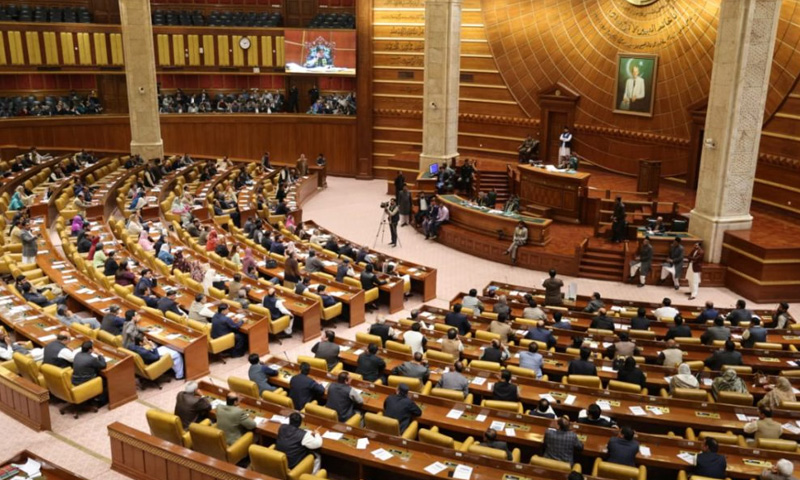
LAHORE: The Punjab Assembly on Tuesday unanimously passed a resolution seeking a ban on social media accounts for children under the age of 16, calling for an effective age-verification mechanism on digital platforms and stronger safeguards for children online.
The resolution was moved by government lawmaker Sarah Ahmed and stressed that protecting children’s physical, mental, psychological and moral development was a constitutional and moral responsibility of the state.
It said that in view of international trends towards regulating children’s access to social media, effective legislation was also necessary in Pakistan to ensure a safe digital environment and protect the future of minors.
The resolution called on the Pakistan Telecommunication Authority (PTA) to introduce an effective age-verification system across all social media platforms to prevent children below the specified age from creating or maintaining accounts.
It also urged federal and provincial institutions to launch digital-awareness campaigns for parents, teachers and children, focusing on safe internet use and online risks.
The House further called for coordination between federal and provincial institutions and effective legislation to ensure the online safety and protection of children.
Assembly seeks policy on disposal of solar panels, batteries
The House also unanimously passed a resolution calling for the promotion of local manufacturing of solar panels and modern batteries, while urging the government to formulate a policy for the safe disposal and recycling of used equipment.
The resolution was moved by opposition lawmaker Nadia Khurr.
It noted that Punjab had been promoting solar energy and electric vehicles, while the use of solar panels had expanded considerably across the country over the past eight to nine years.
Similarly, the resolution noted that used electric vehicles had been imported into the country for around 14 to 15 years and the number of batteries and solar panels in use across the province continued to increase.
However, it said there was currently no proper policy or legislation governing the disposal of used or expired solar panels and batteries, creating a major challenge for the environment and public health.
The House urged the Punjab government to introduce a policy and enact necessary legislation for the safe recycling and disposal of batteries and solar panels across the province.
It also called for an annual inspection and fitness-certification system for batteries used in electric vehicles.
Speaker blocks sanitation workers’ welfare bill
During the proceedings, Punjab Assembly Speaker Malik Muhammad Ahmad Khan stopped the Punjab Waste and Sanitation Workers Dignity, Safety, Security and Welfare Bill 2026 from being formally taken up, directing its mover to hold consultations with the government before bringing it before the House.
Lawmakers were told to examine the financial implications of the proposed legislation and discuss its details with the government.
The bill’s mover, Ahmad Iqbal, said he would welcome the government’s adoption of the proposed legislation and urged that it should not be overlooked.
The speaker said that if the bill involved financial expenditure, it should logically be introduced by the government.
He directed Parliamentary Secretary for Law Khalid Ranjha to sit with Ahmad Iqbal and work on the bill.
The speaker also instructed that the bill be brought to the agenda for consideration in the coming days after the necessary consultation.
Three education bills approved
The Punjab Assembly also approved several education-related bills during the sitting.
The House passed the “Ghanni University Sheikhupura Bill 2026”, which was moved by government lawmaker Samiullah Khan.
It also approved the “Punjab Private Educational Institution Bill 2025”, presented by government member Amjad Ali Javed.
The House also passed the “Revolution University Faisalabad Bill 2026”, also moved by Samiullah Khan.
Illegal housing societies
The issue of illegal housing societies also came under discussion after opposition lawmaker Ahmar Rashid Bhatti moved an adjournment motion.
Bhatti said that numerous housing societies in Lahore had allegedly taken money from citizens and failed to provide them with promised plots.
He said people who approached such societies to inquire about their plots were allegedly threatened, and called for government intervention to protect citizens who had invested their savings.
Parliamentary Secretary for Housing Sultan Bajwa told the House that a case against the society in question was already being pursued by the National Accountability Bureau (NAB).
The speaker expressed concern over the broader issue of unregulated housing schemes and questioned how individuals could simply declare land a housing society and begin collecting money from the public.
“You are leaving the poor people’s life savings at the mercy of NAB,” the speaker remarked, according to the proceedings.
He directed the housing department to provide a response by the following day, warning that a parliamentary committee could be constituted if the issue remained unresolved.
The speaker also observed that illegal housing societies had become widespread and demanded a concrete response from the relevant department.
Amjad Ali Javed said that the issue had persisted for years and suggested that the government establish a dedicated complaint centre to help citizens affected by fraudulent or illegal housing schemes.
Shortage of veterinary medicines in Muzaffargarh
During Question-Hour, opposition member Nadia Khurr drew attention to an alleged shortage of medicines at veterinary hospitals and dispensaries in Muzaffargarh district.
She claimed that medicines for animals were not available at the facilities and alleged that some staff members were selling medicines outside the hospitals.
In response, the relevant parliamentary secretary, Asim Sher Makan, said basic medicines were available at veterinary hospitals and dispensaries in the district.
He assured the House that every tehsil headquarters hospital in Muzaffargarh would be upgraded during the next financial year and converted into a modern model veterinary hospital.
Opposition leader raises attack on journalist
Opposition Leader Moin Riaz Qureshi also raised the alleged attack on journalist Talal Ishtiaq.
Qureshi said that the journalist’s house had been attacked and his family members harassed, while an attempt had allegedly been made to abduct his nine-year-old son.
He also said Imtinan Shahid and members of his staff had been receiving calls from unidentified locations.
Qureshi termed the threatening calls and such incidents unfortunate and called for a thorough investigation.
He said the opposition stood with journalists and would continue to support press freedom.
Panel Chairman Samiullah Khan also expressed support for journalists and press freedom, while Law Minister Rana Muhammad Iqbal said notice would be taken of the alleged assault on the journalist.
Iqbal assured the House that a comprehensive investigation would be conducted into the incident.
Punjab Assembly seeks religious teaching books, teachers for minority prisoners
The Punjab Assembly also unanimously passed a resolution calling for the provision of religious teaching books and teachers for minority prisoners in the province’s jails.
The resolution was moved by government lawmaker Raheela Khadim Hussain.
According to the resolution, prisoners can qualify for a reduction in their sentences under the law by completing religious education.
It noted that around 2,558 Muslim prisoners benefited from the facility between 2020 and 2025 after completing religious education.
The resolution stressed the need to effectively implement a similar system for prisoners belonging to minority communities.
It said approximately 1,624 minority prisoners are currently housed in Punjab’s jails, making it essential to establish an effective and practical system to provide them with religious education according to their respective beliefs.
The House called for religious teaching material and qualified teachers to be made available to minority prisoners so they could benefit from the same legal provisions available to other prisoners.
The resolution was passed unanimously.
You May Also Like