- WEB DESK
- October 6, 2026
Rubio says US will find ‘another way’ if Iran talks fail
-

- Zafar Ali
- May 25, 2026
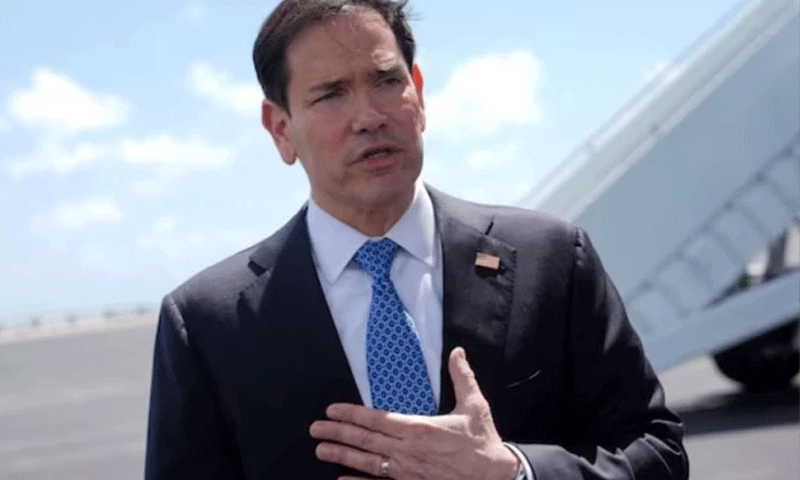
NEW DELHI: US Secretary of State Marco Rubio said on Monday that Washington would secure a deal with Iran or pursue “another way” if ongoing negotiations fail, as efforts continue to end a months-long conflict and stabilise global energy markets.
Speaking to reporters in New Delhi, Rubio said that the United States would give diplomacy “every chance to succeed” before considering alternatives, while acknowledging that talks remained complex and time-sensitive.
“We will either have a good agreement or we will have to deal with the situation another way,” Rubio said, adding that Washington remained engaged but would not negotiate indefinitely.
He said that there was a “pretty solid thing on the table” regarding Iran’s potential commitment to reopen the Strait of Hormuz and enter into a “very real, significant, time-limited negotiation” over its nuclear programme.
US President Donald Trump had earlier said that Iran talks should not be rushed, and that US restrictions on Iranian shipping in the Strait of Hormuz would remain in place until a formal agreement was reached and signed.
“There is no rush. Both sides must take their time and get it right,” Trump said in a statement posted on social media.
A senior US administration official earlier said that Iran had agreed in principle to reopen the Strait of Hormuz in exchange for the lifting of a US naval blockade, alongside steps to address concerns over Tehran’s stockpile of highly enriched uranium.
The official, speaking on condition of anonymity, told Reuters that Washington believed Iran’s leadership had broadly endorsed the framework, although there was no independent confirmation from Tehran.
The US side said that the proposed framework would initially focus on restoring maritime access through the strategic waterway, with nuclear verification and disposal arrangements to be negotiated in later phases under a 60-day timeline.
Iranian officials, however, have signalled resistance to parts of the emerging framework.
The Tasnim news agency, which is affiliated with the Islamic Revolutionary Guard Corps, said Tehran still objected to elements of the proposal, including demands over frozen Iranian funds held abroad.
Ebrahim Rezaei, a spokesperson for Iran’s parliament, said that Tehran would not accept pressure or threats.
“In diplomatic conflict, it is action for action,” he said in a statement on social media platform X, adding that Iran remained open to negotiations but would not concede under pressure.
The negotiations come as oil prices fell sharply on optimism that Washington and Tehran are moving closer to a limited understanding that could ease tensions in the Strait of Hormuz, a critical route for global energy supplies.
Before the conflict, the waterway carried around one-fifth of global oil and liquefied natural gas shipments.
Despite signs of progress, major sticking points remain, including Iran’s nuclear enrichment programme, sanctions relief, frozen oil revenues, and broader regional security issues involving Lebanon and Israeli military operations.
US officials said any agreement would need to address Iran’s enriched uranium stockpile, while Iranian sources have indicated that dilution under international supervision could be considered at a later stage.
Trump has repeatedly signalled willingness to strike a deal, while also defending his administration’s hardline position and maintaining that any agreement must be “proper and enforceable”.
Analysts say even if a framework is reached, implementation would take time and would not immediately resolve the broader energy crisis, which has already pushed up global fuel, fertiliser and food costs.