- Farah Mehjabeen
- October 26, 2026
Sanaullah questions Naqvi for raising new provinces issue at public forum
-

- WEB DESK
- September 13, 2026
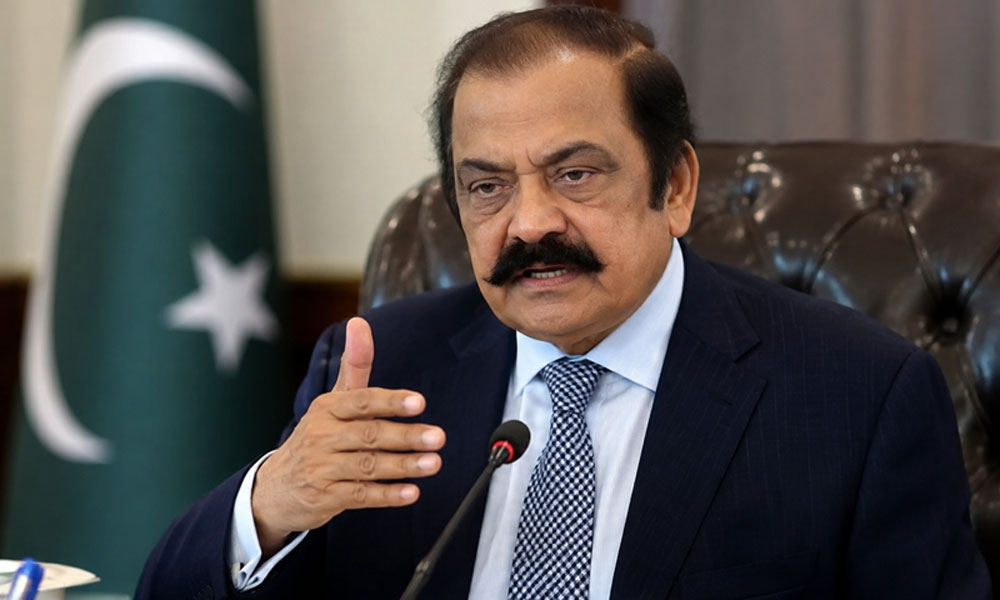
LAHORE: Prime Minister’s Adviser on Political Affairs Rana Sanaullah has questioned Interior Minister Mohsin Naqvi for raising the issue of new provinces at public and economic forums, saying such a major constitutional matter should have been brought before Parliament and cabinet and discussed through the proper political process.
Addressing a press conference in Model Town, Sanaullah said that the creation of new provinces remained under discussion within the Pakistan Muslim League-Nawaz (PML-N), but no final position had been reached and no formal proposal had yet been placed before the federal cabinet or Parliament.
He said that decisions on the creation of new provinces could not be taken through speeches, statements or discussions at business forums and seminars.
“The matter should have been discussed in Parliament,” Sanaullah said, adding that the issue would ultimately have to be decided by Parliament after all political parties presented their positions.
He said that the PML-N was consulting its leadership and workers before finalising its position and would present its policy when the issue came before Parliament. Prime Minister Shehbaz Sharif would also discuss the matter, he added.
Sanaullah’s comments came amid renewed debate over the restructuring of Pakistan’s administrative system following Naqvi’s repeated calls for the creation of new administrative units.
Naqvi, speaking at the Pakistan Economic Summit in Islamabad in late July, had described the existing governance system as having “collapsed” and argued that fundamental reforms were required, including the creation of new administrative units.
He subsequently said the issue should be decided according to the will of the people and that he would continue advocating the creation of new provinces regardless of whether he remained in office.
Sanaullah had already distanced the PML-N from Naqvi’s remarks in early August, describing them as the interior minister’s personal views and saying he could not understand what Naqvi intended to convey.
He had stressed that any change in the provincial structure would require constitutional amendments, parliamentary approval and political consultation.
On Sunday, he went further, saying that discussions at forums and through speeches would not produce a result.
“The discussion on new provinces will be held in Parliament,” he said, adding that all political parties would be able to put forward their positions once the issue reached the legislature.
Sanaullah said that if there was public demand for new provinces, “no one could stop” such a move, but the decision had to be taken through the constitutional process.
He also rejected the impression that a government decision had already been taken on the matter, saying the issue had not been discussed in the federal cabinet.
The adviser said the PML-N would decide its position through consultation and then present that position in Parliament. He added that the party’s deliberations would include views from its workers at the district and union-council levels.
Constitutional process
The debate has assumed greater significance because carving a new province out of an existing province requires a constitutional amendment.
Under Article 239 of the Constitution, a constitutional amendment requires a two-thirds majority in the National Assembly and Senate. Where an amendment alters the limits of a province, it cannot be presented to the president for assent unless it has also been approved by at least two-thirds of the total membership of the affected provincial assembly.
This means that creating a new province out of Punjab, Sindh, Khyber Pakhtunkhwa or Balochistan would require the consent of the relevant provincial assembly in addition to the required parliamentary majorities.
Old debate, new momentum
The demand for smaller provinces is not new.
In 2012, the National Assembly adopted a resolution supporting the creation of a Janoobi Punjab province, while the Punjab Assembly subsequently passed resolutions supporting both a separate South Punjab province and restoration of the former Bahawalpur province.
The issue became politically contentious because competing parties had different proposals for the geographical boundaries of any new province.
The PML-N itself had then called for four new provinces — South Punjab, Bahawalpur, Hazara and the former Federally Administered Tribal Areas — while arguing that the process should be conducted under Article 239 of the Constitution.
The Punjab Assembly later backed the establishment of a national commission to address questions relating to geographical boundaries, distribution of water and other resources, and administrative and constitutional issues.
The proposals, however, did not culminate in constitutional amendments creating the proposed provinces.
The South Punjab demand has remained particularly persistent. A National Assembly resolution adopted in May 2012 called for the creation of Janoobi Punjab and explicitly referred to the constitutional procedure required to alter Punjab’s boundaries.
The Senate’s Law and Justice Committee also revisited the question in 2022, deciding to hold public hearings on proposals for new provinces, including South Punjab and Bahawalpur. In 2023, the committee discussed the creation of South Punjab and Hazara, citing governance, economic development and political and administrative marginalisation among the arguments advanced in favour of smaller provinces.
Why the debate has returned
The issue has gained fresh momentum since Naqvi’s remarks in July.
Naqvi argued that Pakistan’s rapidly growing population could no longer be effectively administered through the existing structure and called for a broader “reset” of the governance system. He later said new administrative units would eventually have to be created but stressed that any such move should reflect the people’s will and political consensus.
Planning Minister Ahsan Iqbal had earlier argued that Pakistan should either create 15 new provinces or establish about 160 fully empowered district governments if it was unwilling to restructure the existing provinces.
Iqbal said the present two-tier system of federal and provincial governments had failed to improve social indicators and argued that the third tier of local government had not received the powers devolved to provinces under the 18th Amendment.
His proposal effectively broadened the debate from the creation of provinces to the much larger question of whether Pakistan’s governance problems should be addressed through new federating units, powerful local governments, or both.
PPP strongly opposes division of Sindh
The proposal has exposed differences within the ruling coalition.
The Pakistan People’s Party, which is a key coalition partner of the PML-N government, has insisted that any decision on new provinces must follow the Constitution and enjoy broad political consensus. PPP leaders have also questioned Prime Minister Shehbaz Sharif’s silence on the matter.
The Sindh Assembly, meanwhile, adopted a resolution rejecting proposals to divide Sindh, alter its territorial boundaries or create new administrative units out of the province. Chief Minister Murad Ali Shah said there would be no compromise on Sindh’s geographical unity.
PPP Chairman Bilawal Bhutto-Zardari had also said the issue should be discussed in Parliament rather than being raised at business forums.
The PPP’s position is particularly important because the ruling coalition’s parliamentary strength and the constitutional requirement for a two-thirds majority make political consensus essential for any constitutional amendment affecting provincial boundaries.
Opposition seeks consensus
The Pakistan Tehreek-e-Insaf has also cautioned against a rushed decision.
PTI Chairman Barrister Gohar Ali Khan has said any division of the existing provinces against the wishes of their residents and representatives could weaken the federation. He called for a commission and broad political consultations similar to those that preceded the 18th Amendment.
In Sindh, however, opposition parties including the Muttahida Qaumi Movement-Pakistan and PTI have argued that the country’s population and governance requirements justify the creation of additional administrative units, while opposing parties remain divided over whether this should mean creating new provinces or strengthening local governments.
Parliament expected to take up issue
The debate is now expected to move from speeches and public forums to Parliament.
Parliamentary Affairs Minister Tariq Fazal Chaudhry said on Septmber 10 that the National Assembly and Senate were expected to meet in October and that the issue of new provinces would be debated when the sessions were convened.
He described Parliament as the proper forum because the National Assembly represents all four provinces while the Senate gives each province equal representation.
Sanaullah warns of armed elements in PTI Sept 27 rally
At the same press conference, Rana Sanaullah said the government was not holding formal, on-the-record talks with the Pakistan Tehreek-e-Insaf (PTI) over its planned September 27 countrywide protest, while warning that reports suggest armed people could take part in the protest.
He said that there could possibly be informal, off-the-record contacts, but no official consultations with the PTI were taking place.
“Whatever happens, its result will become clear,” he said, adding that there were reports that armed people could be present during the march.
Sanaullah said elements involved in militancy in Balochistan and Khyber Pakhtunkhwa could also seek to exploit the PTI’s planned protest.
He said law enforcement agencies had a duty to stop anyone whose intentions were not peaceful.
“Those whose intentions are not peaceful must be stopped,” he said, stressing that maintaining law and order was the responsibility of the state.
The PTI has announced plans for countrywide protest and a long march on September 27 as part of its ongoing political campaign against the government.
Sanaullah said the government would deal with any attempt to disrupt public order in accordance with the law, while distinguishing between peaceful political protest and activities that could pose a security threat.
You May Also Like