
- Reuters
- October 26, 2026
Sindh CM inaugurates $84m WB-funded Sukkur Barrage modernisation project
-

- Zafar Ali
- June 14, 2026
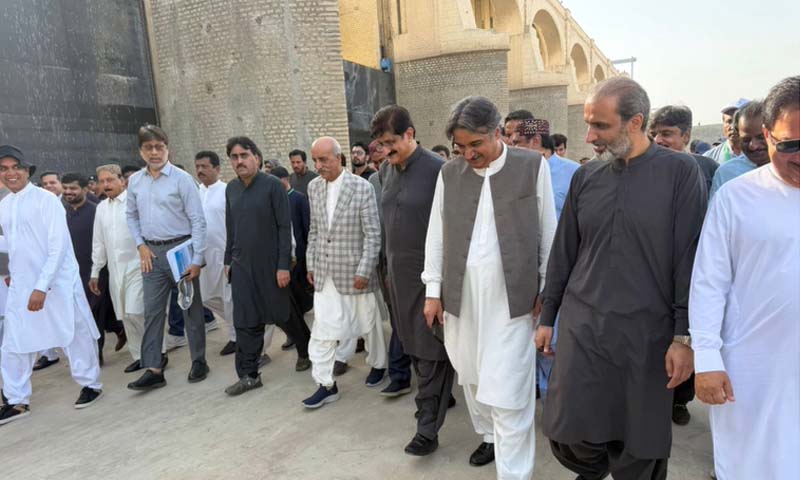
SUKKUR: Sindh Chief Minister Syed Murad Ali Shah on Sunday inaugurated a major phase of a historic Rs23.43 billion ($84.2 million) rehabilitation and modernisation project at the Sukkur Barrage, securing the agricultural baseline for millions of farming families and bolstering Pakistan’s national food security.
The extensive structural overhaul of the 94-year-old Sukkur Barrage has been carried out under the World Bank-funded Sindh Barrages Improvement Project (SBIP).
The initiative aims to reduce climate-induced flood risks, stabilise the Indus Basin irrigation system and improve water distribution across 3.1 million hectares of agricultural land.
The Sukkur Barrage modernisation project has a total cost of Rs23.436 billion ($84.2 million) and is funded by the World Bank under the SBIP framework.
Under the upgrade, 44 high-tonnage gates have been replaced against a target of 32, with each gate weighing around 50 metric tons.
The project supports seven major canals and is expected to benefit more than 600,000 farming families. It also forms part of a broader regional network linked with the Guddu Barrage, where a separate phase worth Rs9.58 billion has already been completed.
Addressing provincial ministers, technical experts and diplomatic observers at the inauguration, Murad Ali Shah described the infrastructure project as a vital shield against changing weather patterns.
“The Sukkur Barrage is not merely a structure of stone and mortar; it is the economic lifeline of Sindh’s agrarian economy,” Shah said.
He said that over 60 per cent of the provincial population resides in rural areas and depends entirely on the reliable discharge of this irrigation system.
The engineering deployment marks the first comprehensive rehabilitation of the barrage’s underwater floors and core structural masonry since its completion during the colonial era in 1932.
Irrigation Secretary Zarif Khero and Irrigation Minister Jam Khan Shoro briefed officials that the project surpassed its initial target of replacing 32 main barrage gates, successfully fabricating and installing 44 high-tonnage gates instead.
Each newly installed gate weighs 50 metric tons. The mechanical layout was upgraded from an obsolete stoney-roller mechanism to a modern fixed-wheel design, completely eliminating old counterweight vulnerabilities. To bypass global supply chain constraints and lower costs, the provincial government established two specialized manufacturing workshops locally in Sukkur, employing 10 Chinese engineering experts alongside 51 senior Pakistani technicians.
The broader SBIP strategy also includes the successful completion of structural upgrades at the upstream Guddu Barrage.
That phase was finalised at a cost of Rs9.585 billion, replacing all 56 main barrage gates and 25 canal head regulator gates to fully stabilize the upper-tier water delivery systems of the province.
Beyond the core mechanical installations, engineers completed vital civil repairs across all 44 structural bays and handed over six out of seven critical gauge wells, with final calibrations underway at the Nara Canal.
The infrastructure layout ensures that the barrage can safely navigate historically high, unseasonal river surges down the Indus River while supplying uninterrupted water allocations to its seven off-taking canals.
The project also implemented rigorous environmental and social safeguards.
A dedicated 45-member environmental compliance team oversaw 580 occupational health and safety training sessions for the construction crews. Furthermore, the provincial irrigation department conducted formal community consultations with more than 1,200 local stakeholders living along the riverbanks to mitigate displacement and economic disruption.
During the ceremony, Shah issued directives to the Sindh Irrigation Department to maintain momentum and ensure the final phases of the comprehensive modernisation plan are fully completed by June 2027.
The chief minister also paid tribute to Pritam Das, the former Project Director of SBIP, praising his technical oversight in overcoming complex underwater engineering challenges during the early phases of the project.
You May Also Like