
- Khurram Iqbal
- September 16, 2026
Talal says Afghan-based network supplying weapons to banned JAAC busted
-

- WEB DESK
- September 16, 2026
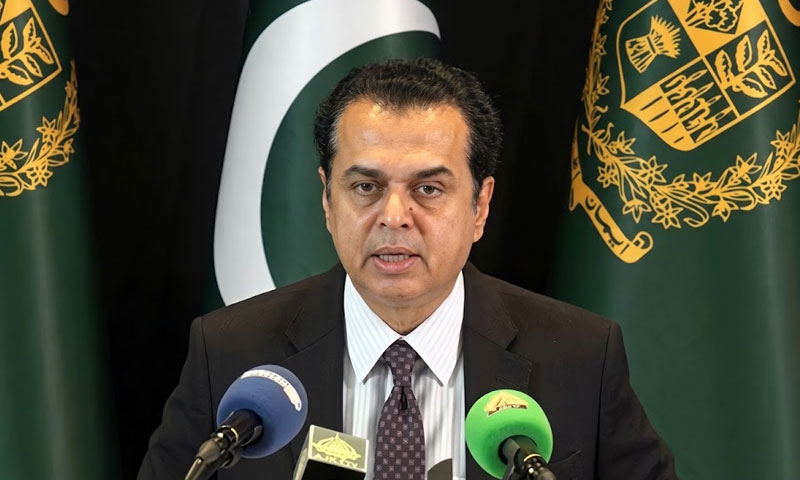
ISLAMABAD: Minister of State for Interior Talal Chaudhry on Wednesday said that authorities had uncovered a weapons-trafficking network allegedly supplying arms from Afghanistan to members linked to the banned Joint Awami Action Committee (JAAC) in Azad Jammu and Kashmir.
Speaking at a press conference in Islamabad, Chaudhry said that the network was traced during an intelligence-based operation and involved people in Afghanistan, Khyber Pakhtunkhwa and AJK, with local facilitators allegedly helping move weapons into the region.
The minister said that the investigation began with the arrest of a man identified as Zia, an AJK resident who, according to him, had been involved in the arms trade for eight to 10 years and had been supplying weapons to people close to the JAAC for about two years.
Chaudhry said that Zia was arrested after security forces came under fire at Kashmir Mor.
Investigators subsequently examined his mobile phone and traced his alleged contacts with other members of the network, he said.
The minister identified one of those contacts as Majid, whom he described as a close aide to Sardar Amaan Ullah, a key member of the proscribed JAAC.
The minister also played an audio recording during the press conference that they said captured a conversation between Zia and Majid about the movement of armed men and the procurement of weapons, including Dragunov rifles.
Chaudhry said that the investigation had also established an alleged link between Zia and a man in Afghanistan named Zarshad, who, he said, operated from different Afghan cities and supplied weapons to Pakistan.
According to the minister, the weapons were transported from Afghanistan to Bara in Khyber Pakhtunkhwa before being moved towards AJK with the help of local facilitators.
He said that another man, identified as Akbar and described as a government employee, was allegedly involved in transporting weapons.
Chaudhry said that Akbar received payment for each consignment and used his official position to avoid checks while carrying the weapons.
An audio recording purportedly involving Zia and Akbar was also played at the press conference.
Chaudhry said that intelligence agencies had traced the alleged network through phone records, intercepted communications and information obtained during the investigation.
He also played what he described as an audio recording between Zia and Zarshad in which various weapons, including Kalashnikovs, were allegedly discussed.
The minister said one transaction mentioned in the alleged communication involved Rs2.2 million, of which Rs1.1 million had been paid, with part of the money allegedly transferred through hawala or hundi channels.
Chaudhry did not present the material as evidence tested in court, and the allegations contained in the recordings could not be independently verified.
Govt links network to AJK unrest
The minister sought to connect the alleged weapons network to the unrest that has gripped AJK, arguing that the violence surrounding protests and the regional elections could not be viewed solely as a political dispute.
He said the government had accepted or partially accepted 37 of the 38 demands raised by the JAAC and had begun implementing them before the group announced a long march.
“Then you suddenly announce a long march,” Chaudhry said, according to the account of his press conference published by Dawn, arguing that the timing raised questions about the group’s objectives.
The government has previously said that most of the JAAC’s demands had been implemented following an agreement reached in October 2025.
However, the issue of the 12 seats in the AJK Legislative Assembly reserved for refugees from Indian-administered Kashmir remained contentious because of constitutional and legal questions.
The AJK government proscribed the JAAC under the region’s Anti-Terrorism Act on June 5, accusing it of engaging in terrorism and activities prejudicial to peace and security. The move came days before the group planned fresh demonstrations.
The JAAC has historically presented itself as a civil-rights movement campaigning on issues including electricity tariffs, wheat subsidies, governance and political representation.
Its 38-point charter became the focus of a series of protests and shutdowns in 2025 and 2026.
Violence disrupted AJK elections
Chaudhry said that the alleged preparations for violence had been under way for about two years and were not something that could have been organised immediately before the recent unrest.
He specifically referred to violence during the AJK elections, saying that a violent incident occurred on the day of the first phase of polling in Mirpur after voters turned out in large numbers.
AJK police had previously accused armed protesters linked to the banned JAAC of opening fire on security personnel during clashes in Rawalakot, while the JAAC disputed the government’s characterisation of the protests and violence.
The government has repeatedly argued that armed elements became involved in the unrest. At the same time, independent fact-checking organisations have warned that some videos circulated online purporting to show JAAC members firing on security forces were AI-generated, highlighting the difficulty of independently verifying material used in the information battle surrounding the unrest.
‘Differentiate political struggle from armed group’
Chaudhry said the government would distinguish between political activity and armed violence.
“We will have to differentiate between political struggle and an armed group,” he said.
He described the alleged arms network as part of a broader “terror-crime nexus”, which he said involved the smuggling of weapons, narcotics, vehicles and petroleum products and provided financial and logistical support for violent activity.
The minister said the government was conducting about 200 intelligence-based operations each day against militant and criminal networks and again accused Afghan territory of being used for attacks and destabilisation efforts in Pakistan.
He also linked the alleged AJK arms network to what he described as a wider system of cross-border smuggling, saying weapons moved from Afghanistan through Khyber Pakhtunkhwa before reaching AJK.
Zia’s alleged confession played
At the end of the press conference, Chaudhry played a video statement of a man identified as Zia.
In the video, the man described himself as an AJK resident from Sudhanoti and allegedly acknowledged links with senior JAAC figures and contacts involved in obtaining weapons.
He also allegedly described communications with Zarshad and Akbar and spoke about attacks on security forces in AJK.
The video was presented by the interior minister as an admission by the suspect, but the circumstances under which the statement was recorded were not independently established at the press conference.
Chaudhry said the government’s investigation would continue and that further evidence concerning the alleged network, including financial transactions, weapons procurement and communications between its members, could be made public.
The allegations add a security dimension to an already politically charged dispute in AJK, where the JAAC’s campaign over governance, economic grievances and political representation escalated into clashes with security forces and ultimately coincided with a highly contentious election period.
You May Also Like

- WEB DESK
- September 16, 2026
Pakistan extends airspace ban on Indian aircraft until Oct 24
- Reuters
- September 16, 2026