- Web Desk
- Today
The US–India trade reset: how 18% tariff reshapes Pakistan’s economic and strategic space
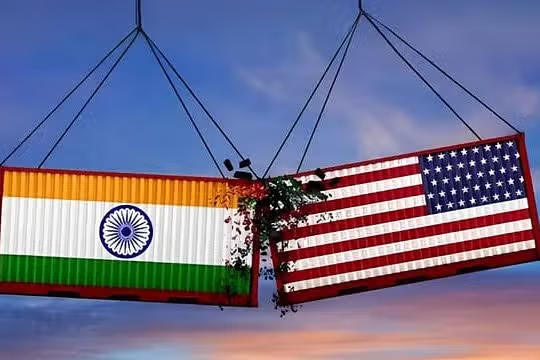
The US–India trade breakthrough of February 2 has brought an abrupt end to what many analysts describe as a year-long “tariff bloodbath.” After punitive duties on Indian exports peaked at 50 percent in late 2025, Washington and New Delhi reset their relationship through a highly transactional “grand bargain.”
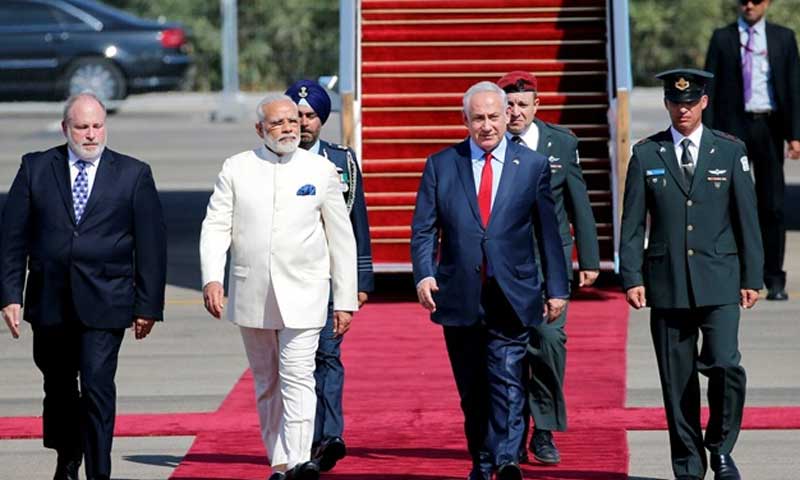
The deal was signed following a direct phone call between Indian Prime Minister Narendra Modi and President Donald Trump and centered on a reciprocal recalibration of trade and energy ties. Under the agreement, the United States reduced its reciprocal tariff on Indian goods from 25 percent to 18 percent and scrapped an additional 25 percent punitive duty imposed in August 2025 over India’s continued purchases of Russian oil.
In return, New Delhi halted Russian oil imports and pivoted toward US and Venezuelan energy supplies. India committed to an ambitious USD500 billion purchase plan covering US energy, technology, and agricultural products, and moved toward zero tariffs on US industrial goods, though it insisted that sensitive agricultural sectors remain protected.
The Doval Doctrine and the Power of Strategic Defiance
Behind the rapprochement, reports have highlighted the role of National Security Advisor Ajit Doval, whose “hardball” approach is widely credited with reshaping the outcome. During a tense meeting with US Secretary of State Marco Rubio in September 2025, Doval reportedly conveyed that India would not accept coercive terms and was prepared to wait out Trump’s entire second term rather than sign a humiliating agreement. This posture of strategic defiance is believed to have forced Washington to soften its stance and return to negotiations with the 18 percent tariff offer.
Internal Fractures: The Indian Opposition’s Critique
While the Modi government has presented the agreement as a win-win outcome, India’s opposition has sharply criticized it as a “strategic surrender.” Congress leaders have warned that opening Indian markets to subsidized American agricultural products under zero-tariff commitments could trigger a renewed farmers’ movement, arguing that abandoning Russian oil and committing to massive US procurement undermines India’s sovereign economic decision-making.
The View from Islamabad: Confronting the “1% Challenge”
In Pakistan, the deal has triggered a moment of geopolitical shock.
For much of 2025, Islamabad believed it had secured a relative advantage with a 19 percent tariff rate on exports to the US compared to India’s 50 percent. With India’s rate now lowered to 18 percent, Pakistan has lost its primary pricing edge, particularly in textiles and leather.
Academic & Policy Monitoring: The Institutional Response
Analysts have warned of an “export competitiveness shock,” estimating potential losses of up to USD1.5 billion in textile orders. They have urged a strategic pivot toward Central Asia, arguing that deeper regional connectivity could help offset Pakistan’s growing vulnerability in US markets.
The deal is increasingly being examined as a security economy hybrid. Observers note that while Pakistan relied on transactional loyalty through counter-terrorism cooperation and diplomatic signaling, India leveraged the sheer scale of its market to extract concessions. The resulting one-percent tariff gap is widely seen as a deliberate calibration by Washington symbolically positioning India as the preferred Indo-Pacific partner while leaving Pakistan marginally disadvantaged. With Trump, today’s certainty is tomorrow’s contradiction.
A Calculated Economic Bargain
Analysts describe India’s 2026 strategy as a “double play,” skillfully leveraging both Russia and the West. In 2025, India used discounted Russian oil imports to shield its economy from global energy fluctuations while simultaneously securing a major trade deal with the European Union, giving it leverage to pressure Washington on tariffs or risk losing access to the vast Indian market to European competitors. This was not a simple “pivot” but a deliberate trade-off: India negotiated tariff relief from the U.S. in exchange for scaling back Russian oil purchases, signaling a move toward a more structured Indo-Pacific economic framework.
Facing the so-called “one-percent challenge,” Pakistan is now reevaluating its economic and strategic approach, as a mere 1% shift in tariffs or market share toward India could cost roughly USD1.5 billion in key exports like textiles. In response, Islamabad is turning to digital diplomacy, aiming to lead the Digital Cooperation Organisation (DCO) as a countermeasure to trade barriers, while the new “Digital Shield” pact with China marks a shift from traditional protection to AI-driven, preemptive security for CPEC projects.
At the same time, Pakistan is engaging in geopolitical hedging by restoring military hotlines with Russia and continuing dialogue with the UN on Islamophobia, carving out a “middle-power” role that navigates between U.S. and China rivalries. Economically, Pakistan’s strategy emphasises rapid technological modernisation and export diversification beyond saturated Western textile markets to overcome the “one-percent challenge.
You May Also Like