- Reuters
- November 9, 2026
Trump says renewed US strikes on Iran ‘quite unlikely’ as Gulf states favour status quo
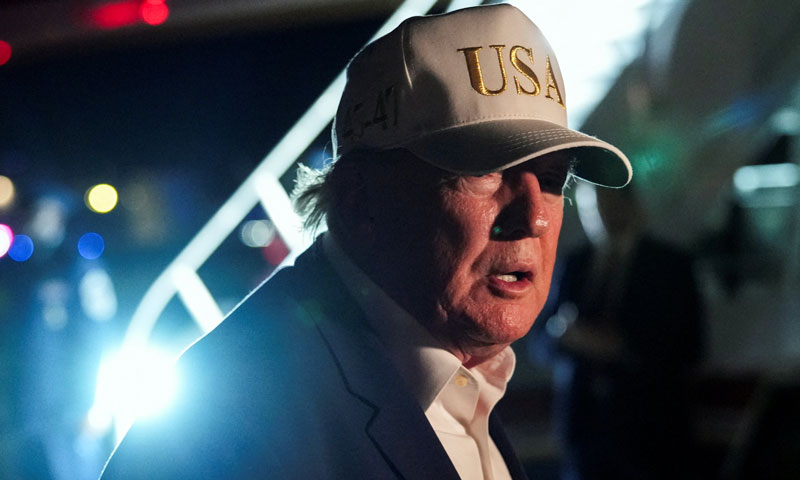
WASHINGTON/CAIRO/ABU DHABI/ISLAMABAD: US President Donald Trump has said renewed American military strikes against Iran are “quite unlikely“, signalling a preference for maintaining economic and military pressure while diplomatic efforts to end the conflict continue.
Trump made the remarks on Monday after meeting Qatari Prime Minister Sheikh Mohammed bin Abdulrahman Al-Thani at the White House, saying regional allies, including Qatar and Saudi Arabia, preferred the current situation over a resumption of the war.
The US president said Washington would maintain its naval blockade of the Strait of Hormuz and continue measures aimed at restricting Iran’s access to resources and military technology.
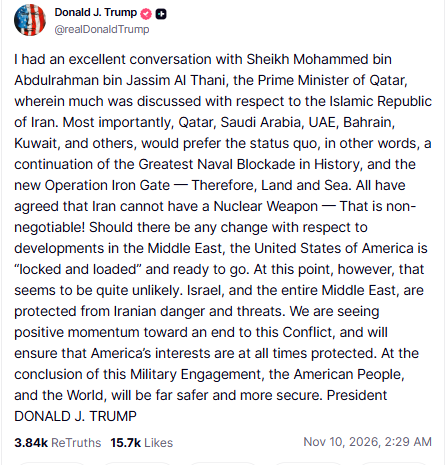
In a post on Truth Social, Trump said the United States remained prepared to resume military action if developments in the Middle East required it, but added that such a move appeared unlikely at present.
“At this point, however, that seems to be quite unlikely,” he wrote.
Trump also described the conflict as “effectively over” militarily but said he did not want to formally declare an end to the war before ensuring the safety of US allies in the region.
“We have great allies and we have to make sure they are not hurt. We want a long-term solution,” he said.
Trump signals preference for pressure and negotiations
According to Axios, Trump had been weighing three options: launching fresh military strikes, maintaining economic pressure on Iran or reaching a negotiated agreement involving significant concessions from Tehran.
His latest remarks suggest he intends to maintain the pressure campaign for now.
This includes continuing the naval blockade and an operation dubbed “Iron Gate”, which Axios reported was aimed at cutting off land routes used by Iran to transport advanced weapons and other technology.
Trump said Qatar, Saudi Arabia, the United Arab Emirates, Bahrain, Kuwait and other regional countries preferred maintaining the status quo rather than restarting military operations.
The remarks came after his meeting with Sheikh Mohammed, who also held separate discussions with US Vice President JD Vance, who has been leading the administration’s negotiations with Iran.
The Qatari prime minister said on X that he had discussed ways to advance US-Iran talks with Trump.
“Grateful for the positive discussions on reaching a deal and bringing peace to the region,” he said.
A diplomat briefed on the meeting told Axios that Trump had made clear he wanted an agreement and was prepared to give negotiations a chance. However, the diplomat said the US president could change course if Iran did not engage seriously in the talks.
Iran dismisses Trump’s remarks on negotiations
Trump said Iran was communicating politely with Washington and expressed hope that an agreement could bring the conflict to an end.
“We are seeing positive momentum toward an end to this Conflict, and will ensure that America’s interests are at all times protected,” he wrote on Truth Social.
However, Iran’s Supreme National Security Council secretary, Mohsen Rezaei, dismissed Trump’s remarks.
In a post on X, Rezaei said the war had “wrecked the U.S. government” and described Trump’s comments about negotiations as imaginary. He also called on Washington to surrender to Iran’s conditions for ending the conflict.
Despite the diplomatic activity, military tensions remain unresolved. Iranian state media reported that the United States had struck Iran’s Qeshm island overnight, while Iran has attacked tankers in the Gulf and Strait of Hormuz this month. Its Yemeni Houthi allies have also carried out attacks on Saudi Arabia.
Meanwhile, oil prices have eased amid expectations that the fighting could end. Brent crude futures fell to $92 a barrel on Monday, according to Axios.
Diplomatic moves
Al-Thani, who is both prime minister and foreign minister of Qatar, met Trump after visiting Tehran last week.
The prime minister called his talks with both Trump and Vice President JD Vance positive.
“Grateful for the positive discussions on reaching a deal and bringing peace to the region,” he said on X.
Iranian security council chief Mohsen Rezaei also said on X the US should “stop manufacturing fake news about imaginary talks” and that it was “time to surrender to the seven conditions Iran has repeatedly set out.”
Iran’s proposal to end the war involves an end to the US blockade of its ports, the lifting of some sanctions and a halt to bombing in return for Tehran stopping its own blockade of the Strait of Hormuz, with talks on its nuclear programme and other sanctions to follow.
The US has repeatedly rejected that plan, with Secretary of State Marco Rubio describing Tehran’s conditions on Sunday as “outrageous and ridiculous and really not realistic.”
Iran’s Foreign Ministry spokesperson Esmaeil Baghaei defended the plan on Monday as the most reasonable offer on the table.
Senior US Republicans including Vice President JD Vance have blamed their party’s losses in last week’s elections on the Iran war. Despite the growing domestic political pressure to end the conflict, Rubio said he did not believe a diplomatic breakthrough was imminent.
A senior United Arab Emirates official, Anwar Gargash, echoed that view on Monday, saying a comprehensive political settlement between the US and Iran appeared difficult.
“We should… prepare for a long period of uncertainty in which neither a decisive resolution nor stable regional order can be taken for granted,” he said.
Vance, who led the negotiations for a short-lived truce in June, will also meet Al-Thani, whose country has been a prime mediator since early in the war, conveying messages between the sides and proposing ways to bridge their differences.
Anxiety over the war has pervaded the region for months, and Turkish President Tayyip Erdogan said on Monday he had told Trump that Ankara did not want to see a new escalation.
“We emphasise at every opportunity that it is possible to resolve these issues through dialogue and diplomacy. Unfortunately, we see a negative shift once again. We are doing our utmost to prevent this,” Erdogan told reporters.
Military action
Sunday night’s strikes on Qeshm island did not impact vital infrastructure or services, a provincial official told Iran’s semi-official Fars news agency on Monday. The US has not commented on the Iranian media reports.
A senior Iranian source told Reuters that US strikes were targeting Iranian radar systems serving both air defence and ship navigation, as well as bases for missile launchers and mine-laying systems.
Attacks on tankers in the Gulf and Strait of Hormuz ramped up sharply in October and have continued at the highest rate since the start of the war, figures from international maritime agencies showed last week.
Iran, which typically does not acknowledge striking vessels that report being hit by projectiles, said on Sunday a tanker had hit a mine east of the Strait of Hormuz.
A state television reporter said on Monday that 11 tankers had been “disabled” over the past 10 days.