- WEB DESK
- October 6, 2026
Trump, Xi launch high-stakes Beijing summit amid trade optimism
-

- Zafar Ali
- May 14, 2026
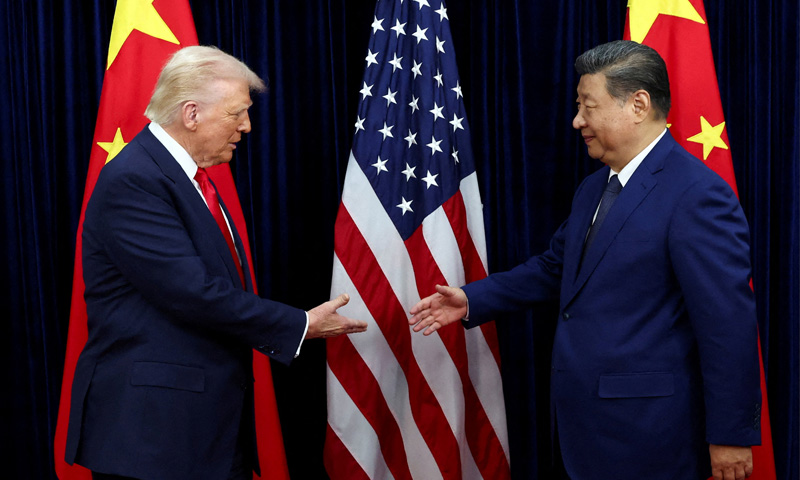
BEIJING: Chinese President Xi Jinping on Thursday welcomed what he described as positive progress in trade negotiations with the United States as he opened a high-stakes two-day summit with US President Donald Trump in Beijing, where discussions are also expected to cover the Iran war and US arms sales to Taiwan.
The visit marks the first trip to China by a sitting US president since Trump’s previous visit in 2017 and comes at a politically sensitive time for the US leader, whose approval ratings have been affected by Washington’s involvement in the Middle East conflict.
“You’re a great leader, sometimes people don’t like me saying it, but I say it anyway,” Trump told Xi during a lavish welcoming ceremony at Beijing’s Great Hall of the People, featuring an honour guard and children waving Chinese and American flags.
“There are those who say this may be the biggest summit ever,” Trump said. “It’s an honour to be with you. It’s an honour to be your friend and the relationship between China and the USA is going to be better than ever before.”
Xi, in his opening remarks, said a stable relationship between China and the United States benefits the entire world.
“When we cooperate, both sides benefit; when we confront each other, both sides suffer,” Xi said.
According to China’s state-run Xinhua news agency, Xi also said preparatory trade talks held by economic teams from both countries in South Korea on Wednesday had produced an “overall balanced and positive outcome”.
Officials familiar with the negotiations said the talks aimed to preserve the trade truce reached last October and establish mechanisms to support future trade and investment ties.
A number of prominent US business leaders joined Trump’s delegation, including Elon Musk, Jensen Huang and Tim Cook. Huang was reportedly added to the delegation at the last minute.
Trump has repeatedly said he wants China to further open its markets to American businesses.
Musk briefly spoke to reporters after the opening session, describing the talks as “wonderful”.
The summit is expected to include extensive engagement between the two leaders. Following Thursday’s formal talks, Trump and Xi are scheduled to tour Beijing’s historic Temple of Heaven and attend a state banquet, before holding further meetings over tea and lunch on Friday, according to the White House.
Shift in power dynamics
Analysts say the balance of power between Washington and Beijing has shifted considerably since Trump’s 2017 visit, when China sought to showcase its growing economic strength and purchased billions of dollars in American goods.
Ali Wyne, senior adviser for US-China relations at the International Crisis Group, said this time the United States appeared more willing to acknowledge China’s global status.
Trump enters the talks facing mounting domestic and international pressure. US courts have limited his ability to impose tariffs on Chinese imports, while the Iran war has fuelled inflation concerns and political risks ahead of November’s midterm elections.
Although China’s economy has slowed in recent years, Xi is not facing the same level of political pressure at home.
Still, both governments are keen to maintain the trade truce reached last October, under which Trump suspended triple-digit tariffs on Chinese goods while Beijing eased restrictions on exports of rare earth materials essential for industries ranging from electric vehicles to defence manufacturing.
The two sides are also expected to discuss frameworks for future trade, investment cooperation and dialogue on artificial intelligence.
Washington hopes to increase exports of Boeing aircraft, agricultural products and energy supplies to China in an effort to reduce the long-running US trade deficit. Beijing, meanwhile, wants the United States to ease restrictions on exports of advanced semiconductors and chipmaking equipment.
Iran and Taiwan expected to dominate talks
Beyond trade, Trump is expected to urge China to persuade Iran to negotiate with Washington to help end the ongoing conflict in the Middle East.
However, analysts say Beijing is unlikely to significantly pressure Tehran, given Iran’s strategic importance as a counterweight to US influence.
US Secretary of State Marco Rubio said aboard Air Force One that China also had an interest in resolving the crisis because disruptions in Gulf shipping and the global economy could hurt Chinese trade.
For Xi, US military support for Taiwan is expected to remain a central concern during the talks.
China reiterated on Wednesday its opposition to American arms sales to Taiwan, including a proposed $14 billion package still awaiting Trump’s approval. The United States is legally required to provide Taiwan with defensive capabilities despite lacking formal diplomatic relations with the island.
Ronan Fu, an assistant research fellow at Taiwan’s Academia Sinica think tank, said Trump appeared to believe he still held significant leverage in the negotiations despite growing constraints.
Xi is also tentatively expected to visit the United States later this year in what would be his first trip there since Trump returned to office in 2025.