
- WEB DESK
- September 14, 2026
UAE and South Korea seal landmark trade pact as CEPA takes effect
-

- Sadia Basharat
- May 2, 2026
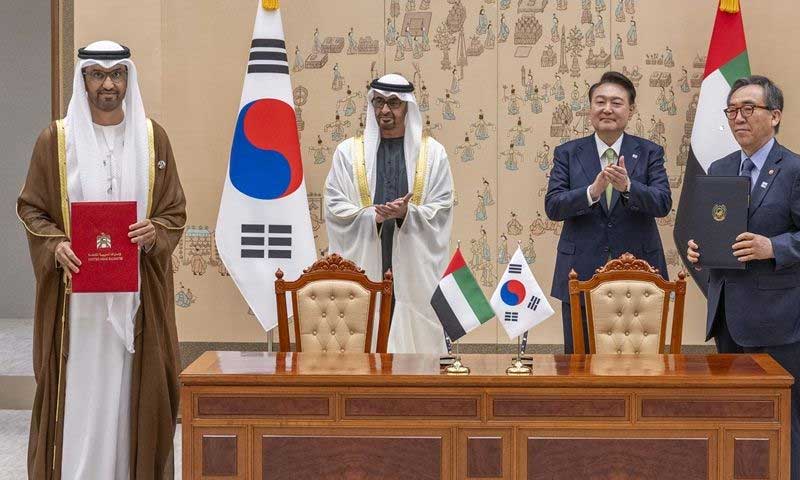
WEB DESK: The UAE–South Korea Comprehensive Economic Partnership Agreement (CEPA) officially entered into force on 1 May 2026, ushering in a new era of economic cooperation between the Gulf state and one of Asia’s leading industrial powers.
The agreement, South Korea’s first such deal with any country in the Middle East and North Africa (MENA) region, is expected to substantially lower barriers to trade and investment while building on already robust bilateral ties, according to Gulf News.
For the UAE, it represents the latest milestone in its ambitious strategy to diversify its global economic partnerships beyond traditional energy markets.
Tariff cuts and trade boost
Under the terms of the CEPA, tariffs will be reduced or eliminated on 91.2 per cent of traded goods and services, creating significant new opportunities for exporters and importers on both sides.
The pact rests on a solid base of $6.9 billion in non-oil bilateral trade recorded in 2025 and is projected to drive a sharp rise in overall trade volumes, cross-border investment, and integrated supply chains.
Analysts anticipate accelerated collaboration in key strategic sectors including energy, advanced technology, renewable energy, manufacturing, logistics, and healthcare.
The agreement also aims to deepen private sector engagement, encouraging joint ventures and knowledge transfer that could strengthen resilience in both economies amid shifting global conditions.
A bridge between Gulf and East Asia
Described by observers as more than a conventional trade deal, the CEPA establishes what many are calling a structural economic corridor linking the Gulf and East Asia.
By fostering closer ties between two dynamic, forward-looking economies, the pact positions the UAE and South Korea to better navigate an increasingly complex international trade landscape marked by technological disruption and energy transitions.
The development comes as both nations continue to pursue ambitious diversification agendas, the UAE through its Vision 2031 framework and South Korea via its own strategies for global supply chain leadership.
With implementation now underway, businesses in both countries are expected to move quickly to capitalise on the new preferential access and collaborative frameworks.
You May Also Like


- WEB DESK
- September 14, 2026
Petrol price rises by Rs4.42, diesel by Rs6.10 per litre

- WEB DESK
- September 14, 2026