- WEB DESK
- October 6, 2026
US launches fresh strikes on Iran as Hormuz dispute derails interim peace deal
-

- Reuters
- July 9, 2026
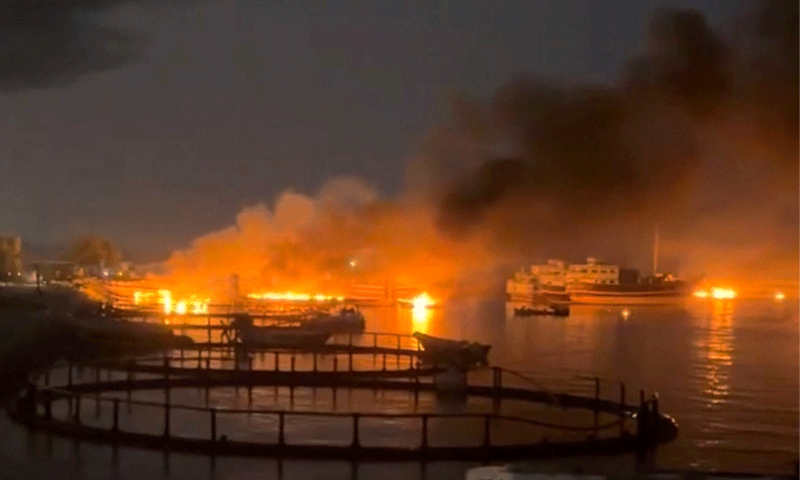
ANKARA: A fresh round of military escalations has pushed the Middle East to the brink of a broader conflict, threatening to completely unravel last month’s interim peace agreement between the United States and Iran. The strategic Strait of Hormuz has emerged as Tehran’s primary strategic asset, eclipsing its long-disputed nuclear programme as a tool of deterrence.
The US military launched a second wave of airstrikes against Iranian coastal targets on Wednesday, aiming to degrade Tehran’s capability to restrict commercial shipping through the waterway, which handles a fifth of global energy supplies.
The strikes triggered immediate retaliatory missile and drone attacks from Iran targeting Kuwait and Bahrain, both of which host critical US military bases.
The rapid escalation followed an incident earlier in the week where ships transiting the strait without Iranian authorisation were fired upon, effectively upending the diplomatic framework established in June.
Strategic shift in Tehran
The Iranian leadership has fundamentally recalibrated its geopolitical strategy. Historically, Tehran viewed the closure of the Strait of Hormuz as a dangerous weapon of last resort due to the threat of total international isolation.
However, following the February 28 joint US-Israeli attacks that killed Iran’s supreme leader and senior officials, Tehran enacted a blockade of the waterway.
The subsequent disruption to global energy markets forced Washington to the negotiating table, convincing Iranian policymakers that control over the strait is their most potent lever against Western pressure.
Diplomatic sources indicate there is absolute consensus across political factions in Tehran regarding the prioritisation of the waterway over the nuclear file. Iranian officials believe that conceding on the Hormuz issue would only invite intensified US demands regarding its conventional ballistic missile stockpile and nuclear enrichment activities.
Consequently, Tehran has refused to engage in scheduled nuclear negotiations until Washington formally recognises its authority to manage traffic through the strait.
Conflicting interpretations of the pact
The immediate catalyst for the renewed hostilities lies in the ambiguous terminology of the Memorandum of Understanding (MoU) signed on June 17 by US President Donald Trump and Iranian negotiators.
The interim deal temporarily restored commercial transit by stating that Iran “will make arrangements using its best efforts for the safe passage of commercial vessels with no charge for 60 days only.”
This clause has generated opposing interpretations. Tehran maintains the text acknowledges its sovereign right to manage and secure the maritime corridor. Conversely, Washington and its Gulf allies reject this stance, asserting the language merely bound Iran to facilitate unhindered passage without imposing unilateral restrictions or using force.
The diplomatic impasse has translated directly onto the battlefield, with both nations accusing the other of violating the core tenets of the short-lived truce.
Heavy bombardment of coastal hubs
The fresh American bombardment heavily targeted Iran’s southern coastline, stretching from the mouth of the strait to the Gulf of Oman. According to Iranian state media, strikes hit Bandar Abbas, the country’s premier port city and a major hub for the Islamic Revolutionary Guard Corps (IRGC) navy.
Further east, the coastal cities of Konarak and Chabahar suffered infrastructure damage, including a direct hit on a maritime traffic control tower and localised electricity grid failures.
Extending beyond the immediate coastline, US assets struck an airfield in the southeastern city of Iranshahr, resulting in the death of a firefighter, while standard infrastructure in northern Iran, including a key railway bridge near Aqqala, was also hit.
In response, Kuwaiti defence authorities confirmed their air defence systems were actively intercepting waves of incoming Iranian drones and missiles, whilst neighbouring Qatar briefly declared an elevated security alert across its territory.
CENTCOM confirms strikes
The United States military’s Central Command (CENTCOM) confirmed the operation shortly after the bombardments commenced, stating that the action was taken at the direction of the US commander-in-chief. In a statement released on X, CENTCOM announced that its forces had started conducting additional strikes against Iran to further degrade its ability to threaten freedom of navigation in the Strait of Hormuz.
The military command added that the United States is holding Iran accountable for recent unjustified aggression against commercial shipping and civilian crews freely navigating the vital international waterway.
Air defence engaged
Prior to the official confirmation from Washington, Iran’s semi-official Mehr news agency reported late on Wednesday night that domestic air defence systems had been deployed and were actively engaging what it described as “hostile targets” near the port city of Bandar Abbas.
According to Al Jazeera, both Mehr and Fars news agencies also reported the sounds of loud explosions in Bandar Abbas and Sirik along the southern Gulf coast, where anti-aircraft batteries had been activated. Additional reports from Mehr indicated that explosions were also heard further east near the coastal towns of Konarak and Chabahar as regional forces braced for further escalation.
The military action followed a sharp exchange of words between Washington and Tehran earlier in the day. Responding to threats of strikes by US President Donald Trump, Iran’s Deputy Foreign Minister Kazem Gharibabadi stated on X that Trump’s remarks were “not a sign of strength, but an admission of the failure of a policy that for years has been built on force, sanctions, and threats.”
He added that “with the criminal and murderous Trump, one must speak in his own language,” asserting that the US president “apparently understands the language of force better.”
Concurrently, Ali Akbar Velayati, an adviser to Iran’s Supreme Leader Mojtaba Khamenei, warned that the formal cancellation of the memorandum of understanding by Washington “pushes the region toward the flames.”
In a statement cited by the Mehr news agency, Velayati laid the responsibility for the escalation on the US leadership, adding that Iran had previously warned that the region was not a venue for political gambling and that acts of adventurism would receive an immediate response.
Future of diplomacy imperilled
The military exchange has cast a shadow over the prospects of converting the temporary memorandum into a permanent peace settlement. Speaking ahead of a NATO summit in Turkey, President Trump expressed skepticism about the future of the diplomatic track, stating he believed the interim ceasefire was effectively “over” and describing Iranian negotiators as “dishonourable.”
While Trump indicated he did not anticipate a protracted ground war, his administration has vowed that further disruptions to shipping will meet harsher military retribution.
Faced with renewed US pressure, Iranian officials have warned of asymmetric countermeasures if the strikes continue.
A spokesperson for the Iranian parliament’s National Security Commission stated that options under active consideration include a formal withdrawal from the nuclear Non-Proliferation Treaty (NPT), a rewrite of Iran’s defensive nuclear doctrine, and the potential closure of the Bab-el-Mandeb Strait at the mouth of the Red Sea, a move that would simultaneously choke off two of the world’s critical maritime trade arteries.