- WEB DESK
- October 6, 2026
US strikes Iranian targets as fragile diplomacy struggles to contain widening conflict
-

- Reuters
- May 26, 2026
Fresh US military strikes on Iranian targets in the country’s south are once again attempting to fracture the fragile state of ongoing diplomatic efforts aimed at ending the nearly three-month-long conflict that has destabilised the Middle East and disrupted global energy markets.
The latest attacks, announced by the US military on Monday, targeted missile launch sites and boats allegedly attempting to lay naval mines near the Strait of Hormuz. Washington described the operation as a defensive move intended to protect American troops and maintain security in the strategic waterway, even as negotiations with Tehran continued in Qatar.
The developments came amid renewed diplomatic activity involving Iranian officials, US intermediaries and regional powers seeking a framework agreement that could pave the way for a broader ceasefire and future negotiations on Iran’s nuclear programme.
US says strikes were defensive amid ceasefire talks
The US Central Command said the military action was conducted in self-defence, accusing Iranian forces of threatening American personnel stationed in the region. Navy Captain Tim Hawkins, a spokesperson for Central Command, said the United States remained committed to defending its troops while still exercising restraint during the ongoing ceasefire.
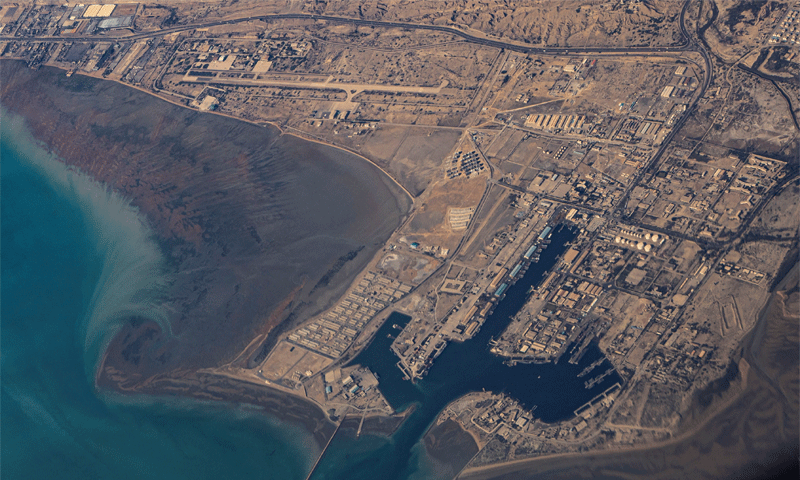
The strikes reportedly focused on southern Iranian areas near Bandar Abbas, a critical port city located along the Strait of Hormuz. The narrow waterway is among the world’s most important oil transit routes, carrying nearly one-fifth of global oil and liquefied natural gas shipments under normal conditions.
The military action unfolded just hours after Iran’s foreign minister and the country’s top negotiator held talks in Doha with Qatar’s prime minister regarding a possible agreement with Washington. According to officials familiar with the discussions, the negotiations centred on reopening the Strait of Hormuz, managing Iran’s stockpile of highly enriched uranium and securing the release of frozen Iranian funds abroad.
US Secretary of State Marco Rubio said Washington remained willing to pursue diplomacy before considering any alternative course of action. Speaking during a visit to India, Rubio said there was a “solid” proposal on the table that could reopen the strait and launch time-bound negotiations on Iran’s nuclear activities.
US President Donald Trump also signalled cautious optimism, saying discussions with Iran were progressing positively. However, he warned that further military action remained possible if diplomacy collapsed.
Shortly after Trump’s remarks, the US military confirmed the new strikes.
Nuclear dispute and Strait of Hormuz remain key obstacles
Despite the renewed diplomacy, Iranian officials sought to temper expectations about the possibility of a rapid breakthrough. Foreign ministry spokesperson Esmaeil Baghaei said substantial progress had been made on several issues but stressed that no final agreement was imminent.
According to Baghaei, discussions over Iran’s nuclear programme would only proceed after a broader framework accord was finalised. Tehran has repeatedly denied seeking nuclear weapons, despite Western concerns over its growing stockpile of uranium enriched to near weapons-grade levels.
At the start of the conflict, Iran was believed to possess roughly 440 kilograms of uranium enriched to 60 per cent purity, technically a short step away from the 90pc enrichment generally associated with nuclear weapons capability.
Reports in regional media suggested negotiators were exploring a phased plan under which the Strait of Hormuz would gradually reopen after a ceasefire agreement. Iran would reportedly begin clearing naval mines from the waterway during a transition period before normal commercial shipping resumed.
Baghaei said Iran did not intend to impose transit tolls on vessels using the strait but indicated charges could apply for navigation assistance and environmental protection services under a future agreement involving neighbouring Oman.
The disruption to maritime traffic has significantly reduced shipping through the strait. Before the war began, between 125 and 140 vessels crossed the route daily. Since the conflict erupted, only a few dozen ships have been travelling through the passage each day.
Iranian state television claimed 32 vessels and five oil tankers passed through the strait over the previous 24 hours with approval from the Revolutionary Guards’ naval forces.
Regional tensions deepen as Trump revives Abraham Accords push
The latest developments also highlighted the growing regional dimensions of the conflict, with tensions extending beyond Iran and the United States.
On Monday, Israeli Prime Minister Benjamin Netanyahu said Israel would intensify military operations against the Iran-backed Hezbollah group in Lebanon. Soon after, the Israeli military announced strikes targeting Hezbollah infrastructure in Lebanon’s Bekaa Valley and other areas.
Although Israel and Lebanon agreed to a ceasefire earlier this year, Israeli forces have continued carrying out attacks that they describe as preventative and defensive operations against Hezbollah positions.
Meanwhile, Trump used the diplomatic momentum around Iran to push for an expansion of the Abraham Accords, the US-brokered agreements aimed at normalising relations between Arab states and Israel. In a social media post, he called on Saudi Arabia and Qatar to join the accords and urged countries including Pakistan, Egypt, Jordan and Turkey to follow suit.
Analysts and regional observers, however, questioned the feasibility of linking the Iran negotiations to a broader regional realignment.
Ali Vaez of the International Crisis Group said Trump appeared to be presenting a potential Iran agreement as a continuation of the Abraham Accords strategy, though he cautioned against assuming that a fragile ceasefire could reshape the region’s political order.
Despite continued military exchanges and unresolved disputes, global markets responded positively to signs that negotiations were still alive. Oil prices fell more than four per cent on Monday amid optimism that diplomatic efforts could eventually reduce tensions and restore stability to global energy supplies.