‘Water is our red line’, Pakistan tells India
-

- Web Desk
- Now
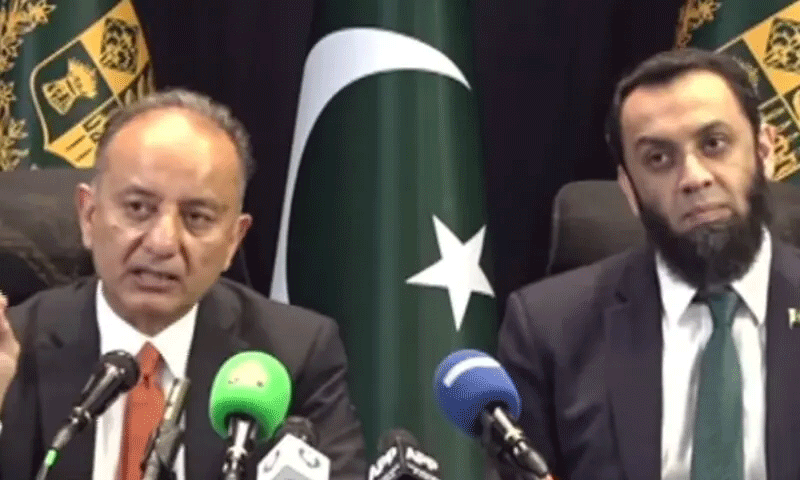
WEB DESK: Information Minister Attaullah Tarar on Monday asserted that the Indus Waters Treaty (IWT) between India and Pakistan could not be unilaterally revoked or altered, emphasising that the people of Pakistan had a rightful claim to the Indus waterways under the “legally enforceable treaty” that continues to remain in force.
Addressing a joint press conference with Climate Change Minister Musadik Malik in Islamabad, Tarar said the treaty provided a clear framework that had been implemented on the ground.
His remarks come amid heightened tensions over water sharing, following India’s unilateral decision last year to place the accord in abeyance after a brief military conflict in May 2025.
India has since maintained that it would ensure not a single drop of water flows into Pakistan, a stance Pakistan has described as an act of war.
Seminar to highlight Pakistan’s position
Tarar noted that Prime Minister Shehbaz Sharif and Chief of Army Staff Field Marshal Asim Munir had repeatedly described water as both Pakistan’s lifeline and red line.
He said Pakistan’s stance had received international support, with the country’s narrative gaining traction on global forums where India’s position had been rejected.
The minister announced that a seminar would be held in Islamabad on Tuesday to raise awareness about Pakistan’s rights under the IWT, with water and legal experts from around the world expected to participate. “This is a victory for Pakistan in the narrative domain,” he added.
Agriculture, food security at stake
Speaking after Tarar, Musadik Malik highlighted the broader implications of any disruption to water flows, pointing to both climate change and actions by India as factors. He stressed that 40-50pc of Pakistan’s population depended on agriculture for their livelihood, with the sector accounting for 20-25 per cent of the national economy.
“Someone else is trying to control the entirety of the country’s food security, 50pc of employment and 25pc of the economy,” Malik said, warning of severe consequences for any attempt to deprive Pakistan of its water share.
He questioned whether upper riparian states could arbitrarily stop water flows to lower riparians, noting that even in the absence of treaties elsewhere, water continued to flow under international conventions.
The ministers reiterated that Pakistan would pursue the matter on the basis of justice and rights at the upcoming seminar. They also expressed hope for political consensus on constructing dams to better regulate water flows.
A treaty under strain
The 1960 Indus Waters Treaty, brokered by the World Bank, allocates the eastern rivers (Ravi, Beas and Sutlej) to India and the western rivers (Indus, Jhelum and Chenab) largely to Pakistan. Despite surviving multiple wars and crises, the agreement has faced severe challenges since India’s 2025 announcement.
Pakistan has secured favourable rulings from the Permanent Court of Arbitration, including limits on India’s ability to hold the treaty in abeyance and restrictions on pondage at projects such as Ratle and Kishenganga.
Recent reports of Indian plans to divert water from the Chenab to the Beas have been strongly denounced by Islamabad as violations of the treaty and international law.