
- Web Desk Zahid Gishkori
- 5 Hours ago
When love for a greener planet transcends borders
-

- Web Desk
- Apr 07, 2024
By Shreya Pareek & Syed Sibte Hassan
KARACHI: A decade ago, Shahzad Qureshi, an entrepreneur from Karachi, Pakistan came across a TED talk titled “How to create a forest in your backyard?”. He was so fascinated by the idea that he spent the next few months reading more about it. During the same time, Karachi was undergoing a deadly heatwave taking several thousand lives.
Qureshi decided to get in touch with Shubhendu Sharma from Uttarakhand, India, the man who was creating these tiny forests. Qureshi sent Sharma a message, asking him for his help in creating these forests in Pakistan. Sharma runs a company, Afforestt in India that specialises in creating native, natural forests in small spaces.
One video call was enough to make 51-year-old Qureshi and 39-year-old Sharma come together for a common goal of making the planet greener. Qureshi acquired land and started the visa process for Sharma.
“When Sharma explained about the technicalities of creating these, I immediately knew that we had to bring him here to Pakistan. The public was aware of planting trees at that time and annually millions of trees were planted in Karachi, but a majority of these trees died annually. Which means there is some problem with the built-in care with them,” said Qureshi.

After a long visa process, he finally landed in Karachi on November 10, 2015, and that marked the beginning of a long ongoing friendship and partnership of planting forests across the globe, Qureshi said.
“I stayed at Qureshi’s house and got along with his father really well. His father was from Agra, India and my father had also spent some time in that city. We talked a lot about both countries and how similar things are,” Sharma said.
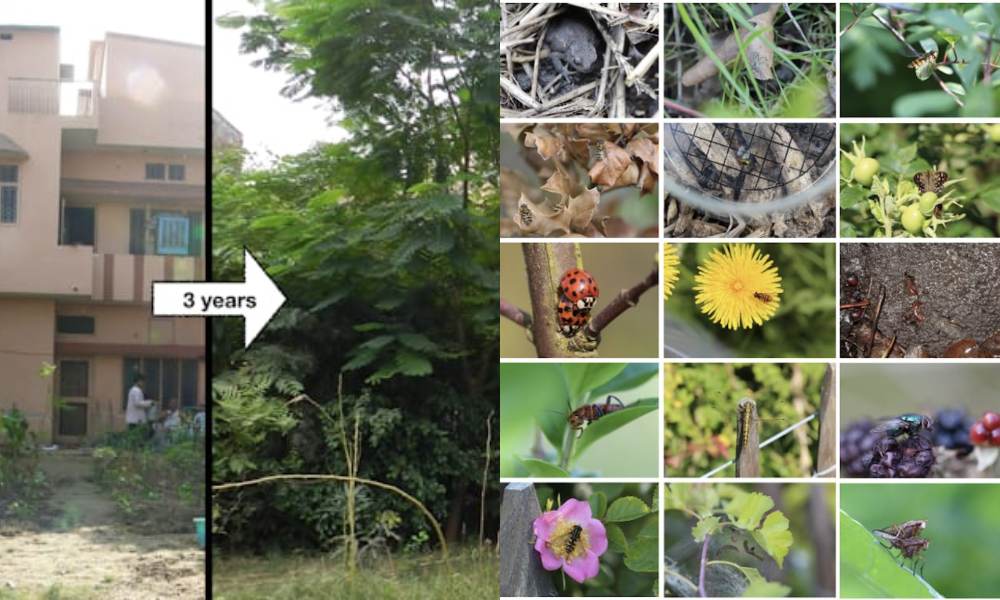
Sharma introduced Qureshi to the Miywawaki method of plantation, which focuses on creating small patches of forests in urban spaces. The method helps them create self-sustaining lush green forests in the heart of the city within two years.
The unique method
Sharma learned about creating forests from a Japanese scientist Akira Miyawaki in 2009. The method works on the concept of bringing back the potential natural vegetation of any specific region by planting only native trees in a way that they support each other to grow faster.
The method has several steps starting with a soil survey, finding the lost native vegetation, and providing the missing nutrients to the soil.

“We try to find out the native vegetation that would have existed in any geography before the human intervention. We do so by visiting the nearby natural forests of that area and reading old literature,” Sharma mentioned.
Once the plant species are identified, they are planted in close proximity. About 50 to 100 varieties of native species are planted at a density of 3-5/sq meter starts. Once these plants grow up, they form layers in four categories; main tree species, sub-species, shrubs, and ground-covering herbs.
After plantation the site is monitored, watered, and weeded for two years. This gives an initial boost to the forest to support itself. After that, the forest becomes self-sustaining and does not require any interference. “Once the forests become self-sustaining, no management is the best management,” said Sharma.
The method, which originated in Japan was modified by Sharma as per Indian geography and later for other countries and demographics as well. “After learning from Dr. Miyawaki and reading his literature, I wrote it as a standard operating procedure, so it could be replicated,” Sharma mentioned.
Coming together for a common cause
Since the method was proven to be successful in India, Qureshi was confident that it would work in Pakistan as well since both countries have similar geography.
“I really love to see Indian urban forest projects in their country and the solutions they are providing, so we can copy-paste these in Pakistan as we both have the same regions and areas,” Qureshi said.
The duo then travelled to different locations in Pakistan, looking for the material to plant their very first forest in Karachi. In 10 days, the first forest in Pakistan was ready. The first forest was planted in the 500 square meters of space in a public park.
“The idea behind creating a forest in the park was to gather people’s attention. We collected the funds from the public, initially, they didn’t understand the logic but eventually, they understood what we planned to achieve,” Qureshi said.
“We did not know if I would be able to get a Visa next time so we made the forest in a hurry. We also made a few mistakes, due to which the forest did not grow. I had to come back to India. We kept coordinating over the phone and video calls to track the progress of the forest. We implemented some changes and finally, the forest started showing some life after one year,” recalls Sharma.
It took him years to finish the design and plantation in the park. Qureshi claims that it is now a 100 percent self-sustaining park with around 40 thousand trees in it. The park also has a vegetable patch, sitting spaces, and interesting corners.
After this first successful attempt, Sharma visited Pakistan five more times to help Qureshi create forests there. Visa was still a major issue for both of them to regularly work together. Hence, they started looking for opportunities in other places.
Read more: Plantation drive along Rawalpindi Ring Road to start this week
Both of them also visited many countries with him to create these forests. Together, they attended the climate change conference in New York in 2023. They also organised workshops to train other people in this methodology.
After seeing this success, they created more forests in Lahore, Iran, and Nicaragua together. Their friendship grew organically and Qureshi opened a partner company, Urban Forest in Pakistan to create more forests independently.
They launched a successful Kickstarter campaign where the duo raised around 30,000 USD to create high-quality video tutorials on how to make a forest in multiple languages. Video tutorials in Hindi, English, and Punjabi have been released. They are now working on creating these videos in Spanish.
Love transcends borders
As they continued their work, their bond grew stronger. Gradually, they shared common interests, conversations, jokes, and much more.
Every time the duo would meet, they would bring souvenirs for each other. Sharma would actively look for the tag ‘Made in India’ on his gifts while Qureshi would bring gifts with the tag ‘Made in Pakistan’.
Qureshi recalls his first visit to India in 1997. “As soon as I landed, I saw so many similarities. People, their language, their food, their dialect, their style, their dress, and everything else was so similar. I didn’t feel I was in a different country. It felt like home,” Qureshi said.
Qureshi wants to visit India again. This time to learn water management techniques from India. However, getting a visa still is a big challenge.
“I think the governments of both countries should start trusting their citizens. We won’t become bad citizens by visiting each other,” Sharma said.
The current situation is, that to invite someone from Pakistan to India, the invitation needs to be attested by a gazetted officer. “I could not find a single officer who was ready to attest that. We need to eliminate the fear first,” said Sharma.
“We think we will face a problem in visiting other countries if we have a Pakistani visa on our passport. Similarly, people there think that they might face problems with their authorities if their passport has an Indian visa. We have to stop fearing so much,” said Sharma.
Qureshi thinks that people should actively start travelling cross-border. With more and more people showing interest in travelling, things might get a little flexible.
“If you are not able to visit physically then you can indulge in cross-border projects digitally. Some great things can happen with remote collaboration too,” Qureshi said.
You May Also Like