
- WEB DESK
- September 9, 2026
Which Pakistani cities are least prepared for climate disasters?
-

- WEB DESK
- September 9, 2026
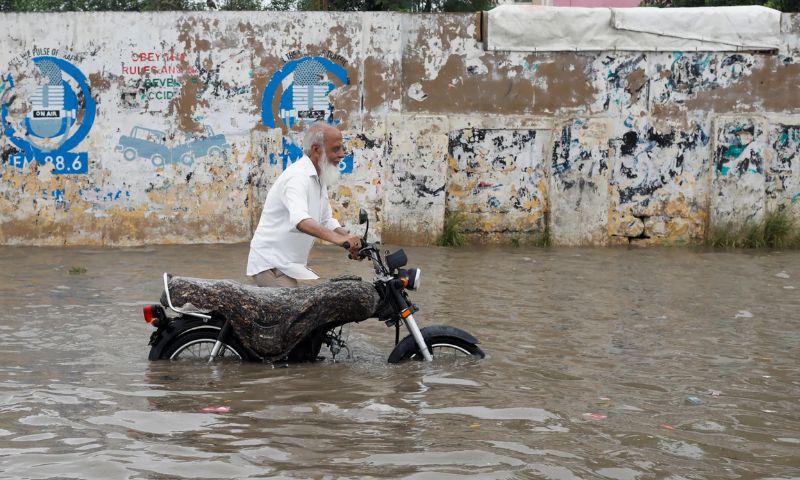
As climate threats intensify across the region, how prepared are Pakistan’s major cities to withstand and adapt to them? A global assessment of 72 major urban centres places Karachi, Faisalabad, Hyderabad, Multan and Lahore among the cities assessed for climate resilience, with Karachi ranking eighth among the world’s 10 least resilient major cities.
The findings from March earlier this year highlight the growing challenge facing Pakistan’s urban centres, where exposure to extreme heat, flooding and other climate hazards is compounded by varying levels of adaptation and resilience.
The assessment by AlphaGeo uses its Climate Risk & Resilience Index (CRRI) to measure both the physical exposure of cities to climate hazards and their ability to reduce the resulting risks through adaptation.
Among the Pakistani cities specifically cited in the assessment, Hyderabad recorded a resilience-adjusted risk (RAJ) score of 41, Multan 38 and Lahore 35. A higher RAJ score indicates lower resilience.
Karachi’s position as the eighth least resilient major city globally puts it among the 10 urban centres with the highest residual climate risk in the assessment.
What does the assessment measure?
The CRRI examines exposure to six major physical hazards, including inland and coastal flooding, heat stress, drought, wildfires and hurricane winds.
But the report does not treat physical exposure as the only measure of climate vulnerability. It also assesses cities’ adaptation capacity and calculates a resilience-adjusted risk score, or RAJ, representing the risk that remains after adaptation is taken into account.
The difference between a city’s physical risk and its RAJ score is described as the “adaptation delta”, effectively showing how much adaptation can reduce the risks associated with a city’s underlying climate exposure.
AlphaGeo said the findings demonstrate that geography is not destiny when it comes to climate risk. Cities with similar levels of physical exposure can end up with substantially different residual-risk scores because of differences in infrastructure, governance, investment and adaptation measures.
South Asia faces a difficult climate challenge
The report identifies South Asian cities as particularly vulnerable, with several recording high levels of residual climate risk.
Ahmedabad, Hyderabad, Multan, Dhaka, Kolkata and Lahore recorded RAJ scores ranging from 35 to 41, placing them among cities facing significant climate-related challenges. The findings suggest that high physical exposure in the region is being compounded by comparatively limited adaptation capacity.
For Pakistan, the results raise questions over whether major urban centres are keeping pace with the increasing frequency and intensity of climate-related threats, particularly as extreme heat and flooding place growing pressure on urban infrastructure.
The report also cautions that national or city-wide rankings do not tell the whole story. Climate risk can differ substantially within the same city, meaning residents in different neighbourhoods or even on different streets can face very different levels of exposure and resilience.
Which cities are adapting better?
Several Chinese megacities performed strongly in terms of adaptation efficiency. Beijing recorded an adaptation rate of 50%, while Tianjin and Shenzhen each recorded 49% and Shanghai 46%.
According to AlphaGeo, these cities demonstrate how effective adaptation can substantially reduce residual risk even where physical exposure is relatively high.
The contrast with South Asian cities highlights the role of investment, infrastructure and institutional capacity in determining how effectively cities can respond to climate threats.
Where do the most resilient cities stand?
The assessment also found relatively low resilience-adjusted risk among several cities in Europe, Africa and Latin America.
Chicago, Addis Ababa, Melbourne, Barcelona, Buenos Aires, Paris and Nairobi all recorded RAJ scores below 14, putting them among the better-performing cities in the assessment.
AlphaGeo said the strongest-performing cities benefit from a combination of relatively lower baseline physical exposure and greater adaptation capacity, supported by governance, wealth and policy measures.
For Pakistan’s major cities, the assessment therefore presents a broader question than simply how exposed they are to climate hazards: how much of that risk can be reduced through better planning, infrastructure and adaptation?
The report stresses that climate resilience is not fixed and that differences in policy and investment can significantly alter the level of risk ultimately faced by urban populations.
You May Also Like

- WEB DESK
- September 9, 2026
Eleven terrorists killed in security operations in Balochistan: ISPR

- WEB DESK | Saba Bajeer
- September 9, 2026