- Reuters
- October 6, 2026
WHO reports 906 suspected Ebola cases, 223 deaths in DRC
-

- Zafar Ali
- May 29, 2026
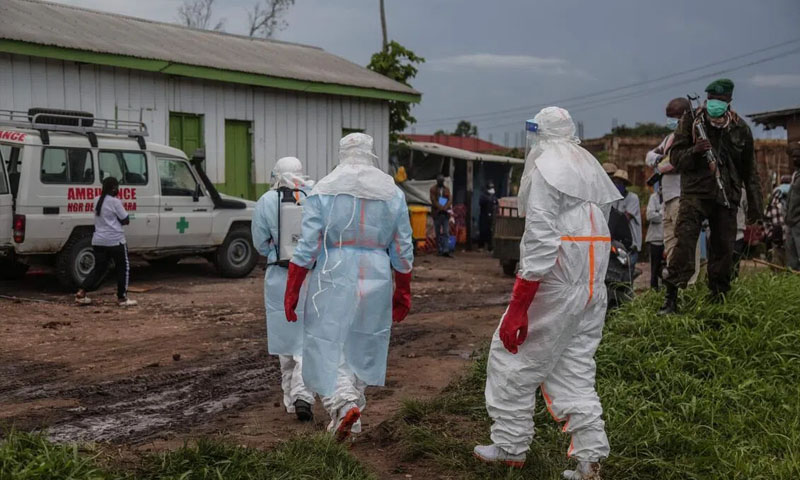
GENEVA: The World Health Organization (WHO) said on Friday that 906 suspected cases and 223 suspected deaths linked to the Bundibugyo strain of Ebola have been reported in the Democratic Republic of Congo (DRC), as the outbreak continues to spread and authorities expand surveillance and testing.
The WHO said 125 confirmed cases, including 17 confirmed deaths, have been recorded in the eastern provinces of Ituri, North Kivu and South Kivu. In neighbouring Uganda, seven confirmed cases have also been reported, including three imported from the DRC and one death, though no community transmission has been detected.
Health officials said the outbreak likely began around two months ago and was officially declared a public health emergency of international concern after spreading undetected across a densely populated region.
Experts have warned that the Bundibugyo strain — for which no approved vaccine exists — has a high fatality rate estimated between 30 per cent and 50 per cent.
“It’s huge. It means that up to five out of 10 people are likely to die,” said Anais Legand of the WHO Health Emergencies Programme, adding that the figures remain preliminary and require further investigation. She said early treatment could reduce fatalities.
WHO said testing capacity is being strengthened, with efforts underway to clear a backlog of suspected samples. Officials added that rising case numbers reflect improved surveillance rather than necessarily a worsening trend.
“As for whether the peak has passed, investigations are still ongoing. I don’t think we can say that at this stage,” Legand said.
Global health authorities are also fast-tracking potential vaccines, therapies and diagnostics, including experimental vaccine candidates and antibody-based treatments, while noting that most remain in early development and would require emergency authorisation before deployment.
Unlike the more common Zaire strain of Ebola, there are currently no approved vaccines or treatments for the Bundibugyo variant.
WHO has recommended prioritising several experimental options, including vaccine candidates based on rVSV and ChAdOx1 platforms, as well as antibody therapies such as MBP134 and antiviral drugs including obeldesivir and remdesivir, for evaluation in clinical trials.
Diagnostic companies, including BioFire Defense and Altona Diagnostics, are also expanding testing capacity to support outbreak response efforts in the DRC.
Health authorities said the situation remains under close monitoring as they race to contain the spread of the virus and develop effective medical countermeasures.
Vaccines still in early development
Among vaccine candidates under review is rVSVΔG/BDBV-GP, which uses the same platform as Merck’s approved Ervebo vaccine for the Zaire strain and has shown survival benefits in animal studies. Researchers at the University of Texas Medical Branch are involved in its development, with discussions ongoing but no final production decision, according to a spokesperson.
WHO has indicated that manufacturing could take six to nine months.
A second candidate, a single-dose rVSV Bundibugyo vaccine being developed by the International AIDS Vaccine Initiative, has been described by WHO as the most promising option for prevention. Its development could take seven to nine months before clinical trial readiness.
A third candidate, ChAdOx1 Bundibugyo, is being developed by Oxford University and the Serum Institute of India using the same platform as the Oxford/AstraZeneca COVID-19 vaccine. The Serum Institute said it began production under an emergency response framework in coordination with CEPI and Oxford after the outbreak was identified.
WHO said doses could be available within two to three months for early clinical evaluation, while additional animal studies are still required.
Experts said a single-dose regimen may be suitable for contacts of confirmed cases, while a two-dose approach could be used for high-risk groups such as healthcare workers and frontline responders.
Antibody and antiviral therapies under review
WHO has prioritised Mapp Biopharmaceutical’s MBP134, a pan-ebolavirus monoclonal antibody therapy, for clinical trials in confirmed Bundibugyo cases. The drug has previously shown safety in early trials and is supported by the U.S. Biomedical Advanced Research and Development Authority (BARDA).
Regeneron’s antibody candidate maftivimab is also under consideration. The company said laboratory studies show activity against Bundibugyo Ebola, and it is preparing existing supplies for potential clinical trials. Its approved antibody combination Inmazeb has also been donated in limited quantities for possible use.
Other investigational treatments include antibody therapies derived from Ebola survivors, such as BDBV289-N, which showed up to 100 per cent protection in animal studies even when administered days after infection.
In antiviral research, Gilead Sciences’ oral drug obeldesivir is being evaluated as a post-exposure treatment, with preclinical studies showing strong protection in animal models of Ebola infection.
Remdesivir has also demonstrated laboratory activity against Bundibugyo, with some studies suggesting stronger effects than against the Zaire strain.
WHO has additionally proposed evaluating combination therapies involving monoclonal antibodies and remdesivir.
Diagnostic gaps slowing response
Testing limitations have been identified as a key challenge in controlling the outbreak.
Diagnostic tools such as BioFire Defense’s FDA-cleared Global Fever Special Pathogens Panel and Germany’s Altona Diagnostics RealStar Filovirus RT-PCR kit are being used or scaled up to improve detection capacity in affected regions.
Both companies are increasing production and working with public health authorities to meet rising demand.
WHO officials say expanding diagnostic capacity is critical to tracking transmission chains and accelerating outbreak containment as the situation evolves.
You May Also Like