
- AFP
- November 19, 2026
‘Why bloodshed only in Sindh?’: MQM-P’s Siddiqui hits back at Bilawal over new provinces
-

- WEB DESK
- November 19, 2026
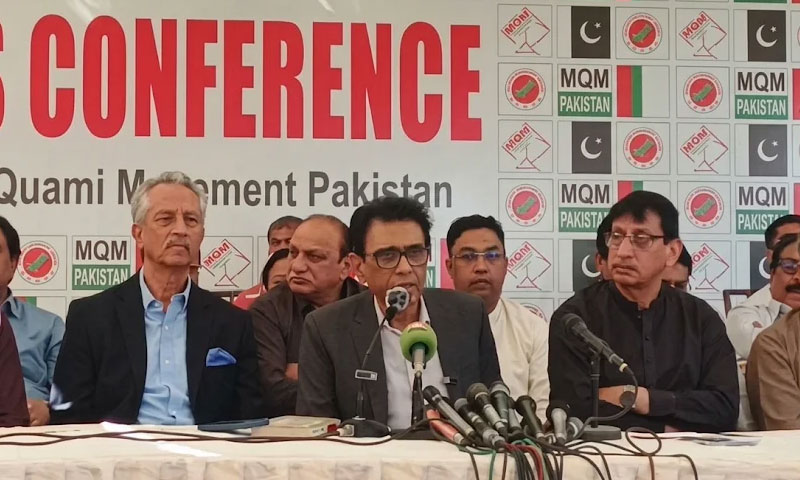
Muttahida Qaumi Movement-Pakistan (MQM-P) Chairman Khalid Maqbool Siddiqui on Thursday criticised Pakistan Peoples Party (PPP) Chairman Bilawal Bhutto Zardari over his Tuesday warning that forcibly creating new provinces in Sindh could lead to ‘bloodshed’, questioning why such violence would occur specifically in Karachi and other urban centres.
Addressing a press conference alongside the party’s lawmakers, Siddiqui said the demand for new provinces was being raised through democratic forums, parliament and public discussions, but was being met with threats instead of arguments.
The controversy comes amid renewed debate over the possible creation of new provinces and speculation surrounding a speculated 28th Constitutional Amendment. However, there has been no official confirmation that the government is preparing such an amendment.
The debate gained momentum after Interior Minister Mohsin Naqvi declared that the existing governance system had “collapsed”, calling for the creation of new provinces or administrative units to address the country’s challenges.
On November 12, Naqvi proposed holding a referendum to seek public opinion on the creation of new provinces, describing it as a way to settle the debate.
Both parties are allies in the Pakistan Muslim League-Nawaz (PML-N)-led coalition government at the Centre, but hold opposing views on the creation of new provinces or administrative units, particularly in Sindh. While the PPP has repeatedly opposed any division of the province, the MQM-P has advocated its administrative restructuring.
Bilawal’s warning over division of Sindh
Two days ago, Bilawal warned that forcibly dividing Sindh could trigger bloodshed across the province, saying he did not want to see people from the same communities turning against one another.
He made the statement while responding to a question during a ‘Meet the Press’ event at Karachi Press Club.
“If Sindh is divided by force, there will be blood on the streets of Karachi, not garbage,” Bilawal said, adding that those responsible would be questioned.
He warned that coercive measures could deepen divisions in society, turn political differences into enmity and drive ordinary people to take up arms.
The PPP chairman said the consequences would not remain confined to Karachi but could spread to Hyderabad, Mirpurkhas, Tando Allahyar and Nawabshah, where, he feared, people could end up killing members of their own communities.
“I do not want to see such bloodshed,” he said.
Bilawal maintained that the PPP was not opposed to the creation of new provinces through constitutional and legal procedures and in accordance with public aspirations, but would resist any attempt to divide Sindh through force.
He also said that creating new provinces would not resolve Pakistan’s governance crisis, arguing that the existing system had “collapsed” and its underlying problems needed to be addressed.
The PPP chairman called for restoring public trust in parliament, the election commission, judiciary and media, stressing that any reset of the governance system must come through a political process rather than non-political intervention.
MQM-P slams PPP chief
Responding to Bilawal’s remarks, Siddiqui asked: “Why will there be bloodshed in Karachi, Hyderabad and Mirpurkhas?” He said the warning was directed not at a political party but at an entire community.
The MQM-P chairman urged Bilawal to respond to the party’s arguments through dialogue rather than threats, saying his party had never demanded a separate Muhajir or Karachi province but advocated the creation of additional provinces across the country wherever population growth made them necessary.
Siddiqui argued that the demand concerning urban Sindh was for administrative units and should not be portrayed as an attempt to undermine the province’s identity or territorial integrity.
He also questioned the PPP’s differing positions on provincial restructuring in Sindh and Punjab, asking why the party supported a resolution for new provinces in the Punjab Assembly but opposed similar demands in Sindh.
“Why can new provinces be created in Punjab but not in Sindh? Is Sindh a sacred cow?” he asked.
The MQM-P chairman said the country’s administrative structure needed to evolve in response to population growth and governance challenges, adding that the Constitution, law and political dialogue should determine the way forward.
Questions over representation, census
Siddiqui claimed that more than 65% of Sindh’s population lived in urban areas and had already decided in favour of creating new provinces.
He alleged that official census figures had understated the population of urban Sindh, particularly Karachi, while delimitation and electoral arrangements had further reduced the area’s political representation.
He said Karachi accounted for 38% of Sindh’s population, while other urban centres, including Hyderabad, Sukkur and Mirpurkhas, represented a substantial share of the province’s population.
The MQM-P chairman alleged that the undercounting of urban populations and subsequent constituency delimitation had restricted their representation to around 25%.
He also questioned the administrative division of Karachi into districts, including Malir, Keamari, West and East, alleging that the arrangements were politically and linguistically motivated.
Siddiqui maintained that new provinces would be economically viable, arguing that Karachi and other urban centres had sufficient economic potential to sustain themselves. He added that urban areas would also be willing to share resources with other parts of the country if needed.
Criticism of PPP’s governance in Sindh
The MQM-P chairman also questioned the PPP’s performance during its years in power in Sindh, asking how federal funds allocated to the province had been spent.
Referring to government figures, he said poverty had increased in Sindh despite it being the country’s wealthiest province. He also criticised the province’s education indicators, alleging that it had a large number of schools but a low literacy rate.
He questioned why the PPP had not introduced the quota system in Punjab while defending similar arrangements in Sindh, and criticised what he described as hereditary and feudal politics.
Siddiqui also referred to ethnic unrest in Sindh during previous PPP governments, asking Bilawal to explain the circumstances surrounding the introduction of the language bill that had triggered tensions in the province.
He urged the PPP chairman to move beyond what he described as an ‘ethnic political outlook’ and assume the role of a national leader.
You May Also Like

- WEB DESK
- November 19, 2026
Pakistan projected to have most Muslims by 2070, research says
- WEB DESK
- November 19, 2026
22 militants killed in intelligence-based operations across KP

- Usman Khan
- November 19, 2026
