
- Reuters
- October 16, 2026
Kashmir is Pakistan’s ‘most beloved child,’ says DG ISPR on AJK unrest
-

- WEB DESK
- July 31, 2026
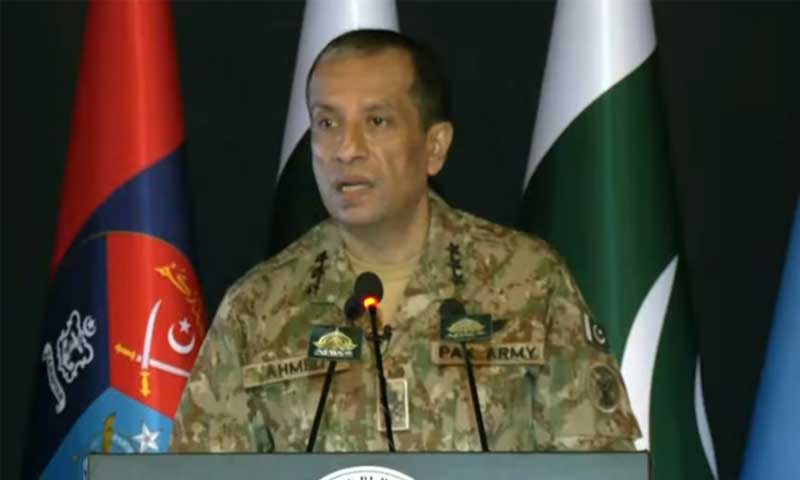
WEB DESK: Director General of Inter-Services Public Relations (ISPR) Lieutenant General Ahmed Sharif Chaudhry is holding a press conference today to brief media on the security situation and ongoing counterterrorism operations across the country. Speaking at length upon the security situation as well as development and progress in Balochistan, Lt General Chaudhry also spoke about the unrest in Azad Jammu and Kashmir.
Referring to Kashmir as Pakistan’s most beloved child he said it is not because the Constitution says so, but because Pakistan has consistently demonstrated its generosity and commitment toward it.
DG ISPR said stagnation was not the solution in Kashmir, adding that what to do and how to do it was a matter for politicians to decide. “Kashmir and Pakistan are inseparable,” he said. “There is only one voice: we are Pakistanis, and nothing can change that.” He said the path adopted by the people of Pakistan and Kashmir over decades rested on principles that were constitutionally and internationally proven, the principle of self-determination.
“Ask the Muslims of India today, ask the Kashmiris, ask the Sikhs, ask the minorities,” he said. “Ask them to gather the courage to tell you what these people really are.” He said that for the last 80 years, anyone who wanted to see the brutal face of Hindu Rashtra needed only look at occupied Kashmir, describing Pakistan as an ideological state and the most consequential state in the present world. “The decision of the Kashmiri people is settled, it is in their DNA,” he said.
The DG ISPR said India had tried three approaches in occupied Kashmir. First was appeasement: he said billions had been poured in, but questioned whether India had been able to buy the Kashmiri people, adding that Kashmiris had made clear they were not for sale. Second, India had turned occupied Kashmir into one of the most heavily garrisoned places in the world, with nearly a million security personnel deployed. “No one can travel from one village to another without an NOC,” he said. “Whenever they want, whichever child they want, they lift them from their homes.” Yet despite this, he said, India had not been able to extinguish the spirit of Pakistan that exists there. The DG ISPR said India routinely conspired to diminish Pakistan, pointing to episodes such as Pulwama and what he called the “Pahalgam drama,” adding that no such drama had ever worked against Pakistan. He said Pakistan’s position had been made clear in 2019 and was reaffirmed even more firmly by 2025.
He said India, unable to shake Pakistan’s resolve through force, had turned to a third track, running a parallel legal effort against Pakistan. “They played a game here over rights,” he said. “The state was aware even then of what was behind this. They exposed themselves.” He said the real agenda began with the idea that Kashmiris should not have representation, “not because the Azad Jammu and Kashmir Assembly said so, but because we said so; not because the constitution says so, but because we will write the constitution.”
He said the state had shown generosity even at that time, telling them to contest elections, win a majority, and then legislate accordingly. “But no, they said set the constitution and law aside, we will do it by force of the stick,” he said. “This time, the plot being laid is a little more subtle,” he said, adding that the monopoly on violence rests with the state alone.
Good governance essential for Pakistan
When asked about Interior Minister Mohsin Naqvi’s remarks regarding the ‘collapse’ of the system, Lt General Chaudhry said those comments were made by Naqvi in his personal capacity and that he would not comment on them, adding that the National Action Plan comprised 14 points and that steps needed to be taken to improve governance.
“Good governance is quintessential for Pakistan,” he said. “How to achieve that is for the government of Pakistan, but if you ask us, there needs to be a serious discussion, something needs to be done.”
He noted that when Pakistan’s population stood at 6 to 7 crore, there were four provinces, and today, with a population of 25 crore, the country still has the same four provinces. “We have to think about whether this is good governance,” he said, adding that all political parties wanted to see governance improve.
“That debate has to be done sensibly by the government. It has to be done by the will of the people, the will of Pakistanis is supreme,” he said. “If that good governance, that administrative reset, is needed, it has to be done through the constitutional method, through political representatives, but as per the will of the people.”
Definition of ‘hard state’
The DG ISPR had opened his briefing saying that he would particularly focus on the situation in Balochistan, noting that 7,177 intelligence-based operations had been conducted in Khyber Pakhtunkhwa and 31,080 in Balochistan. The DG ISPR: “Two thousand and eighty-four terrorists had been killed in operations so far this year, averaging around 10 killed per day. 819 security personnel and civilians had been martyred this year, at a rate of roughly four per day.”
He said a total of 3,145 terrorism-related incidents had occurred nationwide so far this year, with 1,971 incidents recorded in Khyber Pakhtunkhwa and 1,971 in Balochistan.
Of those, 303 were Pakistan Army soldiers and 394 were personnel of law enforcement agencies, while 322 civilians were martyred this year, he said. He added that 28 suicide bombings had taken place so far this year, and that, as in the previous year, the suicide bombers involved were Afghan nationals. He said Afghan nationals were involved in all such incidents, including those in Tank and Karachi.
The press conference comes as counterterrorism operations continue at pace across the country. According to the ISPR, 36 terrorists have been killed in operations in Balochistan and Khyber Pakhtunkhwa over the past 36 hours. On Wednesday, 10 police personnel were martyred and 22 others injured when terrorists attacked a checkpost in Hangu, Khyber Pakhtunkhwa.
Turning to the definition of ‘hard state’, Lieutenant General Sharif said that it refers to a state which follows its constitution and rule of law: “Contrary to what is believed, hard state does not mean a state where military is above everyone but a state where elitism does not exist.” He added that the Constitution clearly lays out certain fundamental responsibilities for all citizens, stating that among these is the duty to remain loyal to the state.
“We must remain loyal to the country and uphold the Constitution,” he said, adding that loyalty to the state was the basic duty of every citizen. He said citizens could demand their rights only after fulfilling their duties.
Referring to remarks made by the Field Marshal Asim Munir at a workshop in Balochistan a few days earlier, Lieutenant General Sharif said: “The Field Marshal said in clear words that we talk about movements for rights.” He said the Field Marshal had noted that while rights were frequently discussed, duties were not. “We should also launch a movement regarding every citizen’s duties,” he said.
He posed the question: “Is it not the duty of every citizen that our first and last identity should be Pakistani?” He said citizens should not prioritise their tribal or ethnic identity over this. “Our identity is that we are all Pakistanis,” he said.
The DG ISPR said it was necessary to understand the fundamental and central position of the state of Pakistan. “If there is a state, there is politics,” he said. “The state is life, the state is identity,” he added, describing these as basic duties and urging citizens to reflect on whether they were fulfilling them.
Sense of deprivation in Balochistan
“Going forward I will talk about two things from which all matters relating to duties and rights stem,” he said, adding that the discussion would address the root problem in Balochistan. He said the province’s fundamental issue was the tribal, or “sardari,” system, which he described as a segment of society that believed it had no duties, only rights.
“This tribe thinks that the status quo must be preserved at all costs,” he said, explaining that under this status quo, an ordinary or poor family’s child should not be educated or allowed to progress. “They want the poor man’s child to not become a doctor, to not join the army, to not become an engineer. They want the poor man’s child to remain my slave,” he said, adding that this mindset, of having rights without duties, was the core driver of terrorism in Balochistan.
He said the second issue was the appeasement-oriented approach of the sardari system, under which tribal leaders orchestrated terrorism and then raised alarm that Balochistan was slipping away, in order to be engaged and appeased in the manner they always had been.
Questioning the narrative of deprivation in Balochistan, the DG ISPR cited figures to argue that residents of Gwadar had access to substantial facilities. “There is infrastructure, hospitals, roads, recreational facilities, an international airport. Relative to the population, the facilities are more than adequate, show me another city in Pakistan with a population of 350,000 that has this,” he said, adding that the same held true for Turbat, where facilities were disproportionately high relative to the population.
“Show me a city in Punjab with this level of facilities, forget KP, forget any other province,” he said, adding that per capita income in Punjab was in fact ‘lower’ than in Balochistan.
He said the benefits accrued by Balochistan’s ‘tribal chiefs’ and ‘elite’ were tied to terrorism, which was why they prevented the province’s youth from progressing or pursuing education. “If they progress, who will fill the ranks of the sardars’ armies?” he asked.
The DG ISPR stated that RSS and Hibatullah and Party received a befitting response whenever they have spoken against the armed forces, adding that 2,084 militants had been killed in Balochistan. Calling the province one of Pakistan’s most challenging regions because of its vast deserts, mountainous terrain and geographical size, he said, “You cannot sit in an air-conditioned room and claim that the situation in Balochistan is ‘out of control’.” He praised Frontier Corps (FC) personnel and police for their operations against militants, saying “the sacrifices and efforts of our security personnel cannot be fully appreciated unless one sees the realities on the ground.”
Speaking about attacks on development projects, he said, “Terrorists opposed to development in Balochistan target soft targets such as trains and then flee.” He alleged that the same groups attacked roads, schools, colleges and other development schemes before claiming that no development was taking place in the province. “They attack development projects and then create a narrative of deprivation, claiming that Balochistan is being treated unfairly,” he said.
Terrorists target soft targets, development projects to build “deprivation narrative
DG ISPR pointed out that terrorists areopposed to development enter Balochistan, strike soft targets such as trains, and flee the scene. He said these groups deliberately targeted development projects and then claimed no development was taking place, that schools, colleges and roads were not being built, in order to construct a narrative of deprivation and portray the province as being treated like a stepchild.
Detailing attacks carried out by ‘Fitna al Hindustan’ and ‘Fitna al Khwarij’ on police stations in Balochistan, he said these operations followed a repeated pattern, with police and the Frontier Corps (FC) jointly foiling the attacks and killing the attackers involved.
“Why don’t we acknowledge the sacrifices of these police personnel? Why don’t we pay tribute to them?” he asked, saying this was because a video would later surface showing attackers arriving and retreating, which would then circulate widely on social media. He said terrorists in Balochistan honey-trapped and abducted young girls, then blackmailed them into carrying out attacks by threatening to defame their families.
The DG ISPR said the FC and Counter Terrorism Force had foiled an attack on the Kotla police station in Jhal Magsi on March 30, while police and the FC also thwarted attacks on police stations in Kalat and Khaliqabad the same day. “There is no difference between Fitna al Hindustan and Fitna al Khwarij,” he said.
He said a large number of terrorists had attacked the Dhadar police station on April 24, but police, the FC and the Anti-Terrorism Force (ATF) foiled the assault, killing the attackers involved; Constable Sooba Khan was martyred in the operation.
He said a large-scale attack on a police station in Khuzdar took place on June 8, which police and the FC jointly repelled, forcing the terrorists to retreat.
This is a developing story
You May Also Like

- WEB DESK
- October 16, 2026
Maryam Nawaz takes aim at Maulana Fazl over PTI support

- Reuters
- October 16, 2026
Tesla unveils flying car with rocket thrusters
- WEB DESK
- October 16, 2026