- Javed Soomro
- November 6, 2026
Bilawal offers way forward to end KP governor’s rule; urges govt to stop fighting PTI, Maulana
-

- WEB DESK
- November 6, 2026
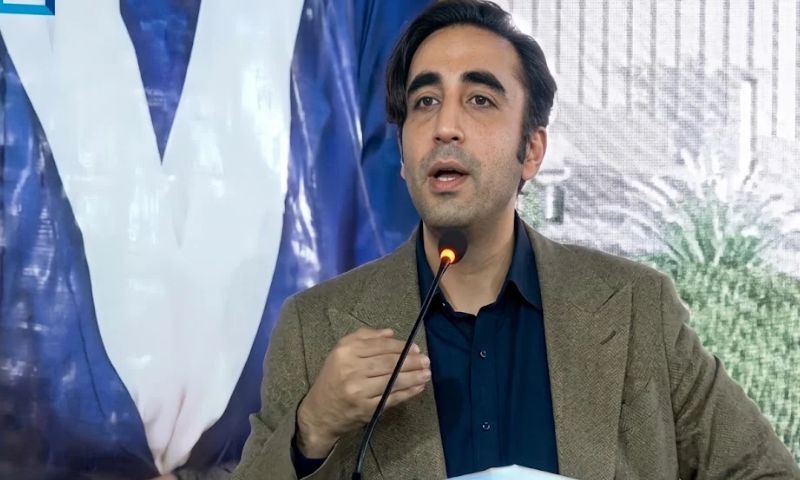
LARKANA: Pakistan People’s Party (PPP) Chairman Bilawal Bhutto Zardari on Friday said he would ask the federal government to end governor’s rule in Khyber Pakhtunkhwa if the Centre and the Pakistan Tehreek-e-Insaf (PTI) reached an agreement on tackling terrorism.
Urging the government and the PTI to keep the door to dialogue open, Bilawal said political differences should not stand in the way of addressing the country’s security and economic challenges.
“Let the government and PTI talk; they should not close the door to dialogue,” he said while speaking at a ceremony regarding the groundbreaking of a 600-bed hospital in Larkana and later talking to journalists.
He said he would ask the federal government to withdraw governor’s rule in the province if the two sides reached an agreement on counterterrorism.
He said that Prime Minister Shehbaz Sharif could not be held responsible for the imposition of governor’s rule in Khyber Pakhtunkhwa.
The PPP chairman also called on the federal government to end its political confrontations with the PTI and Jamiat Ulema-e-Islam-Fazl (JUI-F) chief Maulana Fazlur Rehman and focus on the economic difficulties facing the public.
“We are fighting PTI, we are fighting Maulana, and we are also fighting Afghanistan and India. If we keep fighting everyone, how will we deal with the economic challenges facing the people?” he asked.
Speaking as a former foreign minister, Bilawal said political differences should be set aside and the government should engage all stakeholders instead of allowing disputes to dominate the national agenda.
“Our focus should not be on differences. We should focus on what we can do for the people,” he said, stressing the need for a coordinated response to the country’s economic difficulties.
PPP, federal government agree to improve coordination
Bilawal described his recent meeting with Prime Minister Shehbaz as positive, saying the premier had invited a PPP delegation to Islamabad for dinner.
He said the two sides had agreed to improve coordination between the federal government, Khyber Pakhtunkhwa and the PPP and work together on a strategy to ease public hardships.
He thanked the prime minister for holding talks with PTI at the PPP’s request, adding that he did not want to undermine anyone’s electoral mandate.
Bilawal proposed that federal cabinet meetings also be held in the provinces to improve coordination with provincial governments.
He said a meeting would be held in Karachi to discuss federal-provincial cooperation, while another meeting with the prime minister was expected during Shehbaz’s visit to the city after the COP meeting.
The PPP chairman said his party had supported three to four federal budgets, but development projects undertaken by the federal government in Sindh had remained negligible for a long time. He cited the Thar coal project as an initiative being developed with federal support.
Bilawal urges opposition to join electoral reforms
Bilawal said the PPP had sent delegations to opposition leaders in the Senate and National Assembly to urge them to play a constructive role in electoral reforms.
He called on all political parties, including PTI, to join the parliamentary committee working on reforms ahead of the next general election.
The PPP chairman said electoral reforms had been part of PTI’s stated position from the outset and that the party should participate in the process if it wanted changes to the electoral system.
He said the opposition’s focus had largely remained on meetings with jailed PTI founder Imran Khan and securing his release. If Imran had authorised opposition leaders to represent the party, they should ensure PTI’s participation in the reform process, he added.
Bilawal warned that if the opposition stayed away from the committee, its complaints about election rigging would carry little weight.
He said the power to change governments rested with voters, not guns, and that national interests should take precedence over party interests. He added that the prime minister had accepted the PPP’s proposal for electoral reforms.
Iran-US tensions add to economic pressures
Commenting on the international situation, Bilawal said the Iran-US conflict had added to economic difficulties around the world, with people in different countries bearing the consequences.
He said the United States had witnessed public opposition to an attack on Iran, adding that Donald Trump had received votes during his presidential campaign on a promise to end wars.
Bilawal described the global economic situation as unprecedented in his experience and said Pakistan was already grappling with inflation, poverty and unemployment.
He said the economic pressures placed an additional responsibility on the government to address public hardship and ensure access to essential services, particularly healthcare.
Rs9.2bn hospital project in Larkana ahead of schedule
Earlier, Bilawal reviewed development projects in Larkana and Qambar Shahdadkot, including the construction of a new 600-bed hospital in Larkana.
He said the hospital project was running a month ahead of schedule and appreciated the efforts of the Sindh government and the team overseeing its construction.
The project was initially estimated to cost Rs9.2 billion, but its cost could rise because of inflation and higher construction expenses amid regional conflicts, he said.
Bilawal said the existing Chandka Medical College Hospital, established in 1970, was struggling to cope with the growing population and the influx of patients from surrounding areas, including parts of Balochistan.
Recalling his initial interactions with doctors and hospital staff after being elected as an MNA from Larkana, he said he had realised that the facility was facing capacity constraints despite the efforts of its workforce.
The hospital had originally been built to serve a much smaller population and could no longer meet the healthcare needs of Larkana and neighbouring areas, he said.
The new facility was intended to provide modern healthcare to residents of the city and the wider region. Bilawal expressed hope that it would be completed around June or July, as indicated by the project team.
He also said the Sindh government was working on an SIUT facility in Larkana to provide free treatment to residents of the city and surrounding areas.
Healthcare should not become inaccessible because of financial constraints, he said, adding that the provincial government had prioritised health facilities across Sindh so people would not have to rely on unaffordable private treatment.
Sindh increases support for public universities
Bilawal also referred to the inauguration of a university in Larkana, saying the Sindh government was working to expand access to higher education despite financial constraints.
He said the Higher Education Commission allocated around Rs65 billion in grants to higher education institutions across Pakistan, while the Sindh government provided approximately Rs45 billion to universities in the province.
The provincial government would continue supporting public-sector universities while working with them to improve revenue generation and financial sustainability, he said.
The objective was to make universities financially viable while ensuring that education remained affordable for ordinary citizens. Bilawal said the government also wanted educational institutions to become autonomous.
Water supply and sewerage schemes to be upgraded
Bilawal said the government was also addressing longstanding infrastructure problems in Larkana and Qambar Shahdadkot, particularly water supply, drainage and sewerage.
He said former prime minister Zulfikar Ali Bhutto had initiated water supply, sewerage and drainage projects in Larkana, but the existing infrastructure had been designed according to the city’s population requirements in the 1970s and could no longer meet present-day needs.
Many residents currently relied on their own tube wells because the city lacked a comprehensive government-run water supply system, he said.
The provincial government planned to extend water supply pipelines across the city to provide residents with access to clean water.
Bilawal said the sewerage network also needed expansion and modernisation, while the absence of a separate rainwater drainage system created problems during heavy rainfall and flooding.
The government intended to upgrade the sewerage system and develop a separate or improved drainage arrangement to cater to the city’s current population and future requirements over the next 25 years, he said.
In Qambar Shahdadkot, water supply and sewerage schemes were already under way and were expected to be completed within the next one to two years.
Bilawal said the Sindh government was undertaking the projects through its own resources and would continue efforts to address the region’s development needs.