
- WEB DESK
- October 6, 2026
274 climbers reach mount everest summit in one day from Nepal side
-

- Sadia Basharat
- May 21, 2026
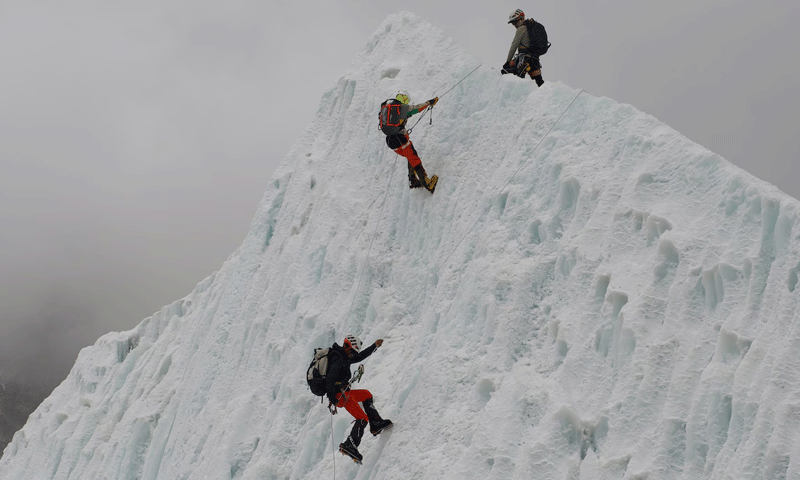
WEB DESK: A record-breaking 274 mountaineers successfully scaled Mount Everest on Wednesday, marking the highest number of climbers ever to reach the summit of the world’s tallest peak from the Nepalese side in a single day.
The 8,849-metre (29,032-foot) mountain, which straddles the border between Nepal and the Tibet region of China, saw an unprecedented flurry of activity on its southern ridges.
According to hiking officials, the surge was heavily concentrated on the Nepalese side this season, as Chinese authorities refrained from issuing any climbing permits for the Tibetan slopes.
Rishi Bhandari, the Secretary General of the Expedition Operators Association of Nepal, confirmed on Thursday that the previous single-day record for the Nepalese side stood at 223 ascents, achieved on 22 May 2019.
Whilst the global single-day record across both faces remains 354 set on 23 May 2019 Wednesday’s extraordinary feat sets a new benchmark for Nepal alone.
Bhandari reported that the official tally could rise further as several teams returning from the peak have yet to brief base camp.
Congestion and the Perils of the Death Zone
The remarkable surge in numbers has renewed intense international scrutiny over the safety of commercial mountaineering on Everest.
For years, seasoned mountaineers and safety experts have criticised the Nepalese government for its liberal distribution of permits, warning that massive queues can lead to catastrophic, fatal traffic jams in the notorious “death zone” the high-altitude region above 8,000 metres where natural oxygen levels are insufficient to sustain human life.
This year, Nepal issued 494 climbing permits, charging a substantial fee of $15,000 (£12,000) per climber. In response to mounting global concern over bottleneck casualties and inexperienced climbers, authorities in Kathmandu have recently pledged to introduce more stringent regulations and higher premium fees to control crowd density.
However, Department of Tourism official Himal Gautam emphasised that official confirmation of Wednesday’s final numbers will depend on thorough verification, requiring climbers to return to base camp, submit photographic evidence, and claim their ascent certificates.
Logistics, Oxygen, and the Alpine Contrast
Despite the harrowing imagery often associated with high-altitude overcrowding, some prominent expedition organisers argue that high summit numbers are entirely manageable under rigorous logistics. Lukas Furtenbach, head of the Austria-based Furtenbach Adventures, maintained that large crowds do not inherently jeopardise safety, provided that operations are impeccably synchronised and sufficiently provisioned.
With 40 of his own clients currently positioned at various high camps waiting for their summit window, Mr Furtenbach noted that his teams purposefully remained behind the primary bottleneck to circumvent the delays.
Drawing a striking contrast with European mountaineering, he remarked that the sheer scale of the peak absorbs the crowd comfortably if properly managed. “If teams carry enough oxygen it is not a big problem,” Mr Furtenbach stated from base camp.
“We have mountains in the Alps like the Zugspitze where we have 4,000 persons on top per day. So 274 is actually not a big number, considering this mountain is 10 times bigger.”