
- Reuters
- September 15, 2026
Air Chief signals shift in South Asian deterrence as Pakistan embraces multi-domain warfare
-

- Sadia Basharat
- May 9, 2026
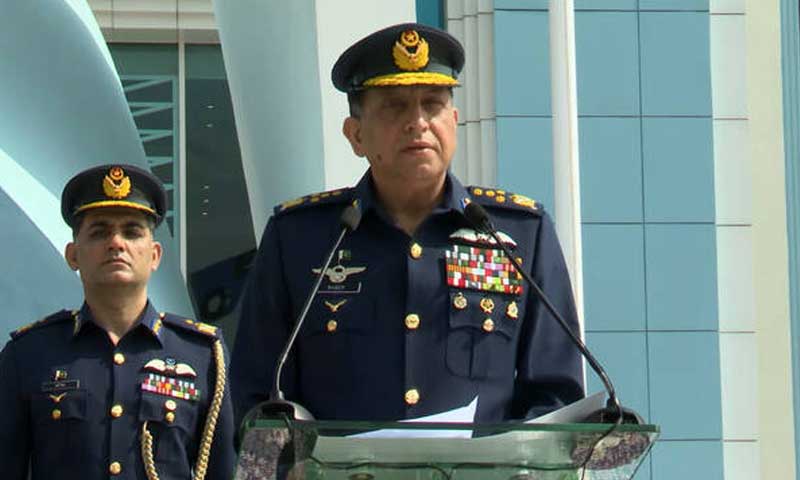
WEB DESK: A year after the May 2025 India-Pakistan crisis, Pakistan’s Air Chief Marshal Zaheer Ahmed Babar Sidhu has outlined a significant evolution in regional military strategy, moving beyond traditional air combat towards integrated operations across physical, digital, and cognitive domains.
In a recent address, the Air Chief emphasised that modern deterrence in South Asia can no longer rely solely on kinetic capabilities.
Instead, he called for a “single operational framework” that seamlessly combines cyber operations, electronic warfare, unmanned aerial systems, and long-range precision strikes.
The remarks reflect a broader transformation in how air power is conceptualised and employed in an era of rapid technological change.
Compression of decision timelines raises miscalculation risks
The Air Chief’s comments come amid growing recognition that emerging and disruptive technologies have fundamentally altered the pace of conflict. AI-enabled surveillance, drone swarms, and network-centric systems have compressed decision-making windows, creating new challenges in a nuclear-armed region.
Analysts warn that this acceleration risks amplifying uncertainty and misperception. With adversaries able to saturate digital and information spaces, the traditional “fog of war” is increasingly replaced by deliberate overload, narrowing the time available for diplomatic de-escalation and calibrated responses.
Need for strategic maturity alongside technological advance
Despite highlighting Pakistan’s technological advancements, Air Chief Marshal Sidhu stressed the continued importance of “calibrated restraint” and strategic maturity.
His address underscored that demonstrating capability must be balanced with responsible escalation control to preserve stability.
As South Asia navigates this new era of hybrid and multi-domain confrontation, observers note that long-term regional security may depend as much on clear communication and crisis management mechanisms as on the sophistication of algorithms and unmanned platforms.
The coming years are likely to test whether technological prowess can be matched by diplomatic wisdom.
You May Also Like

- WEB DESK
- September 15, 2026
Petrol price rises by Rs4.10, diesel by Rs6.41 per litre
- Reuters
- September 15, 2026
Samson, Reddy lead India to series-clinching win over Afghanistan
- WEB DESK
- September 15, 2026
