- WEB DESK
- October 23, 2026
CDF Munir vows to hit Indian-sponsored terrorist outfits ‘wherever they are’
-

- WEB DESK
- October 23, 2026
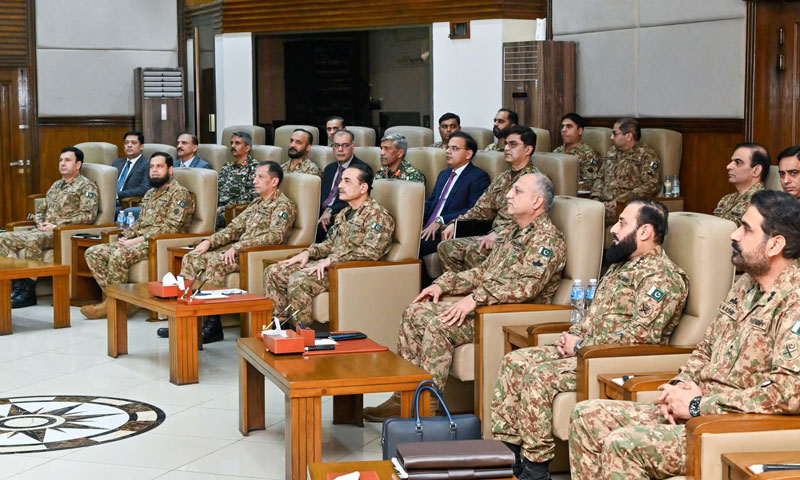
RAWALPINDI: Chief of Army Staff and Chief of Defence Forces Field Marshal Syed Asim Munir has vowed to continue the campaign against what the military described as Indian-sponsored terrorist outfits, saying Pakistan would hit them hard wherever they were.
“He underscored that we will continue the campaign against Indian sponsored terrorist outfits to the fullest and hit them hard wherever they are,” the Inter-Services Public Relations (ISPR) said in a statement on Friday.
The remarks came a day after Prime Minister Shehbaz Sharif chaired an apex committee meeting in Peshawar, attended by Munir, where the premier defended the imposition of emergency and governor’s rule in Khyber Pakhtunkhwa (KP) as a measure taken under “extreme compulsion” amid a resurgence of terrorism in the province.
Munir made the remarks during a visit to Corps Headquarters in Peshawar, where he received a briefing on the prevailing security situation, ongoing counter-terrorism operations, border management measures and the operational preparedness of formations deployed in the province.
Focus on security and operational readiness
During the visit, the army chief commended the high morale and professionalism of officers and troops, directing them to maintain vigilance and the highest standards of operational readiness to counter threats effectively, according to the ISPR.
At Thursday’s apex committee meeting, Shehbaz said the federal government could not remain a silent spectator as terrorism resurged in KP. He accused previous provincial governments of failing to strengthen the police and Counter-Terrorism Department despite receiving substantial resources.
The prime minister said the province had once again been left “wounded” by terrorism after years of sacrifices by civilians, law enforcement personnel and the armed forces had helped restore peace across the country.
He also accused previous provincial administrations of “criminal negligence” over the deteriorating security situation, alleging that militants had been allowed to return after terrorism had largely been brought under control by 2017-18.
Emergency and governor’s rule in KP
The province’s political and administrative arrangements changed on October 11, when President Asif Ali Zardari approved an emergency under Article 232 of the Constitution and governor’s rule under Article 234 following a federal cabinet recommendation.
The federal government cited the worsening security situation and what it described as inadequate cooperation from the PTI-led provincial government on counter-terrorism. Chief Minister Sohail Afridi, his cabinet and advisers ceased to hold office, while executive authority shifted to KP Governor Faisal Karim Kundi.
PTI has rejected the federal government’s justification and challenged the measures in court. Before their imposition, Afridi had argued that providing additional resources to the police alone would not resolve militancy without a change in counter-terrorism policy.
The federal government subsequently established an 11-member advisory council and a separate administrative structure for 12 terrorism-affected districts.
The National Assembly and Senate endorsed the measures on October 14, followed by approval of a resolution at a joint sitting of Parliament on October 15 by 214 votes to 56 amid opposition protests.
On October 17, the federal government appointed 48 members to a Regional Representative and Development Council covering the 12 designated districts, following jirga consultations.
The measures have also been challenged before the Peshawar High Court, which is hearing petitions against the federal intervention in the province.
Tribute to security forces
During his Peshawar visit, Munir paid tribute to the sacrifices of the people of Pakistan, including the martyrs and Ghazis of the security forces.
He expressed confidence that Pakistan, with the support of its people, would inflict a total defeat on terrorists and what he described as their “perverted ideology”, the ISPR said.
The army chief was received by the commander of Peshawar Corps upon his arrival at the headquarters.
You May Also Like