- Web Desk
- 13 Minutes ago
Corps commanders vow action against India-backed groups operating from Afghanistan
-

- Javed Soomro
- 14 Minutes ago
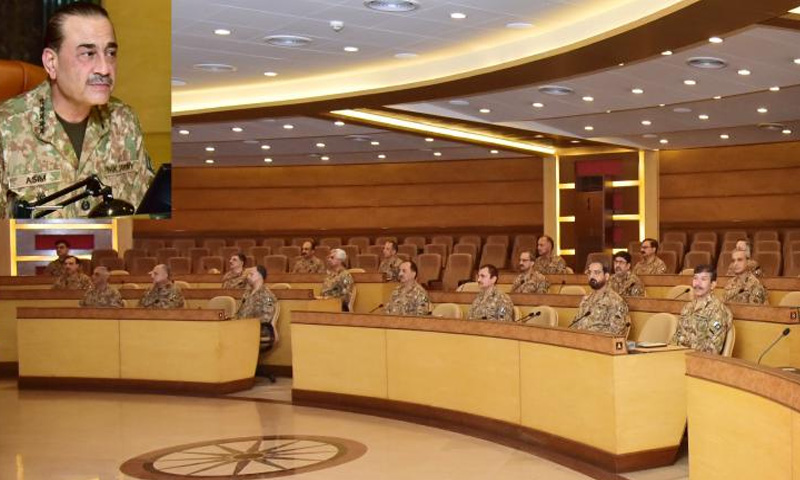
ISLAMABAD: The military’s top commanders on Monday reaffirmed their resolve to continue intelligence-based operations against militant groups operating from Afghan territory under Operation Ghazab lil-Haq, while expressing concern over what they described as the continued use of Afghan territory by India-backed terrorist organisations to launch attacks inside Pakistan.
The commitment came during the 276th Corps Commanders’ Conference chaired by Chief of Defence Forces Field Marshal Syed Asim Munir at the General Headquarters (GHQ), according to a statement issued by the Inter-Services Public Relations (ISPR).
The forum offered Fateha for members of the armed forces, law enforcement agencies and civilians who had lost their lives in acts of terrorism, saying their sacrifices remained the foundation of Pakistan’s security, unity and resilience.
The commanders reviewed the prevailing security situation and expressed satisfaction over the operational preparedness, professionalism and combat readiness of the armed forces.
According to the ISPR, the conference expressed “serious concerns” over the alleged use of territory under the control of the Afghan Taliban by India-sponsored militant groups, including ‘Fitna al-Khawarij’ and ‘Fitna al-Hindustan’, to carry out attacks inside Pakistan.
The forum maintained that lasting regional peace and stability depended on preventing Afghan territory from being used by militant proxies against Pakistan, adding that the Afghan Taliban administration bore responsibility for ensuring that such groups did not operate from areas under its control.
It reiterated that Pakistan had the right to defend its citizens against terrorism and said intelligence-based operations against militant groups operating from Afghan territory would continue under Operation Ghazab lil-Haq.
Beyond military operations, the forum stressed the need to strengthen governance in militancy-hit areas through improved public service delivery and welfare measures. It also called for dismantling what it described as the nexus between terrorist groups and criminal networks allegedly operating under political patronage.
The commanders observed that, following what the military described as Pakistan’s “comprehensive defeat” of hostile elements during Mark-e-Haq, there had been an increased reliance on externally supported hybrid warfare and disinformation campaigns aimed at creating instability in the country.
The forum condemned what it termed state-sponsored financing and facilitation of proxy groups and said attempts to destabilise Pakistan through hybrid means would be met with “strategic clarity and firm resolve”.
Reviewing regional developments, the commanders appreciated Pakistan’s role in promoting dialogue, de-escalation and regional stability, reaffirming the country’s commitment to the peaceful resolution of disputes, respect for international law and greater regional cooperation to address common security challenges.
The conference also discussed recent Indian statements on the Indus Waters Treaty, reaffirming the guidance issued by the National Security Committee on April 24, 2025.
The forum said Pakistan remained committed to taking all necessary measures to ensure the availability of its rightful share of water in accordance with government policy and the aspirations of the people.
The commanders also condemned what they described as ongoing human rights violations and demographic changes in India-held Kashmir, reiterating Pakistan’s diplomatic, political and moral support for the Kashmiri people’s right to self-determination in line with United Nations Security Council resolutions.
Field Marshal Munir directed commanders to accelerate implementation of the military’s multi-domain transformation plan in view of the evolving character of warfare.
He also called for maintaining the highest levels of vigilance, operational readiness and professional excellence, emphasising integrated responses to conventional, sub-conventional and hybrid threats while safeguarding Pakistan’s sovereignty and national interests.
You May Also Like