- Muhammad Zareef
- November 16, 2026
FCC allows PHC to hear Article 199 cases, clarifies curbs on governor’s rule
-

- WEB DESK
- November 16, 2026
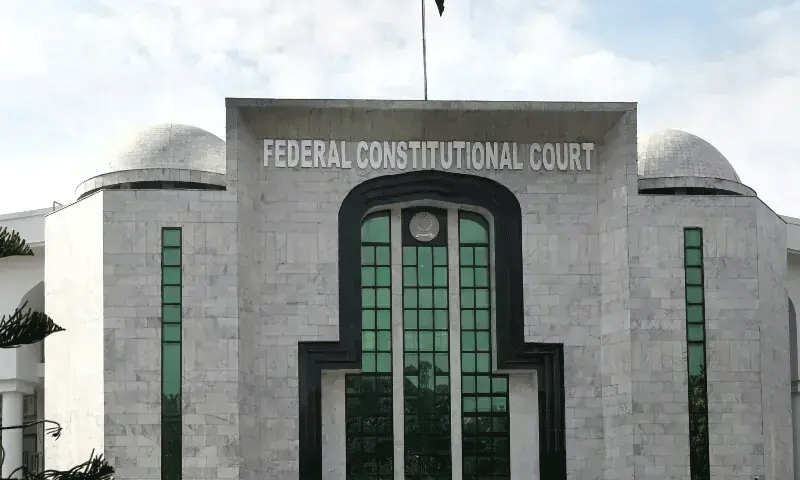
ISLAMABAD: The Federal Constitutional Court (FCC) on Monday modified its November 5 restraining order, allowing the Peshawar High Court (PHC) to hear constitutional petitions under Article 199, while clarifying that the earlier restrictions concerned matters relating to governor’s rule and detentions under the Maintenance of Public Order (MPO) Ordinance in Khyber Pakhtunkhwa (KP).
A two-member bench headed by Chief Justice Aminuddin Khan and comprising Justice Aamer Farooq issued the clarification during proceedings concerning the high court’s constitutional jurisdiction following the imposition of emergency and governor’s rule in KP.
The Article 199 of Pakistan’s Constitution empowers high courts to exercise constitutional jurisdiction, including reviewing actions taken by public authorities, enforcing fundamental rights and examining whether a person’s detention is lawful. It allows individuals to seek judicial relief against government decisions, making it particularly relevant to petitions challenging governor’s rule, emergency measures and detentions under the MPO.
During the hearing, Pakistan Tehreek-e-Insaf (PTI) Chairman Barrister Gohar Ali Khan told the court that its November 5 order had disrupted proceedings at the PHC, affecting constitutional petitions and lawyers’ professional practice.
The bench clarified that the restraining order was intended to apply to matters concerning governor’s rule and the MPO, and that the high court could continue hearing other petitions under Article 199.
The constitutional dispute followed the imposition of emergency and governor’s rule in KP on October 11, after President Asif Ali Zardari approved the federal government’s recommendations amid political tensions and concerns over the security situation.
Justice Aamer Farooq observed that a plain reading of Article 245, which concerns the deployment of armed forces in aid of civil power, could suggest restrictions on the high court’s constitutional jurisdiction.
However, he remarked that applying such an interpretation broadly would bring the judicial system to a standstill.
Barrister Gohar seeks relief for detained PTI workers
Barrister Gohar urged the court to provide relief to individuals detained under Section 3 of the MPO Ordinance, saying several PTI workers and leaders remained in custody without effective access to judicial remedies.
He told the bench that KP had yet to constitute a review board for preventive detention cases and requested that applications concerning detained individuals be decided expeditiously.
Gohar also raised concerns about people being held at Police Lines, urging the judges to consider measures that would allow detainees to seek relief.
The KP advocate general informed the court that a review board would be constituted after three months, adding that detention beyond that period could be referred to the board for consideration.
Chief Justice Aminuddin Khan noted that several miscellaneous applications had been filed at the court’s Peshawar registry and would be examined once they reached the bench.
He added that, apart from the bar council’s application, the remaining petitions had yet to be fixed for hearing.
The court also allowed the bar council to become a party to the proceedings.
Justice Aamer Farooq described the emergency-related litigation as an important constitutional matter and stressed the need for bar councils to participate in the proceedings.
The bench subsequently adjourned the case for an indefinite period.
Gohar says earlier order affected constitutional petitions
Following the hearing, Barrister Gohar said he had requested the FCC to allow the PHC to resume proceedings on petitions challenging emergency and governor’s rule, as well as those seeking the recovery of detained political leaders.
In a post on X, the PTI chairman said the November 5 order had affected petitions concerning the provincial chief minister, assembly speaker and other parliamentarians.
He maintained that the PHC should be allowed to determine whether petitions challenging the imposition of emergency and governor’s rule were maintainable and whether the court possessed jurisdiction to hear them.
Gohar further argued that denying individuals detained under the MPO access to bail and judicial hearings amounted to a violation of their fundamental rights.
His statement outlined the relief sought by PTI, while the FCC’s clarification concerned the scope of its earlier restraining order.
November 5 order had suspended PHC proceedings
The dispute stems from the FCC’s November 5 ruling restricting the PHC’s constitutional jurisdiction, issued during hearings on petitions filed by the KP government against high court orders concerning the detention and release of political workers.
The constitutional court had restrained proceedings on petitions filed under Article 199 on or after October 12, citing the deployment of armed forces in aid of civil power under Article 245 of the Constitution.
Following the ruling, the PHC’s administrative committee stopped scheduling affected constitutional petitions and directed that fresh applications be returned to petitioners.
The restrictions affected several politically significant cases, including petitions challenging emergency and governor’s rule and seeking the recovery of detained PTI leaders.
The ruling also prompted objections from lawyers, with bar associations questioning the implications for access to justice and the high court’s constitutional authority.
Emergency and governor’s rule in KP
The measures placed the provincial administration under federal control, with Governor Faisal Karim Kundi assuming executive authority and the PTI-led provincial government becoming non-functional.
The federal government subsequently authorised the deployment of army personnel under Article 245 to assist the civil administration in maintaining law and order.
PTI challenged the measures before the PHC, seeking the restoration of the elected provincial government.
Earlier on October 14, Barrister Gohar filed a petition questioning the constitutional validity of the emergency and governor’s rule.
The PHC later reserved its decision on petitions challenging the measures, before the FCC’s November 5 order interrupted proceedings.
Monday’s clarification permits the PHC to hear other Article 199 petitions, while the legal questions concerning emergency powers, governor’s rule and preventive detention remain unresolved.