- WEB DESK | Faizan Jalees
- November 28, 2026
From commitments to action: Makkah defence talks enter second day in Islamabad
-

- WEB DESK
- November 28, 2026
ISLAMABAD: Pakistan, Saudi Arabia and Turkiye are set to resume high-level defence and security talks in Islamabad on Saturday, following commitments to accelerate efforts to safeguard Saudi Arabia’s security amid continued Houthi attacks and advance the implementation of the Makkah Joint Defence Agreement (MJDA).
Ahead of the second day of talks, Saudi Defence Minister Prince Khalid bin Salman shared that he had met Pakistan’s Chief of Defence Forces (CDF) and Chief of Army Staff (COAS) Field Marshal Syed Asim Munir on the sidelines of the Strategic Political and Defence Committee (S-PDC) meeting.
The Saudi defence minister said on X that the two had discussed the alliance’s role in promoting security and stability and advancing their defence capabilities.
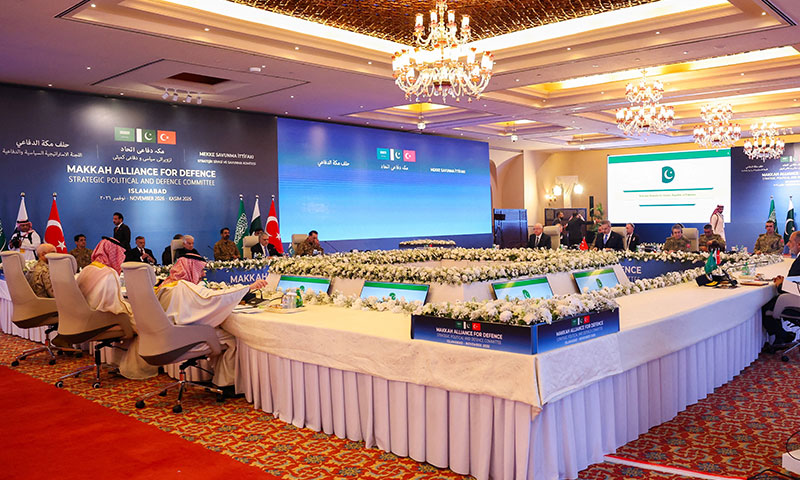
The meeting followed Friday’s discussions between foreign and defence ministers and senior military officials from the three countries, during which Pakistan and Turkiye reaffirmed their commitment to supporting Saudi Arabia’s security under the collective defence provisions of the Makkah pact.
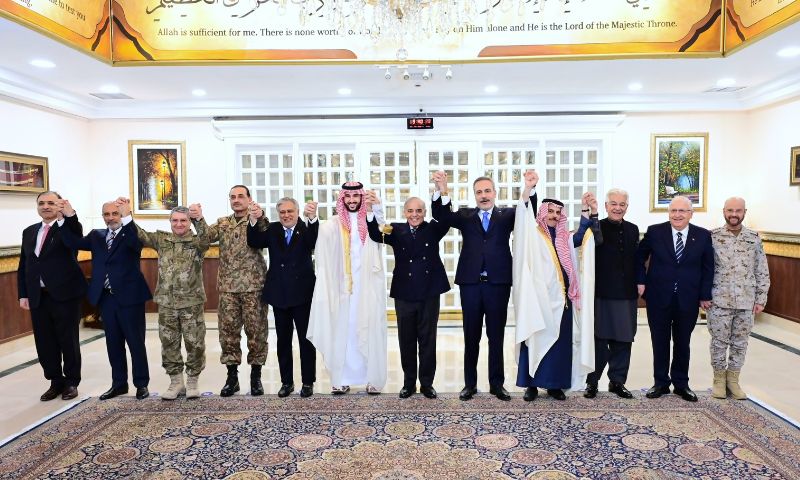
Prime Minister Shehbaz Sharif also received the Saudi and Turkish delegations at the Prime Minister’s House on Friday, where he reiterated Pakistan’s solidarity with the kingdom. The government subsequently released a group photograph of the premier with participants of the committee meeting.
What did the first day of talks achieve?
Friday’s meeting of the Strategic Political and Defence Committee focused on the evolving regional security situation, threats facing Saudi Arabia and progress towards establishing the institutional framework needed to implement the trilateral defence agreement.
Addressing a press briefing following the meeting, Deputy Prime Minister and Foreign Minister Ishaq Dar said the three countries had reviewed progress on decisions taken during previous meetings and expressed satisfaction over efforts to operationalise the alliance’s permanent secretariat in Saudi Arabia.
Pakistan, Saudi Arabia and Turkiye also agreed to maintain consultations on matters of mutual interest, support efforts to de-escalate regional tensions and encourage the peaceful resolution of disputes through dialogue and diplomacy.
However, the security situation facing Saudi Arabia remained central to the discussions.
In a joint statement, the three countries condemned the “persistent and heinous attacks” by the Houthi militia targeting civilians and civilian infrastructure in Saudi Arabia.
Pakistan and Turkiye reaffirmed their commitment to accelerating efforts to support the kingdom in safeguarding its security in accordance with the collective defence provisions of the MJDA.
The three countries also agreed to strengthen cooperation in defence industries, joint technological development, military training and capacity building.
Who is attending the Islamabad talks?
The two-day meeting in Islamabad brings together senior civilian and military officials from all three member countries.
Pakistan is represented by Deputy Prime Minister and Foreign Minister Ishaq Dar, Defence Minister Khawaja Asif and Field Marshal Asim Munir.
The Saudi delegation comprises Defence Minister Prince Khalid bin Salman, Foreign Minister Prince Faisal bin Farhan Al Saud and Chief of the General Staff General Fayyadh bin Hamed Al-Ruwaili.
Turkiye is represented by Foreign Minister Hakan Fidan, National Defence Minister Yasar Guler and Chief of the General Staff General Selcuk Bayraktaroglu.
During his meeting with the visiting delegations on Friday, Prime Minister Shehbaz reaffirmed Pakistan’s commitment to the sovereignty, territorial integrity and security of Saudi Arabia.
What is the Makkah Joint Defence Agreement?
Pakistan, Saudi Arabia and Turkiye signed the Makkah Joint Defence Agreement on August 7, 2026, against the backdrop of heightened regional tensions stemming from the US-Israeli war against Iran and attacks on Saudi territory.
At the heart of the agreement is a collective defence provision under which an armed attack against any one of the three countries would be considered an attack against all three, with assistance to be provided through available means, including military support.
Beyond mutual defence commitments, the agreement provides a framework for longer-term cooperation in military training, defence production, technological development and strengthening the collective capabilities of the three countries’ armed forces.
The Islamabad talks are part of a series of meetings aimed at determining how these commitments will be implemented in practice.
From Makkah to Istanbul, Riyadh and Islamabad
Since the signing of the agreement in August, the three countries have held successive meetings to develop the alliance’s institutional structure and establish arrangements for collective defence.
At the inaugural meeting of the Strategic Political and Defence Committee in Istanbul on August 31, the three countries agreed to establish a permanent secretariat in Saudi Arabia, headed by a secretary-general, with Pakistan initially providing the officeholder for a three-year term.
The security situation subsequently prompted an emergency meeting in Riyadh on October 5, where Pakistan and Turkiye agreed to ensure the rapid deployment of agreed military forces and capabilities in Saudi Arabia, subject to approved arrangements and the national laws of the participating countries.
The meeting also endorsed the nomination of Pakistan’s Lieutenant General (retd) Nauman Mahmood as the alliance’s first secretary-general.
Prime Minister Shehbaz subsequently met the newly appointed secretary-general, reiterating Pakistan’s commitment to Saudi Arabia’s security.
Pakistan’s military leadership has also sought to clarify the distinction between its existing military cooperation with Saudi Arabia and commitments arising from the trilateral pact.
Director General Inter-Services Public Relations (DG ISPR) Lieutenant General Ahmed Sharif Chaudhry had previously stated that Pakistani military personnel had been stationed in Saudi Arabia for decades.
The military spokesperson subsequently said the Makkah pact was moving towards its practical implementation phase following attacks on Saudi Arabia.
Turkiye completes ratification as Islamabad talks get underway
Another significant development came on Friday when Turkish President Recep Tayyip Erdogan formally approved the Makkah Joint Defence Agreement, completing Turkiye’s ratification of the trilateral pact.
The presidential approval, published in Turkiye’s Official Gazette, followed the Turkish parliament’s ratification of the agreement on November 5.
The ratification paves the way for Ankara to provide military support to Saudi Arabia under the agreement.
A Turkish ruling party lawmaker had told Reuters last month that the government would also submit a separate mandate to parliament seeking authorisation for the deployment of military personnel to the kingdom.
Turkiye’s completion of the ratification process comes as the three countries work towards establishing more concrete arrangements for implementing their collective defence commitments.
Why is Saudi Arabia’s security central to the talks?
Renewed attacks by Yemen’s Iran-backed Houthi movement against Saudi territory have emerged as an immediate security concern for the alliance.
The Houthis, who control the Yemeni capital Sanaa and large parts of northern Yemen, have carried out attacks targeting Saudi territory and infrastructure.
Ahead of the Islamabad meeting, Defence Minister Khawaja Asif identified instability along Saudi Arabia’s southern flank as a key item on the agenda.
“The continuous turmoil south of Saudi Arabia will obviously be one agenda point in the meeting and it is very important,” Asif told AFP on Thursday.
He also emphasised the collective defence commitments undertaken by the three countries.
“Any threat to Saudi Arabia is a threat to Pakistan and Turkiye according to the pact, which is absolutely clear,” he said.
Alongside discussions on collective defence, the alliance has pursued diplomatic engagement aimed at reducing regional tensions, including consultations with Iran.
What to watch on the second day of talks
With the first day of discussions reaffirming political commitments to collective defence, attention now turns to how the three countries intend to translate those commitments into practical arrangements.
Progress towards operationalising the alliance’s permanent secretariat, arrangements for military cooperation and coordination in responding to security threats facing Saudi Arabia remain central to the implementation process.
Asif had earlier described the alliance as being at a “nascent stage”, stressing the need for frequent meetings to establish its operational framework over the coming months.
“Initially we need to have frequent meetings to steer what is being formulated, in a way that in the next couple of months we have everything in place so that we can move forward,” he told AFP.
Saturday’s discussions will therefore be closely watched for further clarity on the alliance’s operational framework, military cooperation and its approach to the conflict involving Saudi Arabia and the Houthis.
While Friday’s joint statement reaffirmed the three countries’ commitment to accelerating efforts to protect Saudi Arabia, specific timelines for additional military deployments or new operational arrangements have yet to be publicly announced.