- WEB DESK
- October 6, 2026
G7 ministers discuss inflation, market volatility in Paris talks
-

- Zafar Ali
- May 18, 2026
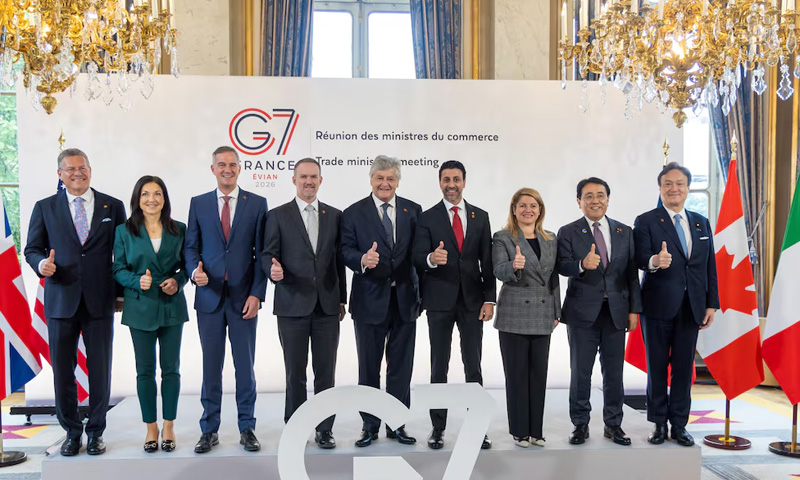
PARIS: Finance ministers and central bank chiefs of the Group of Seven (G7) countries met in Paris on Monday to discuss global economic imbalances, inflation risks, and rising volatility in bond markets following a recent selloff.
The meeting comes amid heightened concern over inflationary pressures linked to geopolitical tensions, including the ongoing conflict involving Iran, which has unsettled global markets and pushed bond yields higher across major economies.
French Finance Minister Roland Lescure, hosting the talks, said the situation in bond markets reflected a correction rather than a collapse.
“They’re undergoing a correction — I wouldn’t say they’re collapsing,” he told reporters on arrival.
He said the G7 forum provided an opportunity for frank dialogue at a time of growing global economic uncertainty.
Finance ministers are expected to focus on policy coordination in response to inflation shocks, market volatility, and supply chain pressures, with central bank representatives also in attendance.
European Central Bank President Christine Lagarde, speaking on arrival, acknowledged ongoing market concerns, saying: “I always worry, that’s my job.”
The meeting is also expected to address long-standing global economic imbalances, which France says are contributing to trade tensions and financial instability.
Lescure has previously argued that current global growth patterns — including high consumption in the United States, weaker domestic demand in China, and underinvestment in Europe — are increasingly unsustainable.
“These discussions are not easy. I’m not going to tell you that we agree on everything,” he said ahead of the meeting, pointing to differences with the United States on key economic issues.
The talks come shortly after a US-China summit in Beijing between President Donald Trump and President Xi Jinping, which produced limited progress on economic disputes despite easing diplomatic tensions.
G7 ministers are expected to seek an update on US-China relations as well as broader geopolitical developments, including sanctions policy and energy security concerns.
US Treasury Secretary Scott Bessent said his recent visit to China had been “very successful” and signalled support for stronger G7 coordination on sanctions targeting Iran.
Another key focus of the Paris meeting is critical minerals and rare earth supplies, where G7 members are seeking to reduce dependence on China, which dominates global supply chains for key technologies including electric vehicles, renewable energy systems, and defence equipment.
Lescure said the G7 would work towards stronger coordination to monitor supply risks, develop alternative sources, and encourage joint investment strategies among allied economies.
He added that the aim was to ensure that “no country can ever again have a monopoly” over critical materials.
The two-day meeting is also expected to explore policy tools such as price mechanisms, pooled procurement, and trade measures aimed at stabilising markets and boosting domestic production.