
- Javed Soomro
- October 17, 2026
Habib University lecture examines women’s place in Islamic spirituality
-

- WEB DESK
- October 17, 2026
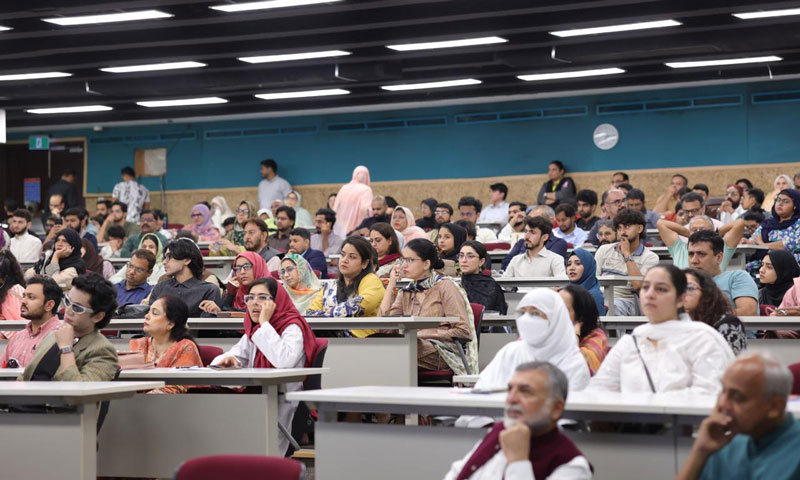
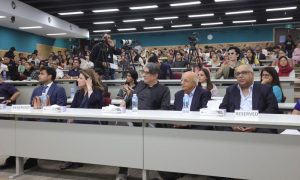
KARACHI: Habib University hosted its second biennial lecture on women and divinity on Friday, bringing together academic perspectives on Islamic theology, spirituality and the representation of women in religious traditions and popular culture.
Titled “Women & Divinity: From Religious Heritage to Popular Imagination”, the lecture was delivered by Dr Marcia Hermansen, the university’s inaugural appointee to the Lady Fatima Zahra Endowed Chair in Women and Divinity.
Established in 2024, the Chair was endowed by Abbas D. Habib and his family in memory of his late mother, Zainab Dawood Habib. The university describes it as the first academic chair of its kind in the world.
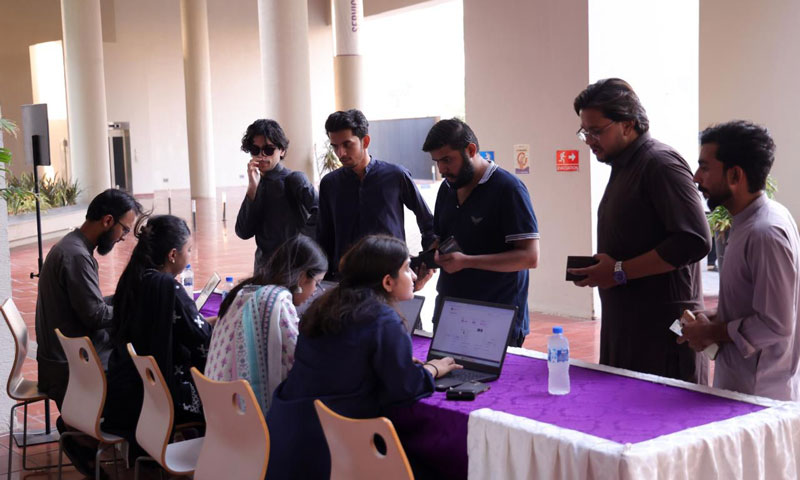
The permanent academic platform is housed within Habib University’s Comparative Humanities programme and aims to advance scholarship connecting religious traditions with contemporary questions of gender, theology, philosophy and society.
Examining women’s place in religious traditions
During the lecture, Hermansen explored women and divinity through traditional religious symbolism, contemporary academic discourse and popular imagination. She examined how these perspectives intersect with Islamic theology, philosophy and spirituality, highlighting how religious ideas are interpreted and understood across different intellectual and cultural contexts.
Hermansen said women had increasingly been marginalised in contemporary society, including in how spirituality and transcendence were understood.
“Society has become much more masculine. We are turning away from ecology into complete catastrophe, building more and more data centres,” she said.
She argued that women were often regarded as secondary to men or defined through their relationships with them, despite being honoured as women and sacred figures in religious traditions.
“Women are positioned as secondary, as derivative, or as defined through their relationships with men — honoured as women, even as sacred figures, yet never recognised as spiritual subjects in their own right,” she said.
Hermansen said the Chair sought to explore how studying women and divinity could hold spiritual and ethical significance for both men and women.
Advancing scholarship on women and divinity
Dr Sajjad Hyder Rizvi, appointee to the Imam Ali Ibn Abi Talib Faculty Chair in Wisdom and the Humanities, said Hermansen’s lecture addressed the importance of the humanities and the role of female perspectives in understanding religion and society.
Rizvi said the study of the humanities and religion faced challenges from what he described as the “quantitative neo-liberal calculus of the present”.
He also highlighted the growing marginalisation of feminine perspectives in theological inquiry, arguing that they were essential to understanding the world and making theological sense of it.
Hermansen is a scholar of Islamic thought, Sufism, Islam in South Asia and Muslims in America. She previously served as a professor of Islamic studies in the Theology Department at Loyola University Chicago, where she also directed the Islamic World Studies Programme.
Her academic work spans textual analysis, religious studies and theological inquiry, bringing historical religious traditions into dialogue with contemporary issues.
In his closing remarks, Abbas D. Habib said he and his family were honoured to have endowed the Chair at Habib University.
The second biennial lecture continued the university’s effort to bring academic research on women and divinity to a wider audience, including people from Karachi’s academic, civil society and media communities.
You May Also Like


- AFP
- October 17, 2026
England, Pakistan and Sri Lanka build up to World Cup with tri-series
- AFP
- October 17, 2026