
- Muhammad Arif Mehdi
- September 22, 2026
Houthis seek strategic high ground in Yemen as reports say Trump halted planned strikes
-

- Reuters
- September 22, 2026
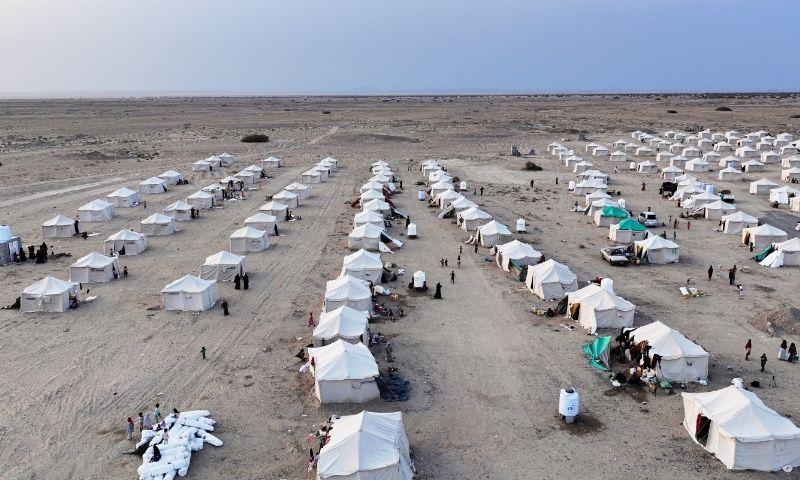
RIYADH/DUBAI: Houthi fighters moved to capture strategic mountain positions in Yemen on Monday, seeking to sever access between the Red Sea coastline and territories still controlled by forces backed by Saudi Arabia, as reports emerged that US President Donald Trump had cancelled planned strikes against the group at the last moment.
The reported Houthi advance comes as fighting intensifies across Yemen, opening another front in the wider Middle East conflict and raising further concerns over threats to regional energy supplies.
According to The New York Times, the Trump administration had prepared airstrikes against Houthi targets on Sunday following renewed appeals from Saudi Crown Prince Mohammed bin Salman. The report said Trump ultimately called off the operation while US personnel were preparing aircraft and loading bombs.
Reuters said it could not independently verify the report. The US Central Command referred questions to the White House, which had not immediately commented.
Yemen government seeks US support
Rashid al-Alimi, president of Yemen’s internationally recognised government, spoke with Trump by telephone on Sunday and requested US military assistance, according to four sources cited by Reuters.
Two sources, including a Yemeni and a Western official, said Trump did not make a direct commitment to provide military support during the conversation.
The Houthis, who are backed by Iran, have made rapid territorial gains in Yemen this month, expanding their control over strategically important areas. Their latest moves have brought the group closer to positions that could allow it to restrict access between the Red Sea and territories held by Saudi-backed forces.
Saudi strikes fail to halt advance
Saudi Arabia has carried out airstrikes against Houthi positions in an effort to slow the group’s advance, but the attacks have so far failed to push the fighters out of the mountainous areas they have occupied.
The developments have increased pressure on Riyadh as it seeks to contain the expansion of Houthi-controlled territory while the broader regional conflict continues to spread.
Britain and France have also offered assistance to Saudi Arabia amid the escalating situation, according to the Reuters report.
Houthis claim attack on Riyadh
The Houthis said they had launched an attack on Riyadh over the weekend, their first such claim against the Saudi capital since the latest escalation began.
The development has heightened concerns over the potential impact of the Yemen fighting on regional security and energy infrastructure, particularly given the country’s strategic position between the Red Sea and the Arabian Sea.
The latest fighting marks a significant expansion of the conflict in Yemen, with Houthi forces seeking to consolidate their positions in the highlands while Saudi Arabia and its allies work to prevent further territorial gains.
Riyadh was apparently struck on Saturday for the first time since the escalation began, with explosions heard and smoke visible near the airport. The Houthis said they had fired missiles at the Saudi capital; the Saudis have not commented.
British Prime Minister Andy Burnham said on Monday he had agreed to Saudi Arabia’s request to provide defensive air-to-air refuelling for a limited time, a move he described as helping to stabilise the wider region. Britain and Saudi Arabia have been close military allies for decades, with Britain serving as one of the kingdom’s largest arms suppliers.
A French diplomatic source said Paris was ready to contribute to securing Saudi Arabia’s energy infrastructure in Yanbu on the Red Sea coast and the East-West pipeline corridor.
Fighting in highlands
The Houthis, who have controlled Yemen’s capital since 2014, seized the country’s Red Sea coast this month in an advance that routed forces of the Saudi-backed government.
Saudi Arabia has launched hundreds of strikes in recent days on the fighters’ positions in the highlands, the Houthis say.
According to the United Nations, nearly 700 people have been killed and thousands injured in the fighting. Nearly 130,000 Yemenis have fled homes within Yemen, and more than 3,000 have fled by boat across the Red Sea to Africa.
Five Yemeni military sources told Reuters the Houthis were now seeking to seize strategic heights, known as the Kahboub Mountains, in two provinces, Taiz and Lahij, which separate the Red Sea coast from the government-held south.
Fighting has centred on the outskirts of the remote mountain Al-Wazi’iyah district in Taiz province, and Ras al-Ara along the Indian Ocean coast between the Bab el-Mandeb Strait at the Red Sea’s mouth and the government’s base in Aden, the sources said.
“The government forces appear to remain largely in a defensive posture following the loss of the Bab el-Mandeb area, while the Houthis are seeking to maintain the momentum of their advance, despite being exposed to intensive air strikes,” said Mohammed Al-Qadhi, a veteran Yemeni journalist now working as a political analyst.
“These mountains could become critical to determining whether the Houthis succeed in consolidating their recent territorial gains or whether government forces will be able to retain the positions necessary to mount a counteroffensive.”
Saudi oil exports
The surge in fighting between Saudi Arabia and the Houthis creates a dilemma for Trump, under pressure to help Saudi allies but anxious not to further expand the deeply unpopular war he launched alongside Israel as “Operation Epic Fury” in February against Iran.
The US bombed the Houthis for two months in early 2025, but Trump called off those strikes after reaching a ceasefire, and has kept out of the Yemen conflict since.
The Houthis’ Red Sea advance risks cutting off the main alternative route Saudi Arabia has used for oil exports that bypass disruption through the Strait of Hormuz.
Saudi Arabia has responded by increasing shipments through the Strait of Hormuz, where a small number of tankers are increasingly shuttling back and forth to bring out oil, charging record fees of as much as a quarter of the cargo’s value to brave the wartime risk. They then transfer the oil to other ships in the Indian Ocean, bound for customers in Asia or elsewhere.
Traders say Saudi Arabia has sold 60 million barrels of oil both this month and next, to be loaded from off Oman on the far side of Hormuz. Satellite data shows Saudi exports through Hormuz reaching 2.9 million barrels per day in recent days, up from just 700,000 in August.
That has helped put a cap on the global price of crude, which has retreated closer to $100 a barrel after approaching $110 last week. But consumers and industries are still paying record prices for some refined fuels, with the US retail price of diesel hitting another all-time high on Monday.
In the latest reported attack in Hormuz, Britain’s UKMTO maritime security agency said a ship sailing into the strait had been hit with a projectile, causing minor injuries to crew. It also said it had learned of an earlier strike on a gas tanker.
Diplomacy in the wider conflict has largely been stalled since a June interim ceasefire agreement between the US and Iran collapsed within weeks. Iran’s President Masoud Pezeshkian is due to fly on Tuesday to New York to attend the UN General Assembly.
You May Also Like

- WEB DESK
- September 22, 2026
PM Shehbaz lands in New York to attend 81st UN General Assembly

- WEB DESK
- September 21, 2026