
- Web
- 5 Hours ago
Imran Khan’s medical report reveals marked improvement in vision
-

- Web Desk
- Feb 16, 2026

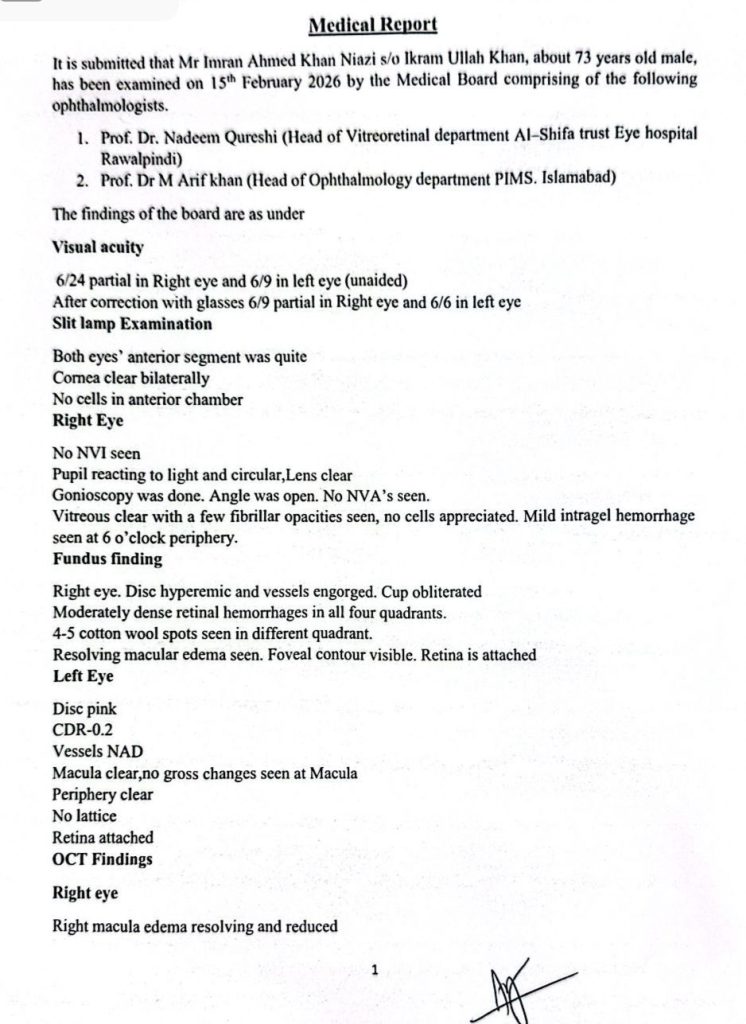
WEB DESK: A detailed medical report concerning the founder of Pakistan Tehreek-e-Insaf (PTI) and former prime minister Imran Khan has been made public, outlining the findings of a recent eye examination and subsequent consultations with political leaders and personal physicians.
According to the report, Barrister Gohar Khan and Allama Raja Nasir Abbas visited the Pakistan Institute of Medical Sciences (PIMS) in Islamabad, where doctors briefed them extensively on the PTI founder’s health condition. His personal physicians, Dr Asim Yousaf and Dr Khurram Mirza, were also given a 25-minute telephonic briefing, after which they reportedly expressed satisfaction over the medical care being provided.
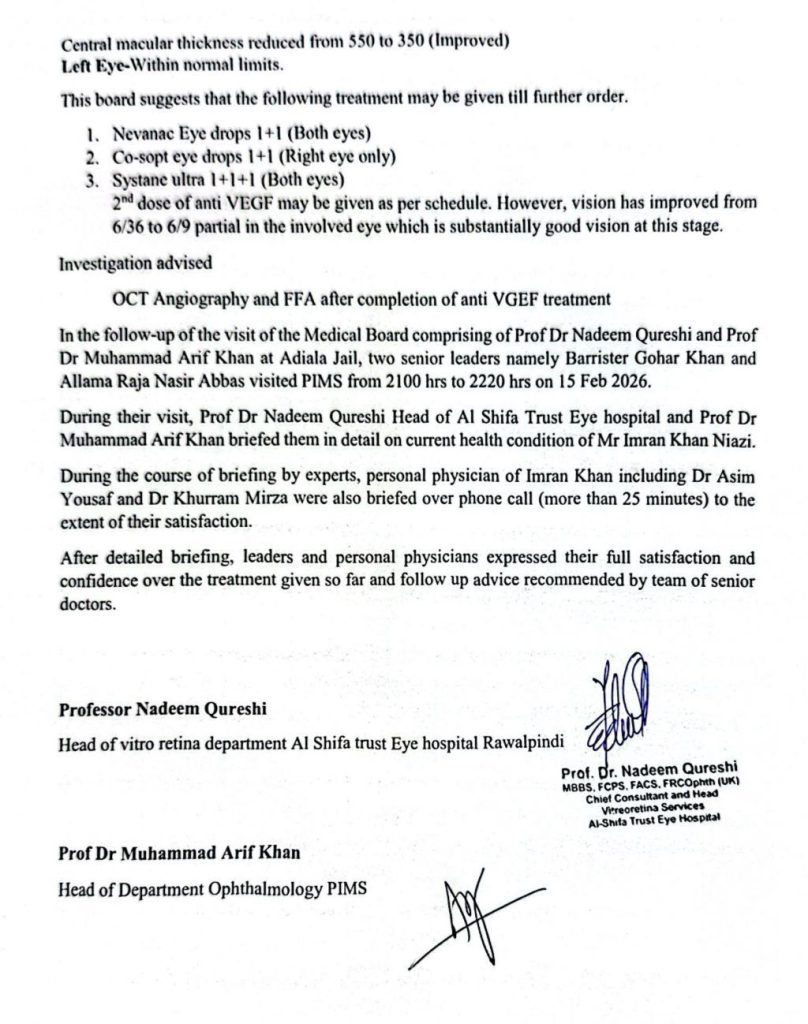
The report stated that both the political leaders and Khan’s personal doctors conveyed full confidence in the treatment administered so far, as well as in the recommendations made by a team of senior specialists.
Khan was examined on February 15, 2026, by a medical board comprising professors specialising in ophthalmology. The board included Professor Dr Nadeem Qureshi from Al-Shifa Trust Eye Hospital and Professor Dr Mohammad Arif Khan from PIMS Islamabad.
Medical findings revealed that vision in his right eye was recorded at 6/24 (partial) without glasses, while the left eye measured 6/9. With corrective lenses, vision in the right eye improved to 6/9 (partial), and the left eye to a full 6/6.
Doctors observed signs of impaired blood flow and inflammation in the retina of the right eye. However, swelling in the right eye had reduced significantly, with retinal thickness decreasing from 550 to 350, a development described as a positive sign of recovery.
The medical board prescribed Nevanac and Systane Ultra eye drops for both eyes, and Cosopt drops specifically for the right eye. The report noted that vision had improved from 6/36 to 6/9 (partial), terming it a considerable recovery at this stage.
Specialists further advised that, upon completion of anti-VEGF treatment, the patient should undergo OCT angiography and FFA tests for a more comprehensive assessment.
You May Also Like