- Web Desk
- 50 Minutes ago
Iran begins six-day funeral for former supreme leader Ayatollah Ali Khamenei
-

- DW
- 3 Hours ago
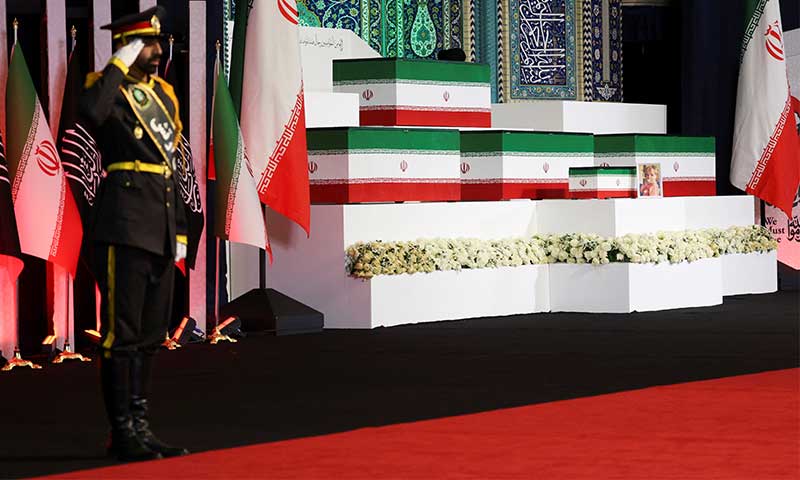
TEHRAN: The six-day state funeral for former Supreme Leader Ayatollah Ali Khamenei began today (Friday), with authorities describing it as the largest public gathering in the capital’s history and framing the ceremonies as a demonstration of national unity and the Islamic Republic’s resilience following the recent war with the United States and Israel.
Acting Tehran Mayor Alireza Zakani said the funeral would be “the largest assembly in the history of the capital,” according to Iranian media, as officials prepared for millions of mourners and foreign dignitaries to attend.
Khamenei, who served as Iran’s supreme leader for 37 years, was killed at the age of 86 in missile strikes on his residential and working compound in central Tehran on February 28, the opening day of the conflict between Iran and the US-Israel alliance. Several members of his family, including his daughter and two grandchildren, were also reportedly killed.
The funeral had originally been scheduled for early March but was postponed because of the war. Authorities announced the revised dates only after a fragile ceasefire between Tehran and Washington came into effect.
Ali-Akbar Purdjamschidian, head of the organising committee, said the ceremonies were intended to “strengthen national cohesion and unity” across Iran’s political, religious and social spectrum.
Nationwide mourning
Iranian authorities have launched a nationwide mobilisation effort ahead of the funeral in the country of around 93 million people. Three official days of mourning have been declared in Tehran, with businesses closed and work suspended as the capital prepares to receive visitors from across the country.
Khamenei is scheduled to be buried on July 9 in the northeastern city of Mashhad, his birthplace. A day earlier, a funeral procession is expected to pass through the Iraqi holy cities of Najaf and Karbala, a move widely viewed as a signal of Iran’s continuing regional influence.
Mixed legacy
Political analysts say Khamenei leaves behind a deeply contested legacy after nearly four decades at the helm of the Islamic Republic.
“Unlike Ayatollah Ruhollah Khomeini, who ruled for a decade after the 1979 revolution, Khamenei led the country for 37 years with pronounced micromanagement, intervening in almost all areas of governance,” said political scientist Mehrzad Boroujerdi of the Missouri University of Science and Technology.
During his tenure, Iran faced mounting international sanctions over its nuclear programme, worsening economic conditions and repeated waves of domestic unrest, including the 2009 Green Movement, the 2022 “Woman, Life, Freedom” protests and nationwide demonstrations in late 2025 and early 2026, all of which were suppressed by security forces.
“Khamenei’s approach was to make no concessions to his opponents, whether to regime critics or reformists within the system,” Boroujerdi said, adding that the strategy widened the divide between the state and society.
A women’s rights activist in Tehran, speaking anonymously, said many government critics remained disappointed that the Islamic Republic had survived, while its supporters had emerged from the recent conflict with renewed confidence.
The war also deepened economic hardship, with heavy bombardment damaging key industries, including petrochemical plants and steel mills, resulting in thousands of job losses and increasing frustration, particularly among younger Iranians.
Foreign policy expected to remain unchanged
Analysts say Iran’s regional strategy is likely to remain largely unchanged despite Khamenei’s death.
Hamidreza Azizi of the German Institute for International and Security Affairs said the prominence of Lebanon in Iran’s recent memorandum of negotiations with the United States reflected continuity in Tehran’s foreign policy.
“Hezbollah has drawn closer to Iran, particularly to the Quds Force, and is relying more heavily on Tehran both politically and militarily,” Azizi said.
He noted, however, that divisions persist within Iran’s leadership, particularly inside the Revolutionary Guards, over the prospect of further negotiations with Washington.
For many attending the funeral, Boroujerdi said, the event is about more than mourning.
“Two major military powers attacked Iran, and yet the Islamic Republic still stands,” he said. “For many, that is proof of resilience.” He added that even partial implementation of the recently agreed 14-point framework with the United States would mark a significant diplomatic achievement, particularly because it reportedly includes a US commitment not to interfere in Iran’s internal affairs, a demand Washington had previously rejected.
You May Also Like