- Reuters
- November 10, 2026
Lahore chokes under smog as AQI hits 561 in worst-affected area
-

- Usman Khan
- November 10, 2026
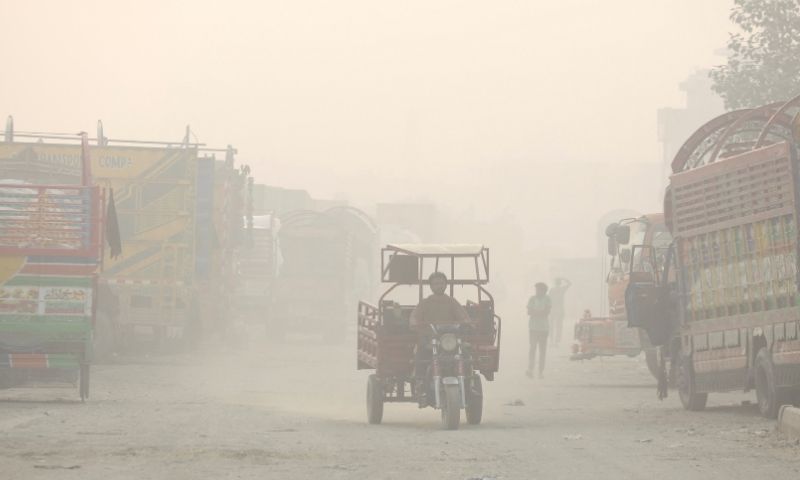
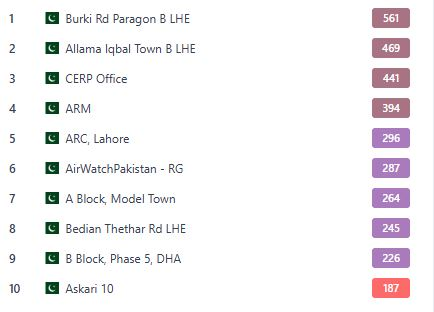
Lahore’s battle with toxic air continued on Tuesday, with pollution levels reaching alarming highs across the city as Barki Road recorded an Air Quality Index (AQI) of 561, while the city’s average stood at 308, according to a private international monitoring organisation.
Barki Road recorded the highest AQI at 561, followed by Allama Iqbal Town at 469 and Gulberg II at 441, according to the latest readings attributed to an international private air quality monitoring organisation.
The latest figures came a day after Lahore topped the global ranking of the world’s most polluted cities, with an AQI of 563 on IQAir’s real-time pollution index on Monday. The city’s average AQI was reported at 501 on the same day, while several localities recorded readings above 600.
On Monday, Barki Road was among the worst-affected areas, with an AQI of 916. The Center for Economic Research in Pakistan (CERP) area recorded 812, while Allama Iqbal Town registered 613 and Askari 10 recorded 555.
Tuesday’s readings show that pollution levels have eased compared with Monday’s reported figures, but air quality remains deeply unhealthy across several parts of Lahore.
Lahore’s worsening air quality
The latest pollution readings come amid a deterioration in air quality across Punjab as the winter season approaches, with Lahore repeatedly featuring among the world’s most polluted urban centres.
On October 28, Lahore ranked third on IQAir’s global list, recording an AQI of 231 between 10am and 11am. Cairo and New Delhi topped the ranking that day, both with readings of 247.
The October reading placed Lahore in the very unhealthy category, highlighting the persistence of the city’s air pollution problem even before the sharp deterioration recorded in November.
What is driving the smog?
Air pollution in Lahore is driven by a combination of vehicle emissions, industrial activity, construction dust, waste burning and seasonal crop-residue burning in the wider region.
Colder temperatures during winter can worsen the situation by limiting the movement of air and trapping pollutants closer to the ground, allowing smog to accumulate over urban areas.
Fine particulate matter, particularly PM2.5, poses significant health risks because of its ability to penetrate deep into the lungs and enter the bloodstream. Prolonged exposure can aggravate asthma and other respiratory illnesses and increase the risk of cardiovascular problems.
Children, older people and those with existing respiratory or heart conditions are particularly vulnerable to high pollution levels.
Authorities have previously stepped up anti-smog operations across Punjab, including the deployment of smog guns, water sprinkling on major roads and measures aimed at reducing dust and airborne particles.
Punjab Senior Provincial Minister Marriyum Aurangzeb has also urged residents to cooperate with anti-smog efforts, advising them to avoid unnecessary travel and limit the use of private vehicles.
However, the latest readings indicate that Lahore continues to face significant air quality challenges, with several neighbourhoods recording hazardous pollution levels.
You May Also Like