- WEB DESK
- October 26, 2026
Ministers say Punjab’s ‘deficit-free’ budget driven by strong revenue growth
-

- Zafar Ali
- June 17, 2026
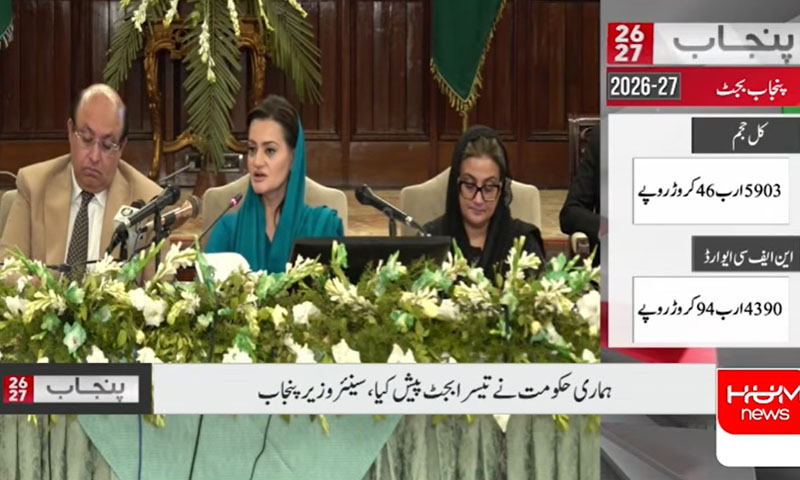
LAHORE: Provincial ministers said on Wednesday that the Punjab government has recorded a 35 per cent to 40 per cent surge in tax collection over the past two years, allowing the government to unveil a deficit-free annual budget without slapping new levies on consumers,.
Speaking at a post-budget press conference in Lahore, Punjab Finance Minister Mujtaba Shuja-ur-Rehman said the provincial government has set a consolidated tax revenue growth target of 47 per cent for the 2026-27 fiscal year by plugging system loopholes rather than expanding the tax net to new sectors.
The provincial cabinet on Tuesday cleared a Rs5.34 trillion “tax-free” budget for the upcoming financial year, relying heavily on federal divisible pool transfers and administrative restructuring to balance its books.
“We have streamlined the existing collection mechanisms instead of introducing fresh taxes,” Rehman said, noting that the provincial excise department had outpaced its annual collection target by 12 per cent.
He said that non-tax revenues from the mines and minerals sector are projected to pull in over 30 billion rupees.
To provide targeted economic relief, Rehman stated that the Board of Revenue’s tax collection targets were intentionally lowered to reduce the financial burden on citizens and local businesses.
Defending the macroeconomic trajectory, Punjab Senior Minister Marriyum Aurangzeb used the briefing to showcase federal and provincial performances over the past 30 months, contrasting it with the economic crisis inherited when Prime Minister Shehbaz Sharif first took power.
“When Shehbaz Sharif assumed office, the country was on the precipice of a sovereign default,” Aurangzeb said, crediting the current stabilisation to the federal economic team’s structural compliance with the International Monetary Fund (IMF).
“Today, economic stability is returning because of hard fiscal decisions.”
Aurangzeb highlighted aggressive right-sizing measures in Punjab, saying that the provincial government has abolished 870 duplicate or redundant ongoing development schemes and eliminated 100,000 vacant bureaucratic positions to lower public expenditures.
Despite a 3.2 per cent contraction in the overall budget volume compared to the previous year, Aurangzeb said that funding for essential social safety nets, healthcare, education, and the “Saaf Suthra Punjab” environmental initiative escaped the chopping block.
She said that the province’s annual development programme (ADP) is locked at Rs752 billion, with provincial tax revenue calculated at Rs519 billion, driven largely by a Rs370 billion target from the Punjab Revenue Authority (PRA).
Aurangzeb dismissed political criticism regarding the province’s federal grants, adding that Punjab continues to bear a substantial burden to keep the federation fiscally viable.
She noted that public welfare rollouts under the plan are actively moving forward, with 600 urban transit buses already delivered out of a targeted fleet of 2,000, and 160,000 interest-free micro-loans disbursed to citizens.
You May Also Like