
- WEB DESK
- October 25, 2026
MQM-P to initiate ‘grand national dialogue’ on creation of new provinces
-

- WEB DESK
- August 16, 2026
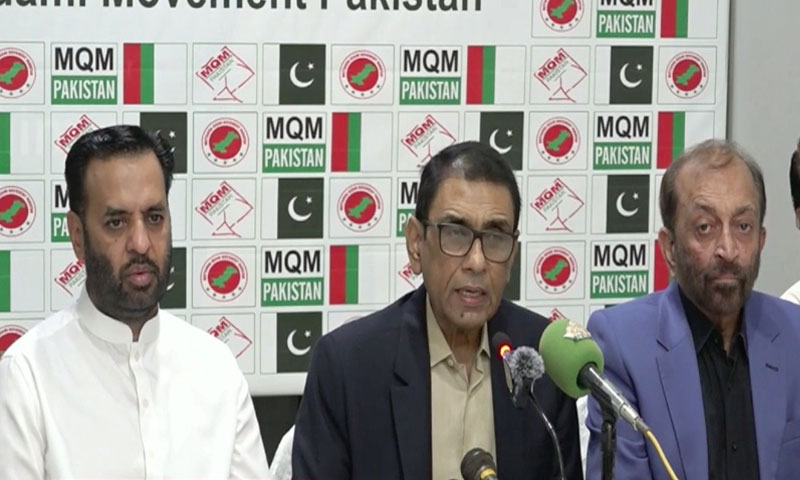
KARACHI: The Muttahida Qaumi Movement-Pakistan (MQM-P) on Sunday announced that it would initiate a “grand national dialogue” on the creation of new provinces, arguing that Pakistan’s rapidly growing population and governance challenges had made administrative restructuring a necessity.
Speaking at a press conference in Karachi alongside senior party leaders, MQM-P Chairman Dr Khalid Maqbool Siddiqui said that his party would approach political parties and other stakeholders to build consensus on the creation of additional provinces and administrative units across the country.
He said that the MQM-P was not demanding new provinces only for Karachi or Sindh, but believed that new administrative units should be created wherever they were needed on the basis of population and governance requirements.
“We need a grand national dialogue on this issue,” Siddiqui said, urging political parties to set aside their differences and discuss the matter in the wider national interest.
The MQM-P chairman argued that Pakistan’s existing provincial structure had not kept pace with demographic changes.
He said that the country had witnessed a rapid increase in population while the number of provinces had remained unchanged.
At the same time, the number of districts and other administrative units had increased substantially, he added.
Siddiqui maintained that the existing provinces were largely created on linguistic considerations rather than solely on administrative requirements.
“We have been saying for the past 40 years that Pakistan’s existing provinces were not created according to legal requirements and were formed on linguistic grounds,” he said.
He argued that the continued expansion of the population without corresponding changes to the administrative structure had created serious governance problems.
‘New provinces needed where population demands’
Siddiqui said that the MQM-P’s demand should not be viewed as an attempt to divide the country or target any particular ethnic or linguistic group.
“We are not saying this only for ourselves. Wherever there is a need for provinces, they should be created,” he said.
The MQM-P leader said the party had supported the 18th Amendment because it believed the benefits of democracy and devolution should reach all parts of the country.
He claimed that the constitutional framework already provided a mechanism for creating new provinces and questioned why raising the issue should be considered controversial.
“If creating provinces was treason, why is it mentioned in the Constitution?” Siddiqui asked.
He said that the MQM-P had previously introduced a bill seeking the creation of provinces and that the proposal was currently before a standing committee.
Siddiqui also said his party was prepared to approach the Supreme Court over what it described as the failure to implement constitutional provisions relating to the creation of new provinces.
“We are ready to talk to different political parties,” he said. “Wherever a voice is being raised for a province, including Karachi, we stand with them.”
He argued that provinces should be created in accordance with population size and administrative needs, adding that the need was greatest in Sindh.
The debate over new provinces has gained renewed momentum in recent weeks after Interior Minister Mohsin Naqvi called for the creation of additional administrative units and urged political parties to build consensus on the issue.
MQM-P leaders have backed the proposal, while former prime minister Shahid Khaqan Abbasi has also called for broader governance reforms, cautioning that the creation of provinces alone would not resolve the country’s structural problems.
‘Sindh needs administrative restructuring’
Addressing the press conference, Federal Health Minister Mustafa Kamal said that the MQM-P wanted a system in which people had greater control over their representatives and could replace governments that failed to address their problems.
“We need a system where our rights and problems are resolved,” Kamal said, arguing that people should have the authority to change their rulers.
He said that conditions in several parts of Sindh were even worse than in Karachi and Hyderabad, with generations of people having accepted poor governance and deprivation as their fate.
“We have raised our voice over this issue and this will give a voice to those people as well,” he said.
Kamal said Sindh had received around Rs22 trillion over the past 18 years but questioned why the province continued to face severe governance and development problems despite the allocation of such resources.
He stressed that the MQM-P was advocating administrative restructuring rather than seeking to divide Sindh or discriminate against its rural population.
“This is not a division; it is a discussion on district administration,” he said, adding that the creation of new administrative units would not be against the interests of Sindhis but would instead empower them.
According to Kamal, Karachi and Hyderabad account for around 43 per cent of Sindh’s population, and the creation of additional administrative units would give greater political and administrative representation to people across the province.
He also criticised the state of Karachi’s municipal infrastructure and governance, saying the country’s economic hub had been reduced to one of the most difficult cities in which to live.
Kamal further referred to recent remarks by Mohsin Naqvi and the chief of the military’s media wing on the need for additional administrative units.
“We did not start this discussion,” he said, referring to the statements made by Naqvi and Director General Inter-Services Public Relations Lt-Gen Ahmed Sharif.
According to Kamal, the MQM-P had repeatedly raised the issue but its proposals had previously been ignored.
He claimed that there was now a growing realisation among those responsible for running the country that administrative restructuring was necessary to improve governance.
“We are supporting the statements of Mohsin Naqvi and the DG ISPR on provinces,” Kamal said.
“If there is an administrative unit, even a farmer from the province can change the chief minister,” he added, arguing that smaller administrative units would make governments more accountable to ordinary citizens.
Constitutional route
Siddiqui also sought to counter criticism that the demand for new provinces could threaten national unity.
He said the MQM-P was committed to Pakistan and had no intention of abandoning the country.
“We will not go back to India because we came after achieving freedom,” he said, referring to the migration of Muslims to Pakistan at the time of Partition.
He also referred to the history of Sindh and the settlement of migrants following Partition, saying the MQM-P did not believe it had occupied anyone’s land.
Siddiqui said the party was willing to engage with Sindhi political and social groups and welcomed those who had supported its position.
The MQM-P has repeatedly cited Article 239 of the Constitution in support of its argument that new provinces can be created through a constitutional process. Earlier this year, the party criticised a Sindh Assembly resolution opposing the creation of a Karachi province, describing the move as unconstitutional and arguing that the Constitution itself provides a mechanism for altering provincial boundaries.
The party’s renewed push therefore comes amid a broader debate over whether Pakistan’s existing four-province structure is capable of effectively governing a population that has grown dramatically over the decades.
You May Also Like



- WEB DESK
- October 24, 2026