- Reuters
- October 26, 2026
NA witnesses heated budget debate over taxes, inflation and IMF reforms
-

- Zafar Ali
- June 15, 2026
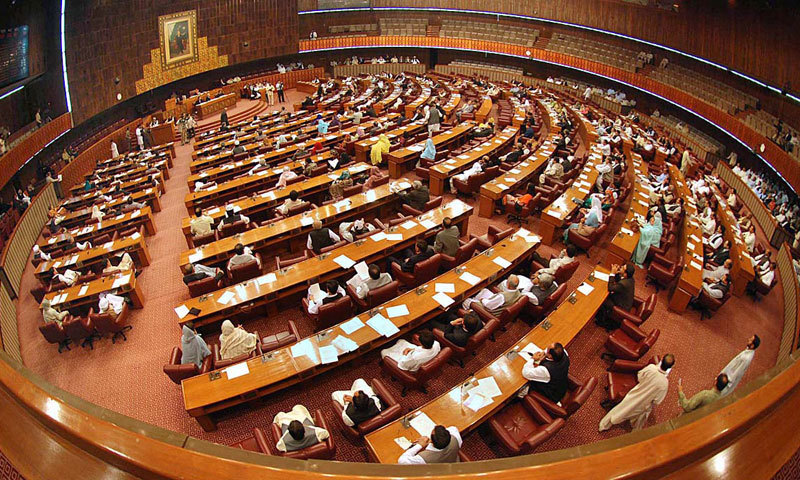
ISLAMABAD: Lawmakers locked horns in a fiery National Assembly debate over the federal budget on Monday, exposing deep political and economic fractures as government defended strict stabilisation measures while opposition and coalition partners slammed the fiscal plan as a punishing “IMF budget” that ignores the poor.
Defending the government’s financial trajectory, Pakistan Muslim League-Nawaz (PML-N) lawmaker Tahira Aurangzeb argued that economic recovery is impossible without national unity.
“Political stability is the only solution to our country’s problems,” Aurangzeb told the house.
“The last three years were completely lost to political chaos. Sit-ins and lockdowns have severely damaged our economy, and our enemies exploit this internal friction.”
Aurangzeb praised the military leadership for maintaining national defence against India, but emphasised that “without political harmony, rapid economic growth remains out of reach. The government had to make incredibly tough choices to avoid default.”
PML-N member Shumaila Rana backed the narrative by presenting positive economic indicators, asserting that Pakistan’s gross domestic product (GDP) had expanded from $335 billion to $452 billion, achieving a 3.5 per cent growth rate despite adverse global conditions.
She hailed the removal of federal excise duties and property taxes on solar panels as “people-friendly policies.”
Rana also launched a fierce attack on the opposition Pakistan Tehreek-e-Insaf (PTI.
“Those who tried to dupe the masses with talk of backyard poultry and small livestock initiatives can no longer sell their economic formulas here,” Rana said, referencing former prime minister Imran Khan’s past agricultural proposals.
She further accused PTI of promoting “political incivility,” targeting women on social media, and orchestrating the violent May 9, 2023 riots that targeted military installations, including the Corps Commander’s House in Lahore.
As opposition lawmakers shouted slogans in protest, Federal Minister for Law and Parliamentary Affairs Azam Nazeer Tarar attempted to assuage anger over rising costs by pointing out internal austerity drives.
“Under our official austerity campaign, the fuel allowance for federal ministers has been slashed by half — from 400 liters to 200 liters,” Tarar argued.
“Federal ministers are operating with minimal resources now. If someone wishes to debate a 200-liter cap, we are open to it.”
However, criticism did not just come from the formal opposition benches.
Highlighting the fragility of the ruling coalition, Pakistan People’s Party (PPP) lawmaker Shahida Rehmani delivered a scathing critique of the budget’s structural flaws.
“Collecting Rs117 per liter in petroleum levy is not a success story for this government,” Rehmani said.
“The heaviest tax burden has been loaded onto the backs of ordinary citizens, salaried professionals, and indirect taxpayers. The industrial sector is collapsing or moving abroad due to exorbitant power, gas tariffs, and production costs.”
Rehmani warned that 93 per cent of the state funds are trapped in recurring expenditure, primarily debt servicing, leaving virtually nothing for social security, human rights, or democratic institutions.
She also raised alarms over the agricultural sector, pointing out that high fertiliser costs and climate change had caused wheat yields to plummet by 15 maunds (roughly 600 kg) per acre without any relief package or research funding in sight.
The rhetoric turned even sharper when Sunni Ittehad Council/PTI lawmaker Shahram Khan Tarki mocked the financial team’s disconnect from reality.
“The finance minister states that anyone earning less than Rs8,765 ($31) a month falls below the poverty line,” Tarki said.
“The finance minister’s imported mineral water and coffee cost more than that. A poor person cannot even afford a single meal a day under this regime. What is the benefit of going to the IMF if the public only gets crushed? You cannot raise taxes any further; there is simply no capacity left.”
The debate also veered into national security and regional grievances. Independent lawmaker from Khyber Pakhtunkhwa Noor Alam Khan lashed out at Defence Minister Khawaja Asif over his remarks suggesting a lack of national consensus against militancy.
“The defense minister is wrong,” Noor Alam Khan said. “The Pashtun nation stands firmly against terrorism. Our police and public are dying alongside the military every day. What more sacrifices do you want from our people?”
Khan also criticised regional budget allocations, noting that while his province faced immediate security challenges, neighboring Balochistan remained deeply neglected. He then directed his ire back toward the treasury benches, demanding immediate structural relief over IMF-driven inflation.
“There isn’t even a minister present here to note down our grievances,” Khan yelled at the front benches. “Show me the real performance of the Federal Board of Revenue. This is an IMF budget; it cannot be called a Pakistani budget. Electricity and fuel prices are soaring daily just to benefit Independent Power Producers (IPPs). The financial managers only know how to suck the blood of the poor. We don’t want more debt—we want cheap flour, cheap electricity, and cheap fuel.”
The budget debate is expected to continue through the week, with the government facing an uphill task to placate both opposition and its disgruntled coalition partners before the final vote.
You May Also Like